
Deconstructing the Three Layers of the Amygdalar Core: Why Template Emotional Valence Is Emotional Readiness for Intensity Emotional Valence
BY: OMOLAJA MAKINEE
Among the most persistent misconceptions in modern Behavioural science is the tendency to treat emotion as a single phenomenon.
Fear, attraction, anxiety, disgust, excitement, panic, anticipation, and desire are often discussed as though they occupy different positions along a single emotional scale. The prevailing assumption is that emotion simply becomes stronger or weaker depending upon circumstance.
Psychextrics challenges this assumption fundamentally.
What appears to be a single emotional process is, in reality, the interaction of multiple behavioural layers operating within the architecture of the amygdalar core. Emotion is not one thing. It is a sequence of operations.
Before emotional intensity can dominate consciousness, a prior behavioural state must first establish emotional readiness. This distinction leads to one of the most important revelations of the 6-Cephalon Model:
Template Emotional Valence and Intensity Emotional Valence are not identical processes.
They are produced by different architectural stages within the amygdalar system.
Understanding this distinction requires a complete deconstruction of the three-layered amygdalar core.
1. The Amygdala Is Not an Emotional Display Screen
The first correction introduced by Psychextrics concerns the fundamental nature of the Amygdala itself.
The Amygdala is not a miniature cortex.
It is not a display surface.
It does not consciously experience fear.
It does not consciously experience attraction.
It does not consciously experience panic.
Instead, the Amygdala operates as a highly specialised behavioural weighting engine designed to evaluate significance before conscious awareness emerges.
Its architecture is therefore radically different from the six-layered display systems of the revised Telencephalon.
The cortex is designed for symbolic rendering. The Amygdala is designed for behavioural direction.
The cortex displays. The Amygdala weights.
The cortex reflects. The Amygdala mobilises.
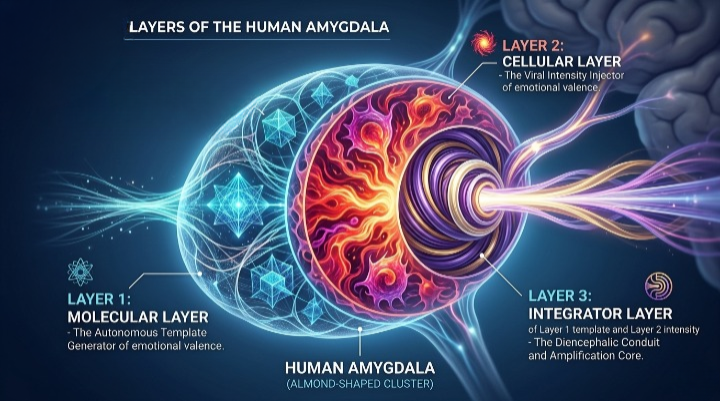
The three-layer structure of the Amygdala reveals precisely how this mobilisation occurs.
2. Layer One: The Autonomous Template Generator
The first layer of the amygdalar core is the Molecular Layer.
Traditionally, Neuroscience has described this region primarily as a sensory reception field heavily influenced by olfactory input. Because the olfactory bulbs project strongly into this layer, it was often interpreted as a specialised smell-processing territory.
Psychextrics proposes a broader interpretation.
Layer One functions as a universal template-matching matrix. Its purpose is not to analyse smells. Its purpose is to compare incoming sensory patterns against pre-existing behavioural templates.
Every incoming signal entering this layer is evaluated against inherited biological frameworks and accumulated environmental imprints. These templates are represented through the interaction of Genetic Index Markers (GIM) and Epigenetic Index Markers (EIM).
When a pattern resembles a previously established behavioural category, the system locks onto that template immediately.
A sudden shadow. An unfamiliar face. A familiar voice. A predatory posture. A sexual cue. A territorial challenge. A comforting environmental signal.
All enter the same matching architecture.
The question being asked is not: “What does this mean?“
The question is: “What does this resemble?“
Layer One therefore generates Template Emotional Valence.
This is not emotional intensity. It is emotional orientation.
The organism becomes directionally prepared before it becomes emotionally overwhelmed.
3. Why Template Valence Is Behavioural Readiness
This distinction explains countless everyday experiences.
A person may enter a room and instantly feel uncomfortable without knowing why.
A person may feel drawn toward an individual before understanding the attraction.
A person may become cautious in an unfamiliar environment before identifying any actual threat.
A person may become alert while walking through darkness despite observing nothing dangerous.
In all of these situations, behaviour has already begun shifting. Yet emotional intensity has not fully emerged. The organism has entered a state of directional readiness. The behavioural compass has already rotated. This is Template Emotional Valence.
The Amygdala has selected a behavioural orientation but has not yet activated full emotional amplification.
The system is prepared. It is waiting.
4. Layer Two: The Viral Intensity Injector
Directly beneath the template-matching layer lies the Cellular Layer.
If Layer One establishes behavioural readiness, Layer Two transforms readiness into force.
This layer contains densely packed neuronal populations capable of rapid recurrent excitation. Its architecture is specifically designed for amplification.
Once a behavioural template has been selected, activity cascades downward into Layer Two. The system no longer asks what category a stimulus belongs to. The category has already been chosen. The task now becomes escalation.
Layer Two injects emotional magnitude. It transforms caution into fear. Interest into desire. Concern into panic. Alertness into terror. Anticipation into excitement.
The remarkable feature of this layer is its viral nature. Because its neurons exist within tightly interconnected populations, activation can spread rapidly through self-reinforcing loops. A small behavioural signal can suddenly become an overwhelming emotional event. This explains why emotional reactions often feel explosive.
The organism experiences the final wave but rarely observes the amplification process itself. The emotional eruption appears instantaneous because Layer Two operates beneath conscious awareness.
5. Why Intensity Emotional Valence Dominates Consciousness
Intensity Emotional Valence differs fundamentally from Template Emotional Valence.
Template Valence guides behaviour. Intensity Valence seizes behaviour.
Template Valence redirects attention. Intensity Valence monopolises attention.
Template Valence creates readiness. Intensity Valence creates domination.
Once amplification reaches sufficient magnitude, behavioural resources become concentrated around the emotional event. The organism becomes increasingly difficult to redirect. Alternative priorities fade. Competing behavioural signals weaken. The emotional event rises above all others.
This is why intense emotional experiences frequently become unforgettable. They are not merely remembered because they are important. They become important because the intensity machinery itself forces heightened hippocampal indexing throughout the behavioural architecture.
6. Layer Three: The Diencephalic Conduit and Amplification Core
The final layer of the Amygdala serves a very different function.
If Layer One selects. And Layer Two amplifies. Layer Three distributes.
This deep layer integrates the template selected above with the intensity generated below. It binds both into a unified behavioural directive. The result is then projected into broader subcortical systems, directed through pathways communicating with the Diencephalon.
At this stage, the emotional signal acquires contextual force. The Diencephalon receives not merely a behavioural orientation but a fully weighted behavioural command.
The signal enters contextual valuation systems. Meaning becomes attached. Priority becomes reinforced. Behavioural urgency becomes stamped onto the organism. The event now possesses sufficient weight to dominate reflective awareness.
This is the point at which emotional intensity becomes capable of overwhelming conscious experience.
7. Why Intuition Feels Different from Emotional Overwhelm
The distinction between Template and Intensity Valence explains a behavioural mystery that has puzzled observers for centuries.
Why does intuition feel so different from overwhelming emotion?
Because they originate from different stages of the same architecture.
Intuition often reflects Template Emotional Valence. The organism has already been oriented. Behavioural systems have already shifted. Attention has already been redirected. Yet full amplification has not occurred. The individual feels guided without feeling flooded.
Emotional overwhelm occurs when the signal progresses through the full amygdalar sequence and enters amplified diencephalic rendering. Now the organism experiences emotional dominance. Conscious awareness becomes captured. Behavioural flexibility decreases. The emotional event becomes the centre of experience.
Template Valence whispers. Intensity Valence screams.
8. Why the Amygdala Cannot Be a Cortical Display Organ
The architecture of the amygdalar core delivers one final conclusion. It cannot be a display system.
Display systems require mechanisms for symbolic representation, reflection, abstraction, linguistic narration, and delayed evaluation. The Amygdala possesses none of these properties. Its architecture is directional from beginning to end.
Inputs enter. Templates are selected. Intensity is generated. Behavioural directives are distributed. Nowhere within this sequence does conscious representation occur.
The Amygdala does not display emotional reality. It determines what emotional realities deserve display. This distinction is profound.
The Telencephalon shows the finished behavioural film. The Amygdala determines which scenes are important enough to reach the screen.
Conclusion: Emotional Readiness Precedes Emotional Domination
The three-layer architecture of the Amygdala reveals that emotion is not a single behavioural event. It is a progression.
Layer One generates Template Emotional Valence—the state of behavioural readiness.
Layer Two generates Intensity Emotional Valence—the force of behavioural amplification.
Layer Three distributes the integrated signal into the broader behavioural hierarchy, particularly through diencephalic pathways that allow emotional significance to dominate reflective awareness.
This architecture explains why intuition precedes overwhelm, why attraction precedes desire, why caution precedes fear, and why behavioural orientation often emerges long before conscious emotional experience.
Template Emotional Valence is therefore not a weaker version of Intensity Emotional Valence. It is the prerequisite. It is the readiness state that allows amplification to occur.
Before emotional intensity can seize consciousness, the Amygdala must first prepare the organism to receive it. Readiness comes first. Intensity comes second. The conscious mind arrives last.
Back to: 👇