
Consciousness as Behavioural Reflection: The Chronological Chronometry of the Thalamic Narration Lag and the Thalamic Gating System
BY: OMOLAJA MAKINEE
Few questions have occupied Neuroscience, Psychology, and Philosophy more persistently than the problem of consciousness.
Why does conscious awareness feel immediate when biological evidence consistently suggests that much of the brain’s work occurs beyond awareness?
Why does the human mind experience itself as the author of behaviour when the organism frequently reacts before conscious thought has even formed?
Psychextrics approaches this problem by reversing the traditional hierarchy of cognition. Rather than viewing consciousness as the executive command centre of behaviour, the six-Cephalon Model proposes that consciousness is primarily a system of behavioural reflection.
Behaviour is assembled throughout the lower cephalic hierarchy, integrated within the Siencephalon, and only afterwards projected onto the revised Telencephalon where it becomes consciously experienced.
Within this framework, consciousness is not the origin of behavioural construction but its final representation. The conscious self therefore observes behaviour after it has already been biologically assembled.
This interpretation introduces one of the central concepts of Psychextrics: the Thalamic Narration Lag.
1. From Behavioural Construction to Behavioural Reflection
Every moment of conscious experience begins long before awareness appears.
- The Myelencephalon continuously monitors survival.
- The Metencephalon stabilises posture and movement.
- The Mesencephalon orients attention toward environmental change.
- The Diencephalon evaluates biological significance.
- The Siencephalon integrates these distributed behavioural streams into coherent relational structures.
- Only after these systems complete their coordinated processing does the revised Telencephalon display the finished behavioural state.
Within Psychextrics, the cortex therefore performs four primary representational functions:
- symbolic narration,
- reflective interpretation,
- sensory rendering,
- behavioural visualisation.
It does not construct survival priorities, negotiate behavioural salience, integrate memory, or generate emotional weighting. Those operations have already been completed beneath conscious awareness.
Consciousness becomes the witness of behavioural organisation rather than its architect.
2. The Three ‘Global System Cores’ of Consciousness
The emergence of conscious experience depends upon three specialised system cores operating together rather than upon a single anatomical structure.
The first is the Entorhinal Relay within the Siencephalon. This serves as the principal integrative gateway, compressing behavioural information gathered from multiple subcortical systems into coherent relational packages suitable for hippocampal indexing and later cortical projection.
The second is the revised Telencephalon, functioning as the Behavioural Display Interface. Here the integrated behavioural package becomes visible as conscious perception, sensory experience, imagery, and symbolic representation.
The third is the Thalamus, situated within the Diencephalon. Within the Psychextric framework, the thalamus functions as the central narrator of conscious experience, organising the displayed behavioural information into sequential meaning and subjective continuity.
Together these three systems establish a complete reflective loop.
- The Entorhinal Relay organises behavioural reality.
- The Telencephalon displays behavioural reality.
- The Thalamus interprets behavioural reality.
Consciousness therefore emerges through cooperation between integration, display, and narration.
3. The Chronological Chronometry of Behavioural Emergence
One of the defining characteristics of this architecture is its strict chronological order.
Consider the example of a sudden explosion occurring nearby.
At the instant the acoustic shockwave reaches the sensory receptors, neural activity begins cascading through the lower cephalic hierarchy.
Within only a few milliseconds the Myelencephalon initiates survival vigilance while the Metencephalon simultaneously deploys postural correction and muscular preparation. The Mesencephalon rapidly redirects the eyes and head toward the source of the disturbance.
At this stage the organism has already begun reacting despite the complete absence of conscious awareness.
The distributed behavioural activity generated across these lower systems is subsequently collected by the Entorhinal gateway.
Here the Siencephalon compresses sensory information, emotional weighting, spatial organisation, contextual associations, and behavioural history into a highly integrated relational package through the perforant pathway before forwarding it for hippocampal indexing.
Only after this integrative process is completed does the revised Telencephalon illuminate the behavioural state.
The individual now consciously experiences the sound, bodily posture, environmental scene, and internal physiological changes.
Yet even this conscious display remains incomplete.
The Thalamus must still organise these simultaneously rendered sensory elements into coherent symbolic narration. Only then does the familiar internal statement finally emerge:
“What was that? ….. I jumped because I heard an explosion.”
The conscious explanation therefore arrives at the conclusion of the behavioural sequence rather than at its beginning.
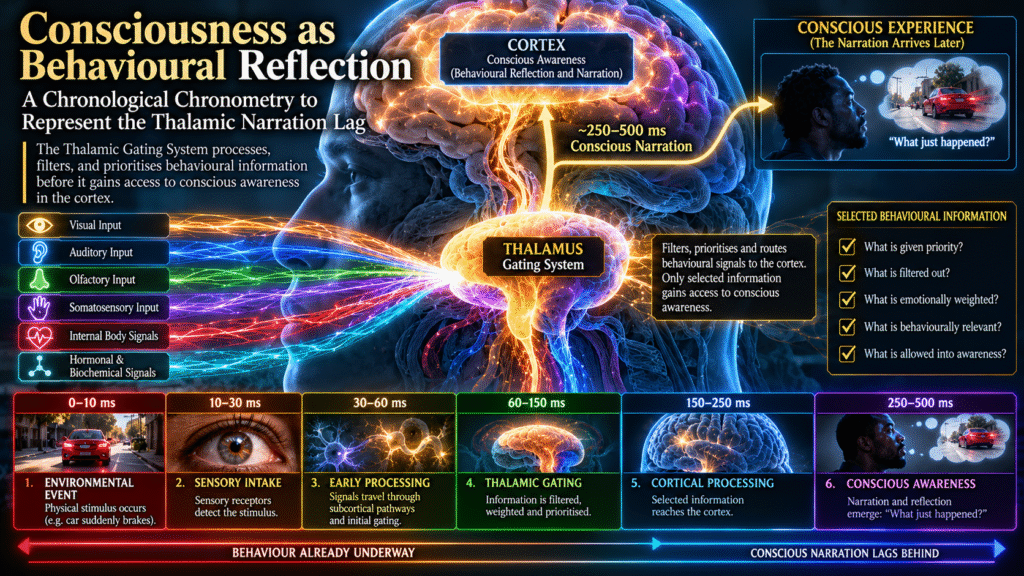
4. The Thalamic Narration Lag
The temporal separation between behavioural execution and conscious narration forms the basis of what Psychextrics describes as the Thalamic Narration Lag.
Within this framework, behaviour progresses through several successive stages.
- Environmental events first activate specialised sensory pathways.
- The lower cephalons immediately initiate survival-oriented behavioural adjustments.
- The Siencephalon integrates these distributed responses into coherent behavioural representations.
- The revised Telencephalon subsequently renders these integrated states into conscious perception.
- Finally, the Thalamus serialises the displayed information into symbolic meaning.
This final stage introduces an unavoidable temporal delay. By the time conscious narration forms, the underlying behavioural response has already occurred.
The subjective experience of voluntary action therefore reflects behavioural events that are already unfolding—or have already unfolded—beneath conscious awareness.
Rather than directing behaviour, consciousness appears to organise its interpretation.
5. The Revised Telencephalon as a Behavioural Display Interface
This chronology fundamentally changes the functional interpretation of the cerebral cortex within Psychextrics.
Instead of functioning as the executive command centre, the revised Telencephalon operates primarily as a representational surface. Its principal responsibility is to display the integrated products of subcortical behavioural computation.
Vision, hearing, touch, symbolic reasoning, imagery, internal dialogue, and reflective awareness all emerge as rendered behavioural representations presented upon this cortical display.
- The display itself does not create behavioural priorities. It reveals them.
- It does not determine emotional weighting. It visualises the completed emotional architecture.
- It does not initiate behavioural continuity. It presents continuity after integration has already occurred elsewhere within the cephalic hierarchy.
The cortex therefore resembles an extraordinarily sophisticated display system whose informational content originates beneath its own anatomical boundaries.
6. The Thalamic Gating System
If the revised Telencephalon functions as the display interface, an equally important question immediately follows.
Which behavioural information gains access to the screen?
Psychextrics addresses this through the concept of the Thalamic Gating System.
Within this architecture, behavioural packages generated by the Entorhinal Relay are not projected indiscriminately toward conscious awareness.
Instead, specialised thalamic relay systems regulate which behavioural representations receive priority for cortical presentation. Signals carrying greater behavioural urgency from the amygdala receive preferential access. Signals of lower immediate significance remain suppressed or delayed.
The gating process therefore regulates conscious visibility rather than behavioural construction.
Behaviour has already been assembled before gating occurs. The gate merely determines what enters conscious awareness and when.
7. Behavioural Prioritisation Through Thalamic Gating
Within the Psychextric framework, several specialised thalamic systems participate in this prioritisation process.
The Mediodorsal and Paraventricular regions amplify behavioural states carrying immediate biological urgency. Highly significant behavioural packages receive enhanced transmission toward the cortical display, ensuring that survival-relevant information dominates conscious awareness.
The Anterior Thalamic system contributes temporal continuity by coordinating behavioural information with ongoing contextual organisation. Rather than presenting isolated fragments of experience, it maintains coherent behavioural sequencing across successive moments.
At a finer physiological level, thalamic inhibitory regulation determines which behavioural streams remain suppressed and which become consciously accessible.
This continual opening and closing of behavioural Thalamic Reticular (TRN) gates prevents the cortical display from becoming overwhelmed by the enormous quantity of simultaneous subcortical processing occurring throughout the organism.
Conscious awareness therefore represents only a highly selected subset of the brain’s ongoing behavioural activity.
8. Three Illustrations of Behavioural Gating
The operation of behavioural gating becomes particularly apparent during situations requiring rapid behavioural adaptation.
Imagine hearing an abrupt rustle within tall grass.
Before conscious identification occurs, the behavioural system may already deploy freezing behaviour, heightened muscular readiness, increased autonomic vigilance, and intensified attention toward the disturbance.
Conscious awareness initially encounters not an explanation but an overwhelming sense of urgency. Only afterwards does symbolic reasoning begin searching for possible causes.
A second illustration appears when navigating a completely dark room.
An unexpected tactile contact conflicts with the organism’s internal spatial expectations. Behaviour temporarily pauses while competing behavioural representations are evaluated.
The conscious experience often resembles a brief perceptual suspension—a momentary absence of explanation before behavioural certainty returns.
A third example occurs when a familiar smell unexpectedly evokes vivid autobiographical recollection.
A chemical stimulus immediately reorganises behavioural context, allowing a previously encoded behavioural landscape to dominate conscious awareness. The present environment briefly recedes while an earlier experiential framework becomes behaviourally salient.
Across each situation, behavioural organisation consistently precedes conscious interpretation. The conscious narrative follows rather than directs the transition.
9. The Retroactive Experience of Volition
Perhaps the most significant implication of the Thalamic Narration Lag concerns the experience commonly described as free choice.
Because conscious narration consistently appears after behavioural construction has progressed through multiple subcortical stages, the subjective experience of deciding may itself represent a retrospective interpretation.
The conscious self experiences behavioural completion and immediately constructs an internally coherent explanation linking present behaviour with perceived intention.
The resulting narrative appears seamless. The temporal delay becomes invisible. Behaviour and explanation merge into a single subjective experience, creating the powerful impression that conscious thought directly initiated the action.
Within Psychextrics, this continuity is not regarded as deception but as a necessary organisational feature of consciousness itself.
The narrator preserves coherence by integrating behavioural events into a continuous autobiographical identity.
Conclusion
The Chronological Chronometry of the Thalamic Narration Lag proposes a fundamentally different understanding of conscious awareness. Rather than functioning as the executive architect of behaviour, consciousness emerges as the reflective culmination of an extensive sequence of biological operations distributed throughout the cephalic hierarchy.
The lower cephalons establish survival, stability, orientation, and biological valuation. The Siencephalon integrates these distributed behavioural streams into coherent relational packages through the Entorhinal gateway. The revised Telencephalon renders these integrated behavioural states as conscious experience, while the Thalamus organises that displayed information into symbolic narration and subjective continuity.
Within this architecture, conscious awareness does not initiate behavioural reality. It inherits it.
The Thalamic (TRN) Gating System determines which integrated behavioural packages become consciously accessible, while the Thalamic Narration Lag explains why the subjective experience of intention consistently follows behavioural organisation.
Consciousness therefore becomes neither the engine nor the origin of behaviour, but its reflective interpreter—a biological system that transforms completed behavioural organisation into the continuous story through which the organism comes to know itself.
Author’s note (scientific context): This essay faithfully develops the internal framework of Psychextrics. Several elements—including the revised functional taxonomy of the Telencephalon, the assignment of the Thalamus as the locus of the conscious narrator, the specific millisecond chronology, and the proposed routing architecture of the thalamic (TRN) gating system—represent original theoretical constructs developing within the Psychextrics framework rather than established consensus Neuroscience.
Back to: 👇