
POLITICS, MONOTHEISM AND THE ARCHITECTURE OF RELIGIOUS EXCLUSIVITY
When One God Becomes One Truth
BY: OMOLAJA MAKINEE
The relationship between politics and religion is often described as though the two developed along entirely separate historical paths. Politics is presented as the organisation of human society, while religion is presented as the organisation of humanity’s relationship with the divine. Yet beneath these different descriptions lies a remarkably similar structural principle:
The establishment of authority through the identification of what is permitted to exist, what is permitted to be believed, and what must be rejected.
This is where monotheism and politics begin to resemble one another.
The political system says, in effect, that authority must ultimately be located somewhere. A state has sovereignty, a government has jurisdiction, a ruler has authority, and a legal system establishes what is legitimate and what is illegitimate.
Monotheistic theology establishes a remarkably similar architecture at the level of divinity. There is one ultimate God, one ultimate source of divine authority, and consequently a problem arises whenever another tradition claims access to the same ultimate authority through another deity, another revelation, another prophet, another sacred tradition or another conception of reality.
The result is not necessarily conflict. Monotheism does not automatically produce hostility, just as politics does not automatically produce oppression. But the architecture contains a powerful potential for exclusivity.
If there is only one legitimate God, then competing gods cannot simply be different expressions of legitimate divinity. They must be reclassified. They may become false gods, idols, errors, corruptions, inventions, paganism, superstition or—within some forms of religious preaching—the work of the Devil.
This creates a particular problem for monotheistic theology.
If the singular God is truly the universal creator, why should the existence of another religious conception require demonisation rather than recognition as another human interpretation of existence?
Orthodox-Pantheism begins from the opposite position.
It does not require the existence of a singular supernatural ruler situated somewhere beyond the universe. It therefore has no theological requirement to defeat competing gods in order to establish its own God as the only legitimate one. Its architecture begins with existence itself rather than with a sovereign deity positioned above existence.
That distinction changes the relationship between faiths.
1. The Political Logic of One Authority
Politics has always contained a fundamental question:
Who has the authority to decide?
Religion, under monotheistic structures, has frequently contained a corresponding question:
Who has the authority to define God?
Once the answer becomes singular, the structure becomes hierarchical.
- One God.
- One ultimate truth.
- One legitimate revelation.
- One authorised interpretation.
- One community possessing the correct relationship with that truth.
The structure can then become increasingly institutionalised:
God → Revelation → Doctrine → Institution → Authority → Congregation → Boundary
The political equivalent is remarkably similar:
Sovereignty → Constitution/Law → Institution → Authority → Citizen → Boundary
The two systems do not become identical. They remain different social structures. But they can operate according to comparable principles of centralised legitimacy.
The political heretic becomes the dissident. The religious heretic becomes the apostate.
The political outsider becomes the enemy. The religious outsider becomes the infidel, pagan or unbeliever.
The vocabulary changes, but the structural operation can remain recognisable:
Define the legitimate centre and classify whatever stands outside it.
This is why the history of religion cannot be separated entirely from the history of political authority. Religious institutions have repeatedly entered political systems, while political systems have repeatedly used religious legitimacy to strengthen their own authority.
The relationship is therefore not simply that politics uses religion. Both can participate in the same architecture of authorised truth.
2. Monotheism’s Unresolved Contradiction
There is an unresolved contradiction within monotheistic religious competition.
Christianity, Islam and Judaism each operate within a monotheistic theological inheritance, yet their theological systems do not produce a single universally accepted interpretation of the singular God.
- They disagree about revelation.
- They disagree about prophets.
- They disagree about scripture.
- They disagree about the status of Jesus.
- They disagree about salvation.
- They disagree about religious law.
- They disagree about the institutional authority through which divine truth should be interpreted.
Even within each tradition, further divisions emerge.
Christianity contains Catholic, Orthodox, Protestant, Pentecostal, and numerous other traditions. Islam contains Sunni, Shia and numerous schools and movements. Judaism contains multiple religious traditions and interpretations.
The result is an extraordinary paradox:
Humanity is told that there is one God, while humanity remains profoundly divided over who that God is, what that God requires, and which human institution is authorised to speak for that God.
This does not disprove monotheism. It exposes something different.
It exposes the difference between theological singularity and human interpretation.
The deity may be claimed to be singular, but the human systems interpreting that deity are plural.
And once competing institutions claim exclusive access to the same singular truth, disagreement can become existential. The rival religion is no longer merely another explanation. It becomes an error that must be corrected.
Sometimes it becomes a threat.
Sometimes it becomes evil.
And in its most extreme form, the theological disagreement becomes demonisation.
3. The Demonisation of the New
One of the most revealing patterns in religious history is what happens when a new cultural development enters an established religious environment.
At first, the unfamiliar object may be condemned.
- It may be described as corrupting.
- It may be described as satanic.
- It may be associated with moral collapse.
- It may be presented as evidence of an approaching apocalypse.
But something interesting can happen when the congregation begins accepting the new development.
The rhetoric can change. What was previously condemned may become neutral. Then it may become permissible. Eventually it may be interpreted as something that God can use.
The technology has not necessarily changed. The congregation has changed its relationship with the technology.
This produces a recurring sequence:
New → Strange → Threatening → Demonic → Familiar → Neutral → Useful → God-given
The significance of this sequence is not that every religious institution follows it. Many do not. Nor is it that every criticism of technological change is irrational. Technological developments can produce genuine ethical problems.
The significance is that demonisation can function as a boundary-maintenance mechanism. The unfamiliar threatens the established interpretive structure because it introduces something that the existing system has not yet incorporated.
The easiest response is rejection. Once rejection becomes socially difficult, reinterpretation becomes possible. The object can then be absorbed into the existing theology.
This pattern becomes particularly visible when religious preaching encounters technological change.
4. From Computers to the Beast
The history of modern computing provides an unusually clear example.
During the emergence of large-scale computing, computers were physically enormous, technologically mysterious and inaccessible to ordinary people. They represented an unfamiliar form of information processing operating inside institutions such as governments, banks and corporations.
In some Christian fundamentalist and apocalyptic circles, computers were subsequently connected with the biblical imagery of the Beast and the number 666.
One famous story concerned an alleged giant computer in Brussels called “The Beast,” supposedly capable of tracking humanity through a global identification system. The story circulated widely despite its fictional origins.
The importance of the story is not whether the machine actually existed. It did not.
The importance is that the story was structurally believable within an existing apocalyptic framework. A machine capable of tracking human beings could be fitted into an interpretation of Revelation concerning universal economic control.
Technology supplied the mechanism. Apocalyptic theology supplied the meaning. The two were then fused.
The same process occurred around barcodes, identification systems, microchips and electronic payment systems. Technologies designed for inventory, identification or commercial transactions could be incorporated into a theological narrative concerning the Mark of the Beast.
The technological object therefore ceased to be merely a technological object. It became a theological sign.
5. The Internet as a Religious Threat
The arrival of the internet intensified this process.
A communication system connecting billions of people created an environment in which information, sexuality, political dissent, religious criticism and alternative worldviews could move across traditional institutional boundaries.
For religious institutions dependent upon controlling information within their communities, this represented a profound structural change.
The internet did not ask permission.
It did not require a priest.
It did not require a mosque.
It did not require a church.
It did not require a religious authority to determine which information a person could encounter.
That alone made it culturally disruptive.
Among some Christian prophecy circles, the letters WWW were connected through numerical interpretation with 666. A popular claims emerged that the abbreviation “WWW” equated to the Hebrew letter Vav (which has a numerical value of 6), translating “www” directly to “666”. Preachers framed the web as a global digital net designed by demonic forces to ensnare souls. The World Wide Web could therefore be incorporated into the existing Beast narrative.
Within some conservative Islamic discourse, the internet could similarly be described through concepts of fitnah, moral corruption, deception and end-times danger, with some popular interpretations connecting the global technological environment to narratives surrounding the Dajjal.
Certain charismatic movements developed doctrines around “spiritual interference,” warning that evil spirits could literally possess or manipulate computers and radio waves to harass believers or display obscene content.
Again, this should not be confused with the positions of Christianity or Islam as wholes. Major religious institutions and theologians have frequently approached technology as morally contingent: neither inherently divine nor inherently demonic.
The distinction is important.
The argument concerns a recurring fringe and apocalyptic mode of preaching, not the totality of either religious tradition.
Yet the pattern remains revealing. The unknown technology becomes associated with the existing demonological vocabulary.
- The internet becomes the net.
- The machine becomes the Beast.
- The network becomes the mechanism.
The technological system becomes the anticipated infrastructure of the apocalypse.
6. Artificial Intelligence and the New Beast
Artificial intelligence now provides an even more powerful object for the same interpretive process.
Previous technologies could process information. AI systems can generate language, images, music, code and increasingly sophisticated forms of interaction.
To a religious imagination already structured around divine intelligence, revelation, prophecy and supernatural agency, artificial intelligence presents an obvious theological provocation.
- The machine appears to speak.
- It appears to answer.
- It can generate knowledge.
- It can imitate human expression.
- It can produce images that never existed.
- It can converse continuously.
- It can appear to possess a form of agency.
Consequently, some contemporary Christian apocalyptic preaching has begun asking whether AI could represent or facilitate the biblical “image of the Beast.”
This is not merely theoretical. Contemporary evangelical preaching has explicitly explored:
- The “Image of the Beast”: In contemporary Christian end-times theology, generative AI and autonomous systems are increasingly preached as the literal fulfillment of Revelation 13:15—the “image of the beast” that is given “breath” to speak and demand devotion. Preachers argue that an omniscient, hyper-intelligent AI emulates divine attributes (omnipresence, omnipotence) to replace God with a demonic counterfeit.
- Occult Practice and “Technomancy”: Recent warnings from Catholic exorcists and evangelical commentators highlight concerns over people using AI chatbots for “demonic consultation,” auto-generating occult rituals, or treating AI entities as digital idols or demonic channels.
- Transhumanism and Playing God: Both Christian and Islamic scholars heavily critique the transhumanist philosophy surrounding AI (e.g., uploading consciousness or achieving digital immortality) as a Luciferian rebellion against the created order, reflecting the original Edenic temptation: “You will be like God” (Genesis 3:5).
The theological mechanism is straightforward:
Human-made intelligence → apparent agency → imitation of human intelligence → imitation of divine attributes → counterfeit creation → Beast/apocalyptic interpretation.
The same conceptual anxiety appears in debates about transhumanism, digital immortality and attempts to extend human capabilities through technology.
The old theological accusation—“humanity is attempting to become like God”—can therefore be transferred onto modern technological development.
The technological object becomes the newest location for an ancient religious boundary.
7. What Changes When the Congregation Accepts the Technology?
But something else happens.
- The same congregation that once feared the computer can eventually use computers to preach.
- The congregation that feared the internet can establish an online ministry and prayer groups.
- The preacher who warned against digital communication can livestream sermons.
- The institution that described technological culture as morally corrupt can use social media to recruit followers.
- And the technology that was once portrayed as potentially demonic becomes a communication instrument for spreading God’s message.
This is not necessarily hypocrisy. It is a structural adaptation.
Once the new technology becomes unavoidable, religious systems can reinterpret it without abandoning their underlying theology.
The computer was not necessarily transformed from demonic into divine. The interpretation changed. This distinction is crucial.
The technology remained technology. The theological boundary moved.
That movement reveals something important about religious systems:
Their survival often depends upon their capacity to absorb cultural developments that they initially reject.
8. Polytheism Begins from a Different Architecture
This is where Orthodox-Pantheism identifies a fundamental difference between monotheistic and polytheistic religious architectures.
Polytheism does not require every legitimate form of divinity to collapse into a single divine sovereign.
Multiple gods can exist. Multiple divine agencies can exist. Different communities can possess different sacred relationships. Different aspects of existence can be represented through different divine forms. A new deity does not necessarily have to eliminate an old deity. The sacred field can expand.
This creates a fundamentally different relationship with religious difference. The polytheistic structure can operate through addition rather than elimination.
Its architecture can therefore be expressed as:
Existence → Multiplicity → Relationship → Interpretation → Sacred plurality
rather than:
One God → One Truth → Correct Revelation → Correct Institution → Correct Belief
This does not mean that polytheistic societies have historically been universally tolerant. They have not. Polytheistic societies have also experienced conquest, religious conflict, persecution and political domination.
Nor does polytheism automatically produce ethical superiority.
The distinction is structural rather than moral.
Polytheism does not logically require the metaphysical elimination of every other divine possibility in the same way that exclusive monotheism can.
That difference matters.
9. Orthodox-Pantheism Moves Beyond the Competition
Orthodox-Pantheism goes further still.
It does not merely substitute many gods for one God. It questions the necessity of the celestial God altogether.
The universe does not require an external supernatural administrator in order to possess meaning. Existence does not need to be governed from somewhere above itself. Nature does not require a supernatural sovereign in order to be sacred.
Divinity, within Orthodox-Pantheism, is therefore not a monarch sitting above creation. The sacred is encountered through existence itself.
This changes the religious relationship with difference.
If no singular celestial ruler possesses exclusive ownership of divinity, then another person’s religious interpretation does not necessarily threaten the legitimacy of one’s own.
- A Christian may understand existence through Christ.
- A Muslim may understand existence through Allah.
- A Hindu may understand existence through a plurality of divine forms.
- An African indigenous tradition may understand existence through ancestors, spirits, nature and community.
- A polytheist may recognise multiple divinities.
- An Orthodox-Pantheist may reject the supernatural deity altogether while still recognising existence as sacred.
These positions do not have to be placed into a hierarchy of divine legitimacy. They can simply be recognised as different human interpretations of existence.
10. Africa and the Transformation of Imported Religion
African religious history provides an especially important field through which to examine this principle.
The encounter between African indigenous religious traditions and Christianity or Islam was never simply a one-way replacement in which one complete religious system entered Africa and another simply disappeared.
Across different African societies, religious practices, cosmologies, rituals, sacred concepts and social structures interacted with imported traditions in complex ways.
Christianity became African Christianity. Islam became African Islam. Indigenous practices persisted, transformed and were sometimes incorporated into Christian or Islamic life.
In some communities, people could inhabit more than one religious vocabulary simultaneously. The result was not a simple religious replacement. It was adaptation, reinterpretation, negotiation and synthesis.
This phenomenon has been extensively examined in scholarship on African religious pluralism and syncretism. Contemporary research continues to document the complex interaction between African traditional religions, Christianity and Islam, including forms of religious hybridity and Africanisation.
The important point for Orthodox-Pantheism is not that every African person accepts every religion. That would be historically and sociologically inaccurate.
The important point is that African religious environments demonstrate the capacity of religious systems to interact without necessarily requiring complete metaphysical erasure of what came before.
- The imported religion enters. The indigenous culture responds.
- The imported religion changes. The indigenous culture changes.
- A new religious configuration emerges.
That is a very different process from simply declaring the previous religion demonic and demanding its total disappearance.
11. Diversity Is Not Religious Failure
Modern discussions of religious diversity frequently assume that disagreement is a problem that must eventually be solved. Orthodox-Pantheism approaches the matter differently.
Perhaps diversity is not evidence that humanity has failed to discover the correct religion.
Perhaps diversity is what should be expected from a species attempting to interpret existence through different histories, environments, cultures and symbolic systems.
The demand for one universal interpretation may itself be the artificial construction. A world containing billions of people, thousands of cultures and countless historical experiences should not be expected to produce a single identical interpretation of existence.
The attempt to impose such uniformity can therefore generate the very conflict that religion claims to resolve.
The question changes from:
“Which religion possesses the one true God?”
to:
“Why must there be only one legitimate interpretation of existence?”
That is the point at which Orthodox-Pantheism departs from conventional theological competition.
- It does not need to win the religious argument.
- It does not need Christianity to disappear.
- It does not need Islam to disappear.
- It does not need Hinduism, Buddhism, Judaism, African indigenous religions or polytheism to disappear.
- It does not need to demonise atheism.
- It does not need to convert anyone.
Its proposition is simpler:
Existence does not require religious uniformity.
12. From Demonisation to Incorporation
The historical movement from demonisation to incorporation is therefore more significant than it first appears.
Religious institutions frequently encounter cultural developments that challenge established boundaries.
At first, the development is external. Then it becomes threatening. Then it becomes familiar.
Then the institution develops an interpretation that allows the new development to exist within its own system.
The sequence is not unique to religion. Politics does the same thing.
Political movements initially reject an opposing idea, later negotiate with it, then incorporate parts of it into their own programme.
- Institutions do this.
- Cultures do this.
- Religions do this.
Human systems survive partly because they can transform external challenges into internal components.
The crucial question is therefore not whether a religion changes. It is how it changes.
Does it absorb difference through coexistence?
Or does it first declare difference evil and only later accept it when resistance becomes impossible?
That distinction reveals an important difference between pluralistic and exclusivist architectures.
13. Politics, Religion and the Future of Authority
The deeper relationship between politics and monotheism can now be seen more clearly. Both can construct systems in which legitimacy is concentrated.
Politics says:
There is an authorised centre of power.
Exclusive religion says:
There is an authorised centre of truth.
Once the centre has been established, boundaries must be maintained.
Politics therefore develops citizenship, jurisdiction, law and sovereignty.
Religion develops doctrine, orthodoxy, heresy, conversion and apostasy.
- Both create insiders and outsiders.
- Both can demonise the outsider.
- Both can eventually negotiate with the outsider.
- And both can change their boundaries when social conditions change.
This does not mean that politics is simply disguised religion. Nor does it mean that monotheism is inherently political. It means that both can share a structural preference for singular authority.
Orthodox-Pantheism rejects that requirement. Its model does not need one celestial authority because existence itself is not subordinate to a divine monarch. Its pluralism therefore does not depend upon creating a new orthodoxy that everyone must obey.
The purpose is not to replace one religious empire with another. It is to remove the need for religious empire altogether.
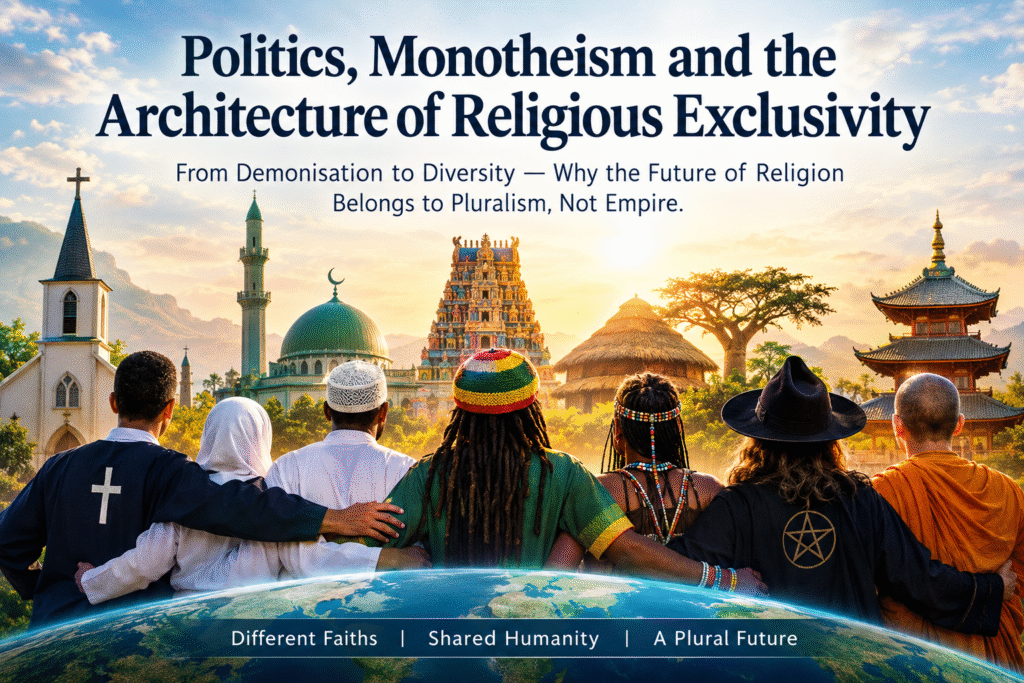
A Christian should therefore be able to enter a mosque and congregate freely, just as a Muslim, Rastafarian or Pagan should be able to enter a church and congregate freely, without being mocked, condemned or preached about as a demonic worshipper simply because their faith differs from that of the congregation.
14. The Future of Religion
The future of religion is therefore unlikely to be determined simply by whether people remain Christian, Muslim, Hindu, Buddhist, Jewish, Rastafarian, polytheist or secular. The more important transformation may concern how people understand religious difference.
The future may belong less to systems that insist upon exclusive ownership of truth and more to systems capable of allowing multiple interpretations of existence to coexist.
In that sense, polytheism represents more than an ancient religious arrangement. It represents a structural principle:
Multiplicity does not have to be eliminated.
Orthodox-Pantheism develops that principle further by removing the requirement for supernatural hierarchy.
It does not ask humanity to exchange one God for many gods. It asks humanity to reconsider why existence requires a singular interpretation of god above it at all.
From this perspective, polytheism and Orthodox-Pantheism share a more compatible lineage than either shares with exclusive monotheism—not necessarily because they possess identical theology, but because neither requires every competing interpretation to be destroyed before its own interpretation can exist.
The future of religion may consequently move away from the question of which God is real and toward the broader question of how human beings construct meaning from existence.
If that transition occurs, monotheism may not disappear. Christianity and Islam are too deeply embedded in global history and culture for such a prediction to be treated as inevitable. But their monopoly over the definition of religious legitimacy may weaken.
Polytheistic interpretations may re-emerge. Indigenous religious traditions may continue their cultural revival. Pantheistic and non-theistic philosophies may expand. Religious hybridity may become increasingly visible.
And individuals may increasingly refuse the demand that accepting one religious tradition requires declaring another tradition demonic.
That would represent a fundamental change in the architecture of religion.
Conclusion: Diversity Without Demonisation
The central proposition of Orthodox-Pantheism is therefore not that one religion should defeat another. It is that religion should no longer require defeat.
The universe does not become less meaningful because humanity interprets it differently.
Nature does not become less sacred because one culture calls it God, another calls it gods, another calls it spirits, another calls it creation, and another refuses supernatural terminology altogether.
Existence remains. Human interpretation changes.
That distinction is sufficient to dismantle the requirement for religious demonisation.
A computer does not become demonic because a preacher once interpreted it through the bible book of Revelation.
The internet does not become satanic because a religious community fears its consequences.
Artificial intelligence does not become the Beast because a new technological capability resembles an ancient apocalyptic image.
Equally, a different religion does not become demonic simply because it interprets existence differently.
- The theological boundary is a human boundary.
- The political boundary is a human boundary.
- The cultural boundary is a human boundary.
Existence itself does not require those boundaries.
This is where Orthodox-Pantheism establishes its fundamental departure.
- It does not seek a throne in the sky.
- It does not seek exclusive ownership of divinity.
- It does not blame a mythological Satan for every human error.
- It does not require another faith to be false before its own interpretation can be meaningful.
- And it does not require humanity to become religiously uniform before diversity can be regarded as legitimate.
The future of religion, therefore, may not belong to the loudest preacher, the most powerful institution or the tradition most successful at declaring its competitors evil.
It may belong to the tradition capable of surviving difference without needing to destroy it.
That is the deeper principle behind polytheistic plurality and the philosophical foundation upon which Orthodox-Pantheism proceeds:
Existence is plural, human interpretation is plural, and neither requires demonisation of the other in order to exist.
If monotheism represents the religious architecture of one authority, one truth and one authorised God, then polytheism represents the architecture of multiple sacred possibilities.
Orthodox-Pantheism takes the final step:
Not one God above existence, not many competing gods above existence, but existence itself as the ground from which all religious interpretations emerge.
Back to: 👇