
Analogy of Behaviour as a Cup of Tea: A Psychextrical Model of Hormonal Dynamics and Neurotype Interaction
BY: OMOLAJA MAKINEE
In the science of Psychextrics, behaviour is not a random product of thought or emotion—it is a sequenced orchestration of hormonal, cortical, and environmental interactions. To simplify this complex relationship, we can imagine behaviour as a cup of tea, brewed within the dual buckets of hormonal architecture.
Here I presents the Psychextrical Analogy of Behaviour as a Cup of Tea, illustrating how testosterone and oestrogen influence emotional and logical processing, and how their inherited spectrums determine individual behavioural outputs beyond gendered boundaries.
1. The Buckets of Hormones
Picture two buckets with sieves at their bases.
- The blue bucket represents testosterone, the dominant hormonal medium in males.
- The pink bucket represents oestrogen, the dominant hormonal medium in females.
Both buckets contain tea bags (representing logic) and receive water (representing emotion) from a tap (representing stimuli).
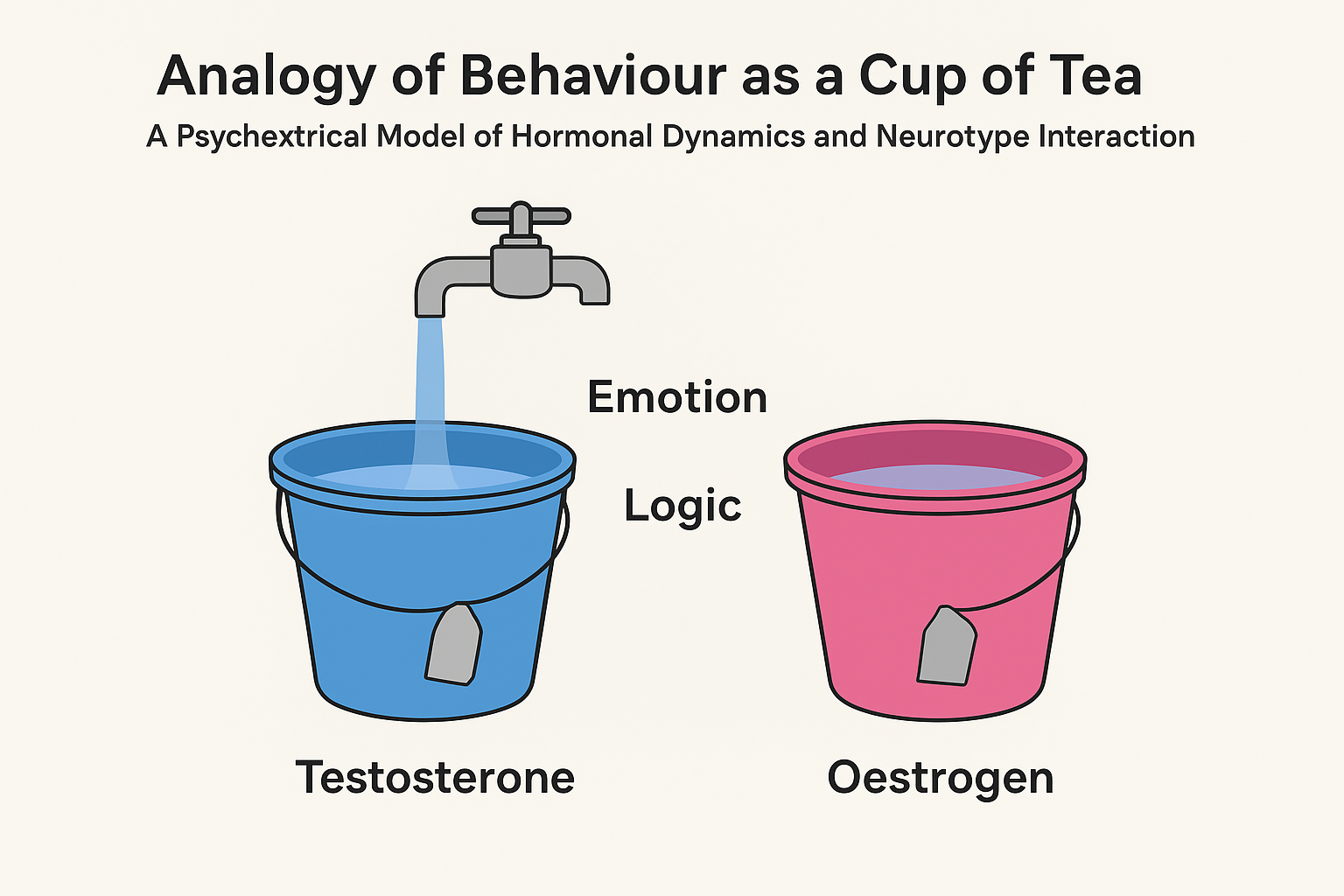
When the tap opens, emotional water flows into each bucket, activating the tea bag of logic. The interaction between the water and the tea bag creates a brew—the behavioural output—that eventually sieves through the bottom. The flavour and strength of this brew represent how logic and emotion blend to form action, speech, reaction, or restraint, in real time and at milliseconds.
2. The Role of Stimuli: Turning on the Tap
Stimuli are the environmental triggers that open the tap of emotion—everything from a sunrise to a stormy weather condition or rainy day, from hunger to affection, from news headlines to music.
Without exposure to stimuli, the tap of stimuli does not switch-on and the emotion of water does not flow, and the logic of the tea bag remains dormant. The psychextrical insight here is that emotion is the motion of behaviour, the energy that animates logic into expression. Logic, by itself, is inert; it becomes animated only through emotional energy.
Thus, every act of behaviour begins with an emotional charge, even when the final expression appears calm, emotional or rational. The difference lies in how the emotional biochemical passes through the hormonal bucket—and this is where testosterone and oestrogen diverge.
3. The Testosterone Bucket: Density and Rapid Logic Activation
The testosterone bucket is dense—its internal medium thick and resistant. In this environment, the tea bags of logic cannot float; they remain immersed, tightly compacted and restricted to the base.
When the emotion of water enters, it immediately strikes these tea bags, releasing their logical content rapidly into the flow. The behavioural output sieving from the base becomes logic-dominant, strong, and thick—like a highly concentrated brew poured swiftly.
However, as emotional water fills up the bucket, logic becomes diluted; the brew lightens. In psychextrical terms, testosterone favours the rapid prioritisation of logic before emotion fully saturates the cognitive field, meaning the brain’s cortical inhibition mechanisms suppress emotional surges to allow rational processing to take precedence.
This creates the familiar pattern observed in most men: swift logical decisions, emotional restraint, and delayed affective release.
4. The Oestrogen Bucket: Excitability and Emotional Amplification
The oestrogen bucket is lighter and more excitable—its internal medium less dense, allowing the tea bags of logic to float.
When emotional water enters, it gushes through rapidly, but because the tea bags float on top, the first brew that seeps through the sieve is emotionally dominant—a lighter, more fluid tea infused with feeling before logic has time to fully steep.
Only after some time does the logic begin to dissolve more evenly through the bucket, tempering the emotional surge and guiding it toward measured expression.
In psychextrical understanding, oestrogen allows emotion to reach conscious awareness faster, activating the brain’s cortical excitation circuits before logic stabilises the flow. Hence, the behavioural pattern observed in most women—emotionally expressive, perceptive, and empathetically responsive before logical moderation occurs.
5. Inheritance and the Hormonal Spectrum
With reproduction, both testosterone and oestrogen buckets contribute their chemical architecture to the offspring. Yet, what is inherited is not the content of logic or emotion—they are constants in all humans—but the interaction style between them.
Through inheritance, some men may receive oestrogen-like excitability in their HFI (Hormonal Fluidity Index), allowing emotion to rise earlier, while some women may inherit testosterone-like density, enabling logic to steep faster.
These variations do not indicate abnormality in most people, either in their HIM or HFI respectively—rather, they may represent neurotype diversity along a continuum of behavioural timing. The question is not who is more logical or emotional, but which signal—logic or emotion—accelerates first in the behavioural relay.
6. HIM, HFI, and Behavioural Brewing
In this analogy, the bucket itself represents HIM (Hormonal Index Marker)—the biological architecture defining whether the framework is testosterone-based or oestrogen-based.
The rate and flavour of the tea’s brewing represent the HFI (Hormonal Fluidity Index)—the behavioural flexibility determined by hormonal interactions, inheritance, and epigenetic modulation.
A man with heightened emotional intuition has not become less masculine—his bucket remains blue—but his water’s turbulence and steeping pattern (HFI) have been epigenetically tuned to favour emotional awareness.
Likewise, a woman with dominant logical precision still carries a pink bucket, yet her fluid dynamics favour the denser steeping of logic before emotion.
Thus, HIM defines the cup vessel; HFI defines the brew in the cup.
7. Milk and Sugar: The Ingestive Modulators of Behaviour
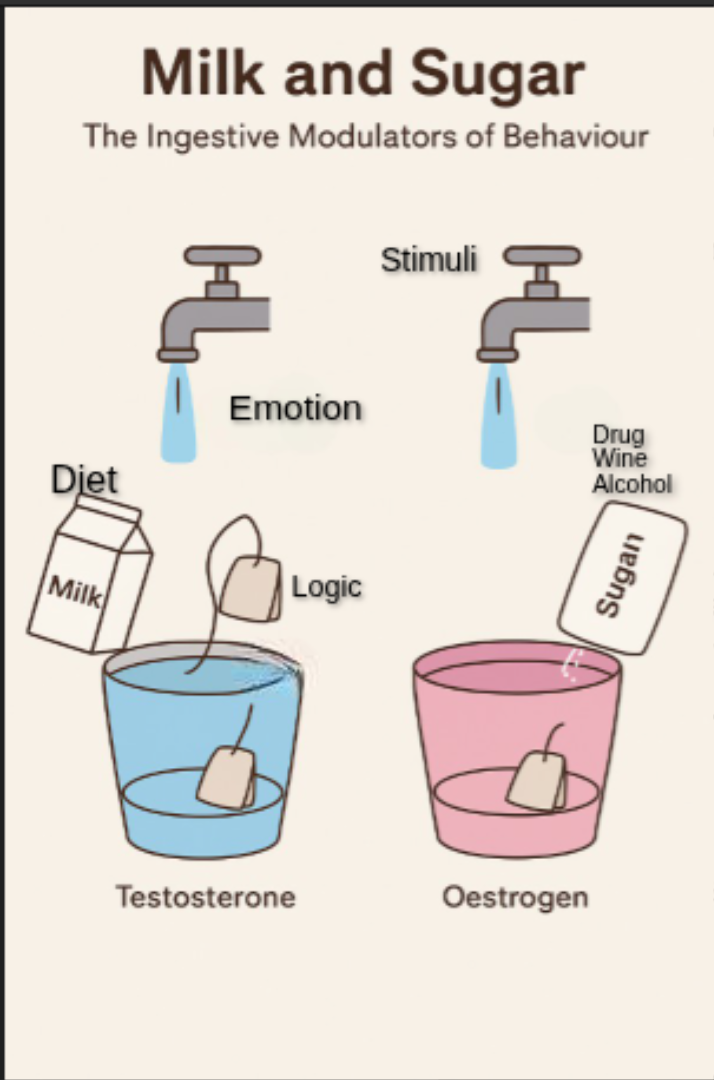
Of course, most people would not like the idea of drinking a blank tea that lacks taste or vitality. This is where milk and sugar enter the analogy—not as mere additives of flavour, but as representations of external influences that shape, modify, or distort behavioural outputs. In the psychextrical model, milk symbolises dietary influences, while sugar represents the stimulatory effects of drugs, wine and alcohol on the hormonal–neural circuitry.
Milk: The Sustenance of Behavioural Nourishment
Milk, in this analogy, captures the varieties of nutritional influence that enter the body—ranging from wholesome nourishment to subtle behavioural allergies. Just as milk comes in many forms—skimmed, condensed, unskimmed, or goat’s milk—so too do diets vary in their biochemical impact on the hormonal and neural systems.
Each type of diet carries a unique chemical profile capable of enhancing or impairing the natural harmony between HIM and HFI. For instance:
- Diets rich in omega-3 fatty acids and amino acids nourish the HIM by stabilising neurotransmitter synthesis, supporting balanced logic–emotion relay.
- Conversely, diets high in refined sugars, trans fats, or hormonal residues can overstimulate or suppress specific thalamic nuclei, leading to abnormal HFI activation—manifesting as impulsivity, irritability, or lethargic behaviour.
This means that in psychextrics, the dietary milk of behaviour can either sustain harmony or introduce imbalance. Some individuals, depending on their neurotype and hormonal spectrum, may be behaviourally allergic to certain dietary patterns. For example, a genetically testosterone-dominant HIM might react to excess phytoestrogen in plant-based diets, leading to reduced assertiveness or mood instability. Similarly, an oestrogen-dominant HIM may react to excessive protein or stimulant diets, displaying agitation or restlessness. These represent diet-induced modulations of HFI rather than true abnormalities of HIM.
Sugar: The Sweet Illusion of Neurochemical Spikes
Sugar, on the other hand, represents drugs, wine, alcohol, and psychoactive stimulants—external substances that spike the brain’s neurotransmitters and temporarily amplify behavioural intensity. Just as sugar sweetens tea but quickly dissolves and fades, these substances create short-lived elevations in emotional or logical energy. They stimulate dopamine and serotonin pathways, accelerating HFI activation and causing temporary behavioural enhancements that mimic emotional clarity or confidence.
However, these spikes are inherently epigenetic in lifespan—their influence exists only while the substance is active within the biological system. Once metabolised, behavioural stability often collapses, leaving the HIM and HFI circuitry fatigued, overstimulated, or chemically desensitised. This is why the overuse of sugar (drugs, wine and alcohol) in the psychextrical sense can lead to behavioural dependency, as the body seeks repeated external stimuli to maintain equilibrium that should be endogenously sustained.
In extreme cases, synthetic substances interfere directly with hormonal homeostasis, altering receptor sensitivity within the hypothalamus or cortical pathways. This is akin to adding too much sugar to a tea—the natural balance between logic (tea-bag) and emotion (water) is lost, replaced by an artificial sweetness that disguises the absence of natural harmony.
Interaction and Consequence
In summary, both milk and sugar affect the final taste of the behavioural cup:
- Milk (diet) modifies the density, tone, and sustainability of behavioural expression.
- Sugar (drugs/wine/alcohol) spikes the immediacy and perceived intensity of emotional–logical reactions.
Their impact on HIM and HFI depends on the individual’s spectrum of hormonal architecture and neurotype receptivity. In some, the result is nourishment—a smooth and well-balanced behavioural blend. In others, it manifests as allergy, overstimulation, or emotional flatness. These differences reveal the psychextrical individuality of behavioural metabolism, where the same substance can either harmonise or disrupt depending on how it interacts with the internal architecture of HIM and the fluid adaptability of HFI.
Thus, from a psychextrical standpoint, the ingestion of any substance—whether food, drug, or drink—is a biochemical dialogue between external chemistry and internal architecture. Understanding this dialogue is central to behavioural diagnosis and treatment in psychextrics, where modifying diet or eliminating stimulants can recalibrate the hormonal sieve, restoring the natural rhythm of logic and emotion that defines human behavioural equilibrium.
8. The Spectrum of Behavioural Timing
Behaviour, therefore, is a matter of timing, not type.
In psychextrical interpretation:
- Testosterone-dominant buckets steep logic before emotion.
- Oestrogen-dominant buckets steep emotion before logic.
- Intermixed inheritances steep both simultaneously or inversely, depending on the epigenetic and environmental conditions of the individual.
This is why some men display deeply emotional sensitivity, and some women exhibit decisive rationality.
It is not gender inversion—it is temporal inversion of behavioural relay.
9. Implications for Psychextrical Diagnostics
The Psychextrical Brain Decoding Scanner would one day map these processes in real time—tracking thalamic signal velocities, hormonal-cortical activations, and the emotional-logic relay sequence unique to each individual.
By diagnosing not “male” or “female” brains but “logical-first” or “emotional-first” neurotypes, it would revolutionise education, therapy, and interpersonal understanding. Imagine teachers adjusting their communication styles based on whether a student’s brain processes emotion before logic; or clinicians prescribing treatments tailored to individual hormonal relay rhythms rather than gender generalities.
Such would be the practical power of Psychextrical Biogenetics—where humanity learns not to categorise itself by sex, but to understand itself by sequence, sensitivity, and spectrum.
10. Conclusion: Brewing the Human Condition
Behaviour, as Psychextrics shows, is not brewed from gender but from timing, density, and emotional activation. The cup of tea analogy reveals that all humans share the same ingredients—logic and emotion—but differ in how their hormonal buckets let those ingredients steep and flow.
In this light, every person’s behaviour is a unique flavour in the great human brew—each defined not by what they are, but by how they steep.

And just as no two cups of tea taste exactly alike, no two neurotypes express logic and emotion in identical ways. In that revelation, Psychextrics invites us to sip carefully, to study deeply, and to understand humanity as an orchestra of biochemical timing—each individual a distinct resonance within the unified field of the human mind.
Back to: 👇