
Difference Between the Neocortex and the Piriform Cortex, and Why the Piriform Cortex Lacks the Descending Feedback Loop of Consciousness
Part I
BY: OMOLAJA MAKINEE
For centuries the cerebral cortex has often been treated as though it were a single functional territory whose various regions merely specialised in different sensory tasks. Vision occupied one area, hearing another, smell another, yet all were generally regarded as participating equally in conscious experience.
Psychextrics reconstructs this assumption by arguing that the cortex is not a uniform sheet performing identical computational work. Instead, evolution preserved two fundamentally different cortical architectures because they solve two fundamentally different behavioural problems.
The revised Telencephalon contains the six-layered neocortex, while the Siencephalon retains the ancient three-layered piriform cortex. Although both structures belong to the broad family of cortical tissue, they participate in consciousness in entirely different ways.
One exists to render behavioural reality through symbolic display, whereas the other exists to perform rapid forward valuation of chemically significant information before conscious narration fully develops.
Understanding this distinction becomes essential because the presence or absence of cortical layers fundamentally determines whether a structure can participate in reflective consciousness or whether it remains a forward-processing behavioural engine.
1. The Final Stage of Behavioural Construction
Within the six-cephalon architecture, behaviour is never created at a single anatomical location. Instead, it emerges through a continuous hierarchy of specialised biological systems, each contributing its own indispensable component before consciousness finally experiences the completed behavioural product.
The behavioural hierarchy unfolds sequentially.
The Myelencephalon establishes survival vigilance, maintaining respiration, cardiovascular regulation, defensive readiness, and the organism’s most primitive behavioural templates.
The Metencephalon transforms survival into coordinated movement by constructing kinetic stability, balance, locomotion, and motor precision.
The Mesencephalon provides spatial orientation, continuously calculating the organism’s position relative to its environment while directing rapid orienting responses toward biologically relevant targets.
The Diencephalon assigns contextual weighting. Through the thalamic and hypothalamic systems, raw behavioural activity becomes prioritised, emotionally weighted, and organised into meaningful behavioural significance.
The Siencephalon integrates signals across memory, emotion, and behavioural continuity. Here the organism’s past becomes compressed into stable behavioural packets capable of informing present action.
Only after these five cephalic systems have completed their respective contributions does the Telencephalon render the assembled behavioural reality into conscious symbolic experience.
Under Psychextrics, consciousness therefore occupies the summit of behavioural emergence rather than its origin.
Behaviour is constructed beneath awareness long before it becomes consciously experienced.
2. The Evolutionary Separation of Two Cortical Architectures
Although both the neocortex and the piriform cortex possess cortical neurons arranged in layers, they represent entirely different evolutionary solutions.
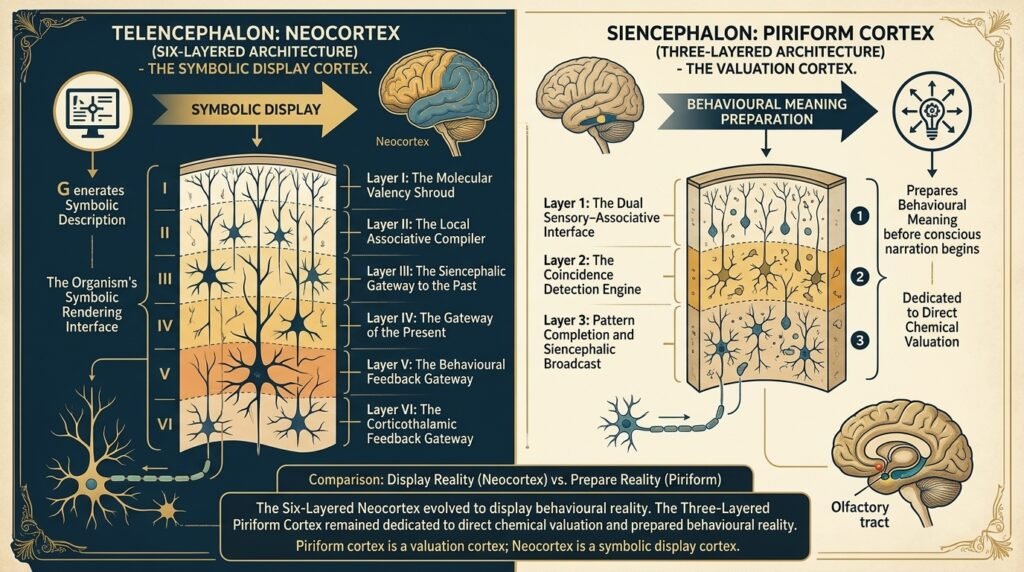
- The neocortex evolved as the organism’s symbolic rendering interface.
- The piriform cortex remained dedicated to direct chemical valuation.
Rather than allowing olfactory information to pass through the elaborate symbolic machinery of the six-layered neocortex, evolution preserved an older cortical territory capable of forwarding olfactory information directly into the behavioural integration systems.
This anatomical separation prevents chemically urgent information from becoming delayed by reflective symbolic processing.
Consequently, smell occupies a unique position within the behavioural civilisation.
- Visual information reaches conscious display after travelling through extensive thalamic relay systems.
- Auditory information follows similar hierarchical organisation.
- Somatosensory information likewise enters through specialised thalamocortical gateways.
Olfactory information follows a remarkably different route. Instead of first becoming symbolic, smell first becomes behaviourally significant at the Piriform cortex. Only afterwards does symbolic narration emerge at the six layered Orbitofrontal cortex.
The piriform cortex therefore represents a valuation cortex rather than a symbolic display cortex.
3. Why the Piriform Cortex Belongs to the Siencephalon
Psychextrics places the piriform cortex within the functional territory of the Siencephalon because its architecture serves behavioural integration rather than behavioural display.
Unlike the revised Telencephalon, whose primary responsibility is conscious rendering, the piriform cortex participates directly in the organisation of behavioural-memory, emotional indexing, and survival valuation.
Its outputs travel immediately toward the amygdala and the Entorhinal gateway. Consequently, olfactory information enters the behavioural archive before it becomes consciously narrated.
This explains why smells frequently evoke powerful emotional memories with extraordinary speed.
- A familiar perfume may instantly resurrect forgotten childhood experiences.
- The aroma of hospital disinfectant may provoke anxiety before conscious reasoning begins.
- The scent of old paper may immediately evoke nostalgia despite the individual having made no deliberate attempt to remember the past.
Within Psychextrics, these experiences occur because the piriform cortex belongs functionally to the behavioural integration architecture rather than the symbolic display architecture.
Its evolutionary purpose is not to describe smell. Its purpose is to determine what smell means for survival.
4. The Three-Layered Architecture of the Piriform Cortex
Unlike the six-layered neocortex, the piriform cortex operates through a highly streamlined three-layer organisation specifically adapted for rapid behavioural valuation.
Information first arrives within the superficial molecular layer. It is then organised through densely packed neuronal populations. Finally, the processed behavioural signal is transmitted directly toward deeper siencephalic structures responsible for emotional valuation and behavioural continuity.
This simplified organisation reflects its specialised function. Rather than supporting reflective symbolic processing across multiple cortical layers, the piriform cortex rapidly determines whether incoming chemical information corresponds with previously established behavioural significance.
Its architecture therefore favours speed, pattern recognition, and behavioural relevance over symbolic narration.
The absence of additional cortical layers is not a biological limitation. It represents evolutionary optimisation for a completely different behavioural task.
Layer 1: The Dual Sensory–Associative Interface
The superficial layer of the piriform cortex contains two distinct operational territories.
The outer subdivision receives direct afferent projections from the olfactory-bulb through the lateral olfactory tract. These fibres deliver raw chemical information immediately after volatile molecules activate olfactory receptors.
Beneath this superficial zone lies an associative compartment receiving extensive intracortical and siencephalic projections. Here current olfactory information immediately encounters stored behavioural associations originating throughout the broader siencephalic network.
Rather than processing these inputs sequentially, the piriform cortex compares them simultaneously. Current chemical configurations are evaluated against previously indexed behavioural patterns almost immediately after entering the cortex.
Within the Psychextric framework this layer performs the first behavioural comparison between present chemical reality and accumulated behavioural history within the Siencephalon.
Layer 2: The Coincidence Detection Engine
After passing through Layer 1, olfactory information reaches the densely packed neuronal populations of Layer 2.
Here individual molecular features cease functioning as isolated chemical events. Instead, synchronised activation allows separate odour components to become recognised as coherent behavioural identities.
Layer 2 therefore functions as a coincidence detector. Its responsibility is to determine whether numerous incoming chemical elements belong together as a meaningful behavioural pattern.
Rather than consciously recognising dozens of individual airborne molecules, the organism immediately recognises a coherent behavioural object. The smell becomes a stable identity rather than a collection of unrelated chemical fragments.
Within Psychextrics this transformation represents the transition from molecular detection to behavioural recognition.
Layer 3: Pattern Completion and Siencephalic Broadcast
The deepest layer of the piriform cortex contains extensive recurrent networks formed by pyramidal and polymorphic neurons.
Unlike the descending output systems of the neocortex, these recurrent networks remain concentrated within the Siencephalon itself. Their principal responsibility is pattern completion.
Even when olfactory information becomes incomplete, fragmented, or partially obscured, Layer 3 reconstructs the behavioural identity using previously established internal associations.
Once stabilised, this completed behavioural package is transmitted directly toward the amygdala for emotional valuation and the Entorhinal gateway for behavioural indexing.
Unlike the revised Telencephalon, the piriform cortex does not attempt to generate symbolic description. Instead, it prepares behavioural meaning before conscious narration begins.
Its architecture remains entirely forward facing. Information continually progresses from sensory capture toward behavioural integration without requiring the reflective detours characteristic of neocortical consciousness.
Conclusion: The Behavioural Difference Between the Neocortex and the Piriform Cortex
The distinction between these two cortical systems illustrates one of the central architectural principles of Psychextrics.
- The neocortex exists to display behavioural reality.
- The piriform cortex exists to prepare behavioural reality.
The six-layered neocortex converts integrated behavioural packets into symbolic awareness, internal narration, linguistic structure, visual imagery, conceptual simulation, and reflective consciousness.
The three-layered piriform cortex performs none of these operations. Instead, it immediately transforms chemical stimuli into emotionally weighted behavioural significance before transmitting them toward the deeper siencephalic systems responsible for memory integration.
Both structures therefore participate in consciousness, but they occupy entirely different positions within its architecture.
One renders. The other prepares what will eventually be rendered.
This distinction explains why olfactory experience often feels unusually immediate, emotionally powerful, and deeply autobiographical.
Rather than first passing through the elaborate symbolic rendering machinery of the revised Telencephalon, olfactory information enters directly into the behavioural civilisation maintained by the Siencephalon, where emotional value and historical continuity are established before conscious narration ever begins.
Part II will examine why this olfactory cortical architecture necessarily lacks the descending feedback mechanisms characteristic of the six-layered neocortex, and why this structural absence fundamentally distinguishes behavioural valuation from reflective consciousness.
Back to: 👇