
The Display Cortex Is Not the Hard Drive: Why the Cortex Lacks a Master Relay but Retains the Amygdala–Hippocampal Axis
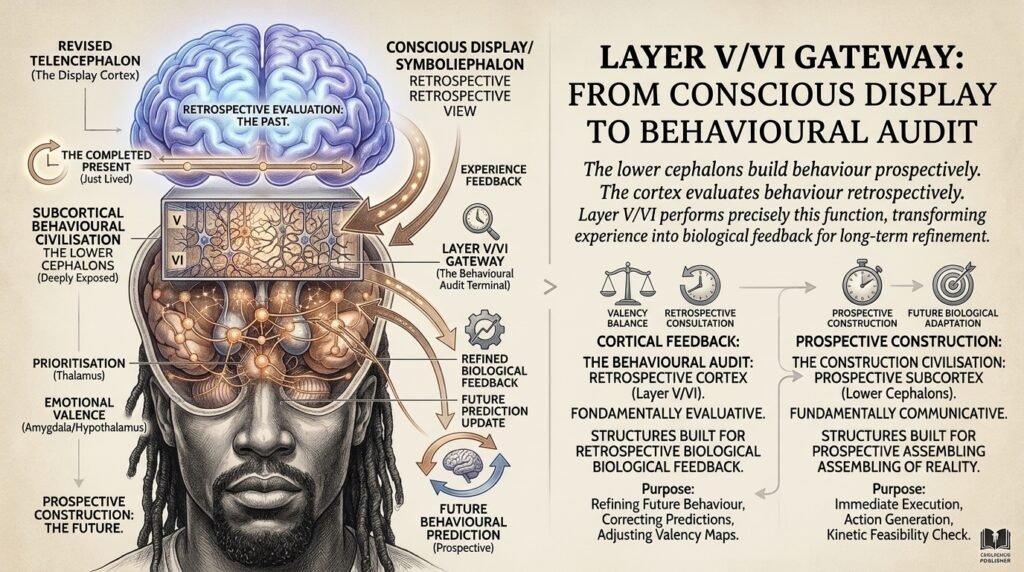
Part III: The Layer V/VI Gateway: From Conscious Display to Behavioural Audit
BY: OMOLAJA MAKINEE
Having established that the Display Cortex neither constructs consciousness nor houses the organism’s behavioural archive, the remaining architectural question becomes unavoidable.
If the cortex functions solely as a rendering interface, why does it maintain such an extensive Layer V and Layer VI feedback gateway?
Why would evolution devote enormous descending circuitry to a structure that merely displays reality?
Psychextrics answers this question by assigning the Display Cortex a role that is neither executive nor passive.
It functions as the behavioural auditor of the cephalic civilisation.
The cortex does not write the behavioural script, but it continuously evaluates the script after it has been rendered.
Its descending pathways exist because every behavioural display must eventually be compared against the biological reality that produced it. The organism cannot survive by constructing behaviour alone; it must continually determine whether the behaviour it generated successfully matched environmental reality.
Layer V and Layer VI perform precisely this retrospective function.
Rather than commanding the present, they evaluate the completed present. They transform conscious experience into biological feedback that can improve future behavioural prediction. Their purpose is therefore not immediate execution but long-term refinement.
This distinction separates the Display Cortex from every lower cephalon.
The lower cephalons build behaviour prospectively. The cortex evaluates behaviour retrospectively.
1. The Mandatory Tri-Centric Interaction Loop
Psychextrics proposes that every autonomous cephalon participates in a mandatory tri-centric interaction loop that maintains communication across the behavioural civilisation. Regardless of whether a cephalon governs survival vigilance, movement, spatial orientation, memory integration, or symbolic display, it must continuously interact with three structural components.
- The first component is its behavioural gateway, through which information enters or exits the cephalon.
- The second component is its amygdala-hippocampal axis, where behavioural events receive emotional authentication and historical indexing.
- The third component is the broader survival architecture that continually recalibrates behavioural templates throughout the Somato-Valence Engine.
The revised Telencephalon follows this universal rule despite lacking a Master Relay.
- Its Layer V and Layer VI pathways function as its gateway.
- Its dedicated amygdala-hippocampal axis authenticates the symbolic reality appearing upon the display.
- Its descending communication modifies the behavioural templates maintained throughout the lower cephalic civilisation.
The cortex therefore remains fully integrated into the behavioural network without becoming its executive centre.
This distinction preserves both cortical importance and subcortical sovereignty.
2. Why Every Cephalon Requires the Amygdala–Hippocampal Axis
The presence of an amygdala-hippocampal axis within every cephalon is not evidence that every cephalon performs identical functions. Instead, it reflects the universal requirement that every behavioural operation be emotionally evaluated and historically integrated.
The lower cephalons use this axis during behavioural construction.
- When the Myelencephalon detects respiratory compromise, the behavioural event is immediately evaluated through survival templates.
- When the Metencephalon adjusts balance, the behavioural outcome becomes indexed for future motor refinement.
- When the Mesencephalon rapidly redirects gaze toward unexpected movement, spatial success or failure becomes incorporated into behavioural-memory.
Each cephalon consults the same axis because every behavioural act contributes to future survival.
The revised Telencephalon participates differently.
It accesses the same emotional and historical architecture only after behaviour has already reached conscious display.
Its role is not to build behavioural templates but to evaluate the symbolic consequences of those templates after they have been rendered into conscious awareness.
Consequently, the cortex communicates with the amygdala and hippocampus not because it generates behaviour, but because rendered behaviour must itself become part of the organism’s continuing behavioural history.
The symbolic experience becomes biologically relevant only after it has been authenticated against emotional value and historical continuity.
3. Layer V and Layer VI as the Architecture of Retrospective Calibration
The specialised function of the cortical feedback gateway becomes most apparent when examining how Layer V and Layer VI operate together.
Layer V receives the completed symbolic simulation produced across the cortical display.
At this stage, present behavioural reality has already been integrated by the Thalamus, historical continuity has already been supplied by the Entorhinal Gateway, emotional weighting has already entered through Layer I, and local symbolic organisation has already occurred throughout the cortical column.
Layer V therefore does not ask how behaviour should be generated. Instead, it asks whether the rendered behavioural outcome accurately represents the biological reality beneath it.
The completed symbolic transcript is then transmitted toward the amygdala and hippocampus.
This descending communication allows the emotional significance of the displayed experience to be verified while simultaneously allowing the behavioural archive to determine how the newly rendered experience should influence future behavioural expectations.
Layer VI extends this process by transmitting calibrated feedback toward the Thalamus and the Thalamic Reticular Nucleus (TRN).
Rather than modifying the current behavioural frame, it adjusts future thalamocortical gating parameters so that subsequent behavioural packets can be rendered with greater accuracy.
The Display Cortex therefore performs continuous behavioural auditing. Every conscious experience becomes an opportunity to refine future behavioural prediction.
4. Symbolic Simulation as Behavioural Rehearsal
This retrospective architecture explains why symbolic simulation occupies such a prominent position within human cognition.
Imagination, moral reflection, strategic planning, internal dialogue, and hypothetical reasoning all appear to involve conscious control over behaviour.
Within Psychextrics, these experiences serve a different biological purpose. They allow the Display Cortex to construct symbolic simulations that can be evaluated before behavioural execution occurs.
When an individual imagines accepting a new job, rehearses an upcoming conversation, contemplates an ethical dilemma, or mentally explores alternative futures, the cortex is not generating new behavioural architecture independently.
Instead, it is presenting symbolic behavioural models to the deeper cephalic systems for continuous auditing.
- Each simulation is transmitted through the Layer V/VI gateway.
- Each symbolic possibility is emotionally authenticated through the amygdala.
- Each projected outcome is indexed within the hippocampal archive.
- Each completed evaluation subtly modifies the behavioural thresholds maintained by the Somato-Valence Engine.
The organism therefore learns from imagined behaviour almost as effectively as from physical behaviour because the behavioural civilisation continuously evaluates both.
Symbolic simulation becomes a biological rehearsal system rather than an independent executive process.
5. Lived Experience: Replaying Yesterday’s Conversation
A familiar everyday experience illustrates this retrospective architecture.
Imagine returning home after an important meeting at work. During the evening, you suddenly begin replaying a conversation that occurred earlier in the day. You remember a particular question from a colleague and immediately think, “I should have answered that differently.”
You mentally reconstruct the entire exchange, trying different explanations, changing your tone of voice, reorganising your arguments, and imagining how the conversation might have unfolded had you responded another way.
- Nothing in the external world changes.
- The meeting has already ended.
- No behavioural action is occurring in the present.
Yet internally, the Display Cortex continues rendering from subcortical cephalons alternative behavioural possibilities.
Within the Psychextric framework, this is not the cortex attempting to rewrite the past. Rather, Layer V and Layer VI are conducting a retrospective audit of the completed behavioural event.
The symbolic simulations are continuously transmitted through the cortex’s dedicated amygdala-hippocampal axis, allowing the deeper behavioural architecture to compare the rendered outcome against stored emotional and behavioural indices.
The experience feels like “thinking things through,” but biologically it functions as behavioural calibration. The completed simulation subtly modifies future EIM-HFI thresholds so that when a similar conversation occurs again, the behavioural civilisation is already better prepared before consciousness even begins speaking.
Conclusion: The Psychextric Interpretation
The revised Telencephalon ultimately derives its importance not from behavioural authorship but from behavioural refinement.
- It does not construct the organism’s behavioural civilisation. It observes that civilisation after it has already acted.
- It does not maintain the behavioural archive. It consults the archive.
- It does not generate emotional valuation. It renders emotionally authenticated behavioural reality.
- It does not require a Master Relay because it routes nothing during behavioural construction.
Instead, it receives completed behavioural packets, transforms them into symbolic experience, and continuously transmits retrospective evaluations back into the biological architecture responsible for constructing future behaviour.
The cortex therefore resembles neither a biological hard drive nor an executive command centre. It is the civilisation’s reflective mirror.
Through its mandatory Layer V/VI gateway and its dedicated amygdala-hippocampal axis, the Display Cortex continuously audits the behavioural reality assembled by the deeper cephalic systems.
Every rendered thought, imagined future, remembered event, moral reflection, and symbolic rehearsal becomes another opportunity to recalibrate the behavioural civilisation beneath awareness.
The screen neither writes the script nor directs the actors, but by faithfully reflecting the completed performance back to the subcortical builders, it ensures that the organism’s behavioural architecture becomes progressively more refined, more adaptive, and more capable of meeting the challenges of future survival.
Back to: 👇