
The Display Cortex Is Not the Hard Drive: Why the Cortex Lacks a Master Relay but Retains the Amygdala–Hippocampal Axis
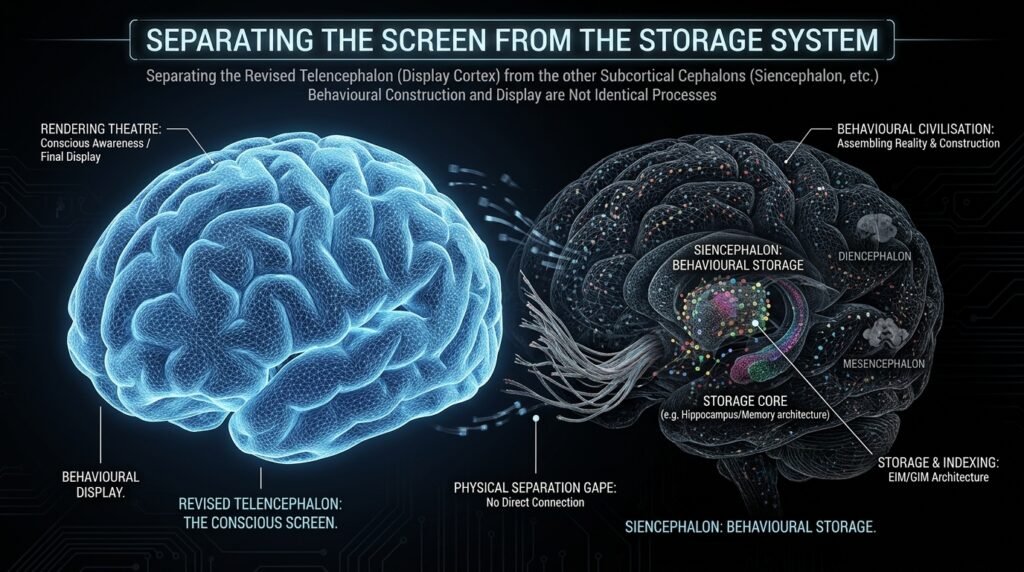
Part I: Separating the Screen from the Storage System
BY: OMOLAJA MAKINEE
One of the most persistent assumptions in modern discussions of the brain is that the cerebral cortex functions as both the generator and permanent storage centre of human consciousness.
Because conscious experience unfolds upon the cortical surface, it is tempting to conclude that the cortex simultaneously constructs, stores, prioritises, and controls every aspect of behavioural reality.
The subjective experience of thinking reinforces this belief. Memories appear to be recalled from within consciousness, decisions seem to originate inside conscious awareness, and personal identity feels inseparable from the cortical landscape. The cortex therefore appears to function simultaneously as projector, archive, executive, and narrator.
Psychextrics dismantles this assumption by separating two biological operations that are frequently treated as one.
Behavioural construction and behavioural display are not identical processes.
The structures responsible for assembling behavioural reality are fundamentally different from the structures responsible for rendering that reality into conscious awareness. Once this distinction is recognised, the role of the cortex undergoes a profound reinterpretation.
Within the Psychextric framework, the revised Telencephalon is not the biological hard drive of the organism. It neither indexes behavioural continuity, emotionally prioritises survival information, recursively stabilises autobiographical history, nor stores behavioural architecture.
Those responsibilities belong to the Siencephalon through its Entorhinal Gateway, hippocampal indexing systems, and amygdala-centred valuation architecture. The Display Cortex merely renders the completed outputs of these deeper systems into the symbolic experience recognised as consciousness. The screen and the archive are therefore separate biological entities.
Just as a computer monitor displays information without storing the operating system that generated it, the Display Cortex projects behavioural reality without containing the behavioural civilisation that assembled it. Every conscious thought, remembered event, imagined possibility, or spoken sentence appears upon the cortical display only after the deeper cephalic systems have already negotiated its biological construction.
This distinction is not simply anatomical; it redefines the architecture of consciousness itself.
1. The Display Cortex as a Dependent System
Understanding why the cortex cannot be regarded as the biological hard drive requires examining its position within the complete cephalic hierarchy. Every lower cephalon possesses mechanisms that actively construct behavioural reality through direct interaction with survival physiology, emotional valuation, motor execution, or memory integration. These structures operate continuously, even when consciousness itself is absent.
The cortex operates differently.
Rather than constructing behavioural reality, it depends entirely upon behavioural reality already being constructed elsewhere. It contributes no independent survival templates, generates no native emotional currency, and maintains no autonomous behavioural archive capable of sustaining consciousness in isolation.
Instead, it receives integrated behavioural packets from the subcortical civilisation and translates them into the symbolic grammar of conscious experience.
This dependency extends to the most fundamental operation of conscious display itself.
The cortex cannot independently illuminate its own behavioural screen.
Before a single conscious frame appears, Layer I of the cortical column must first be unlocked by ascending emotional valence anchored to the amygdala originating from the master subcortical relay systems.
Whether behavioural information arrives through the Diencephalic Thalamus, the Siencephalic Entorhinal Gateway, or the Olfactory Bulb within the olfactory pathway, the cortical display remains biologically dependent upon ascending amygdalar valence before conscious rendering can occur.
The cortex therefore possesses no independent ignition system. It waits.
Only after the deeper cephalic architecture opens the display gate can conscious experience emerge.
This dependency alone distinguishes the cortex from every major behavioural construction engine situated beneath it.
2. The Architectural Bifurcation: Behavioural Construction versus Behavioural Rendering
Psychextrics establishes a strict division of labour between two major biological domains.
- The first domain consists of the Somato-Valence Engine, comprising the Myelencephalon, Metencephalon, Mesencephalon, and Diencephalon.
Together these cephalons build behavioural reality from the bottom upward. They establish survival priorities, regulate physiological stability, calculate movement, orient the organism within space, assign contextual value, and construct the raw field of consciousness through continuous interaction with biological existence.
- The second domain is the revised Telencephalon.
Rather than participating directly in behavioural construction, the revised Telencephalon transforms completed behavioural integrations into symbolic representations that can be consciously experienced. It renders the display modality of vision, hearing, touch, language, imagery, reflection, and internal narration, but only after these behavioural realities have already been assembled beneath awareness.
This architectural bifurcation preserves the sophistication of cortical function while relocating its biological role.
The Display Cortex becomes an extraordinarily advanced symbolic interface without becoming the origin of behavioural existence.
3. The Construction of Consciousness versus the Act of Rendering
This distinction becomes clearer when each component of the Somato-Valence Engine is examined individually.
The Myelencephalon establishes the foundational conditions necessary for survival. Through continuous regulation of homeostatic stability, visceral vigilance, and autonomic readiness, it contributes the earliest layer of behavioural consciousness.
The Metencephalon constructs kinetic consciousness. It continuously calculates posture, balance, muscular timing, trajectory prediction, and coordinated movement, allowing behavioural stability to emerge long before conscious-awareness recognises any physical action.
The Mesencephalon contributes spatial consciousness by organising orientation, target acquisition, ocular movement, auditory localisation, and rapid environmental mapping. It determines where the organism is positioned within behavioural space before symbolic interpretation begins.
The Diencephalon completes this ascending construction by assigning contextual meaning, behavioural value, attentional prioritisation, and emotional significance. Through the Thalamus and Hypothalamus, raw behavioural activity becomes organised into the conscious field recognised as the present moment.
Together these cephalic systems construct consciousness itself. The Display Cortex performs none of these operations.
Instead, it receives their completed outputs and converts them into species-specific symbolic grammar.
- Visual display fields transform spatial computations into perceived images.
- Auditory display regions transform acoustic integrations into meaningful sound.
- Language fields convert behavioural intentions into speech.
- Association cortices organise symbolic simulations and reflective narration.
The cortex therefore creates no behavioural reality. It reveals behavioural reality.
This distinction explains why conscious experience feels immediate despite depending upon an immense behavioural infrastructure operating beneath awareness. By the time behavioural information reaches the Display Cortex, the biological work has already been completed.
Consciousness witnesses the finished product.
4. Autonomy and the Biological Currency of Behaviour
Another fundamental difference separates the Somato-Valence Engine from the Display Cortex.
The lower cephalic systems operate with genuine behavioural autonomy. They are immersed directly within metabolic, visceral, hormonal, and emotional processes that provide the biological currency necessary for independent behavioural action. Their operations remain continuously coupled to molecular memory, physiological regulation, and survival execution.
Consequently, they possess the capacity to bypass conscious awareness entirely when circumstances demand immediate action.
- A sudden withdrawal from pain.
- An involuntary startle response.
- Rapid postural adjustment.
- Instant respiratory compensation.
- Emergency cardiovascular activation.
Each demonstrates the autonomy of the lower cephalic architecture.
These systems do not wait for symbolic interpretation before acting. The Display Cortex possesses no comparable authority.
It cannot independently generate survival behaviour, initiate emotional valuation, or execute biological responses without first receiving behavioural permission from the deeper cephalic systems.
Every conscious simulation, imagined conversation, moral reflection, or strategic rehearsal depends upon behavioural material supplied from beneath awareness.
Its remarkable symbolic abilities should therefore not be confused with executive sovereignty.
The cortex excels at representation. It does not govern the biological foundations of behaviour.
Conclusion: Why the Master Relays Never Belong to the Display Cortex
This architectural distinction naturally raises an important question.
If the cortex is responsible for rendering conscious reality, why does it not possess its own Master Relay capable of independently organising behavioural traffic?
The Psychextric answer follows directly from its functional role.
Master Relays belong exclusively to structures responsible for constructing or integrating consciousness, not displaying it.
- The Entorhinal Gateway functions as the principal integrator of behavioural continuity, organising memory indices and historical architecture throughout the Siencephalon.
- The Thalamus functions as the principal relay of present behavioural consciousness, coordinating sensory integration, contextual valuation, and attentional organisation throughout the Diencephalon.
- The Olfactory Bulb performs a specialised relay role within the olfactory system, providing direct behavioural access for chemosensory information.
Each qualifies as a Master Relay because each actively routes, integrates, organises, or constructs behavioural reality before conscious display occurs.
The Display Cortex performs none of these routing functions. It neither receives competing behavioural streams for integration nor determines where those streams should ultimately travel. It requires access to behavioural information rather than responsibility for directing behavioural traffic.
Consequently, the cortex requires communication channels, not routing centres. Its biological function is fulfilled not by controlling behavioural flow but by rendering that flow into conscious symbolic experience.
This structural limitation is not evidence of cortical weakness. Rather, it reflects the specialised position of the revised Telencephalon within the cephalic hierarchy.
By remaining free of Master Relay responsibilities, the Display Cortex dedicates its architecture to what it alone performs most effectively:
Transforming the completed behavioural civilisation beneath awareness into the continuous symbolic theatre recognised as human consciousness.
Back to: 👇