
Layer V: The Gateway of Behavioural Action
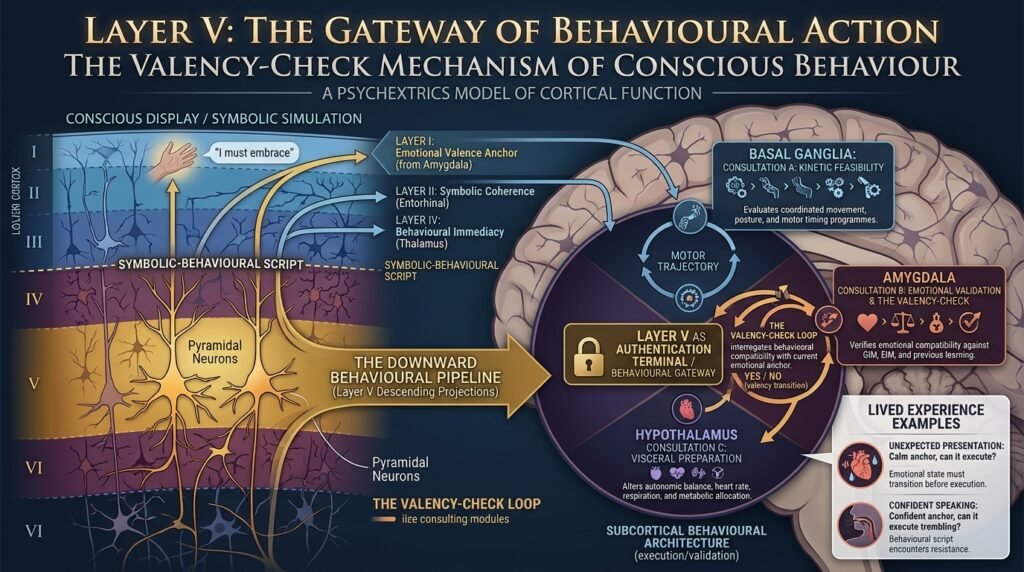
The Valency-Check Mechanism of Conscious Behaviour
BY: OMOLAJA MAKINEE
Dreams provide one of the clearest demonstrations that the Display Cortex functions as a behavioural rendering interface rather than the original architect of behaviour.
During sleep, the cortex continues to construct rich visual landscapes, conversations, emotions, movements, and complex symbolic narratives despite the dramatic reduction of external sensory input.
Mountains can be climbed without muscles moving. Conversations can unfold without vocalisation. Entire worlds can be experienced while the organism lies motionless in bed.
Under Psychextrics, this phenomenon reveals an essential characteristic of the revised Telencephalon. The cortex does not require the external world in order to render behavioural reality. What it requires is access to already integrated behavioural packets originating from the deeper cephalic systems.
Whether those behavioural packets originate from present sensory reality or internally reconstructed memory indices supplied by the Siencephalon, the cortex performs the same fundamental operation: it renders them into symbolic experience.
Dreaming therefore exposes the Display Cortex for what it truly is—a behavioural simulator. During wakefulness it renders behavioural packets generated through ongoing interaction with the environment. During dreaming it renders behavioural packets assembled almost entirely from internally generated memory architecture.
The display remains active because rendering continues, even though the external environment has largely been disconnected from conscious awareness.
This distinction becomes crucial when examining Layer V.
If Layer III introduces behavioural continuity from the Entorhinal Gateway, Layer IV introduces behavioural immediacy from the Thalamus, and Layer II orchestrates symbolic coherence, then Layer V asks an entirely different question.
It does not ask what reality is. It asks whether reality can become behaviour.
1. The Behavioural Threshold of Consciousness
The classical Telencephalon is often mistaken as the executive commander of behaviour because every conscious intention appears to culminate within it. When individuals decide to stand, speak, embrace someone, write a sentence, or perform a difficult task, they naturally assume that conscious intention itself directly commands the body.
Psychextrics proposes a different interpretation.
Layer V does not simply issue behavioural orders. Instead, it performs a structural interrogation of the behavioural architecture already assembled across the cortical column.
By the time behavioural information reaches Layer V, numerous operations have already occurred beneath awareness.
- The amygdala has already opened Layer I using an emotional valence.
- The Entorhinal Gateway has already supplied historical continuity through Layer III.
- The Thalamus has already projected the present through Layer IV.
- Layer II has already woven these streams into a coherent symbolic representation.
Only after this completed behavioural script exists does Layer V assume responsibility.
Its responsibility is neither memory nor narration. Its responsibility is execution.
But execution is never automatic.
Before a behavioural simulation can descend toward the lower cephalic systems, Layer V must determine whether the organism’s existing emotional state possesses sufficient biological compatibility to execute the proposed action.
2. Layer V as the Behavioural Gateway
Within the Psychextric framework, Layer V functions as the Gateway of Behavioural Action.
Unlike the entry gateways situated lower within the cephalic hierarchy, this gateway operates retrospectively rather than prospectively.
- The behavioural script has already been assembled.
- The symbolic meaning has already been rendered.
- The emotional background has already been established.
Layer V therefore performs a fundamentally evaluative role. It interrogates the completed behavioural packet before it attempts to enter the subcortical execution architecture.
Its central question is remarkably simple:
Can the current emotional valence anchored to Layer I execute this behavioural action, or must the emotional state itself change before execution becomes biologically possible?
Everything that follows depends upon the answer.
3. The Valency-Check Principle
Human beings frequently imagine that thoughts directly produce behaviour. Yet everyday experience demonstrates otherwise.
- A person may decide to remain calm while simultaneously feeling overwhelming panic.
- One may determine to speak confidently while the voice trembles.
- Another may intend to remain composed while the heart races uncontrollably.
- An individual may resolve to forgive while anger continues dominating every emotional response.
These experiences reveal that behavioural intention and behavioural execution are not identical operations. Layer V represents the structural checkpoint separating them.
Once a behavioural script reaches this gateway, it is projected downward into the deep behavioural architecture for a comprehensive valency assessment.
Rather than blindly transmitting every conscious intention into physical execution, Layer V first consults the emotional infrastructure anchored to Layer I.
The behavioural script is effectively presented for biological inspection.
Does the current emotional state possess sufficient compatibility to support this action?
If the answer is “Yes”, behavioural execution proceeds using the existing emotional architecture. If the answer is “No”, the organism cannot simply ignore the discrepancy. A different emotional configuration must first emerge before the behavioural plan becomes executable.
Layer V therefore functions less like a command centre than an authentication terminal. Every behavioural intention must first authenticate itself against the organism’s current emotional reality.
4. The Emotional Audit of Behaviour
This authentication process extends beyond simple feelings of confidence or fear. Every behavioural packet possesses emotional requirements.
- Some actions require curiosity.
- Others require compassion.
- Others require urgency.
- Others require aggression.
- Others require patience.
- Others require courage.
- Others require restraint.
Layer V therefore performs an emotional audit rather than a purely motor calculation.
The behavioural script descending from the Display Cortex is compared against the emotional landscape already established within the amygdala and represented across Layer I.
If both configurations remain compatible, the existing emotional state can sustain behavioural execution. No significant reorganisation becomes necessary.
If incompatibility exists, the behavioural architecture encounters resistance. The lower behavioural systems must determine whether the emotional configuration can be restructured rapidly enough to accommodate the new behavioural demand.
This evaluation occurs before the conscious narrator fully appreciates why behaviour suddenly feels effortless or impossibly difficult.
5. The Downward Behavioural Pipeline
Following successful symbolic integration, Layer V activates the principal descending pipeline of the revised Telencephalon. The enormous pyramidal neurons occupying this layer project long descending axons toward multiple subcortical systems.
Unlike the ascending pathways responsible for constructing conscious display, these projections move behavioural information downward.
The completed symbolic script leaves the cortical theatre. It descends toward the behavioural civilisation responsible for physical implementation.
Within Psychextrics, this descending architecture performs three simultaneous consultations.
- First, the behavioural plan is evaluated by the Basal Ganglia for kinetic feasibility.
- Second, the behavioural plan is presented directly to the Amygdala for emotional validation.
- Third, the behavioural consequences are transmitted toward the Hypothalamus for visceral preparation.
The behavioural packet therefore undergoes a comprehensive systems review before physical execution ever begins.
A. The Basal Ganglia Consultation
The first consultation concerns movement itself.
Layer V sends excitatory projections toward the striatal components of the Basal Ganglia.
This consultation does not determine behavioural meaning. Meaning has already been constructed. Instead, the Basal Ganglia evaluate whether the behavioural sequence can be transformed into coordinated movement.
- Posture.
- Balance.
- Motor timing.
- Sequential execution.
- Habitual motor programmes.
These are assessed against the proposed behavioural action.
The behavioural script effectively asks:
“Can the existing motor architecture execute this behavioural sequence?”
If kinetic compatibility exists, the movement becomes available for implementation. If substantial conflict exists, hesitation, awkwardness, freezing, or degraded execution may emerge.
The behavioural intention therefore encounters its first practical reality check.
B. The Amygdalar Consultation
The second consultation is considerably more significant.
Layer V projects directly toward the Basolateral Amygdala.
Within Psychextrics, this projection constitutes the behavioural valency-check. The symbolic script is presented directly to the emotional valuation system.
The amygdala compares the proposed behaviour against multiple behavioural reference systems simultaneously.
- Inherited GIM architecture.
- Accumulated EIM adaptation.
- Existing emotional intensity.
- Current behavioural context.
- Previous emotional learning.
Most importantly, the amygdala asks the central question governing Layer V:
Can the current emotional valence already anchored to Layer I execute this behavioural action?
If the answer is affirmative, the behavioural script proceeds without altering the existing emotional anchor. The organism acts within its present emotional framework.
If the answer is negative, behavioural execution cannot proceed unchanged. The amygdala initiates a valency transition. A new emotional anchor becomes necessary.
Only after the emotional landscape has been reorganised can behavioural execution continue.
Layer V therefore never assumes emotional compatibility. It verifies it.
C. The Hypothalamic Consultation
Simultaneously, descending projections engage the Hypothalamic systems responsible for preparing the organism physiologically.
Behaviour cannot occur independently of the body.
- Speaking requires respiratory adjustment.
- Running requires cardiovascular modification.
- Defensive behaviour requires metabolic redistribution.
- Social engagement requires alterations in autonomic balance.
The Hypothalamus therefore transforms symbolic behavioural preparation into physiological readiness.
- Heart rate.
- Respiration.
- Hormonal mobilisation.
- Metabolic allocation.
- Visceral readiness.
All become aligned with the behavioural programme presently undergoing validation.
The body begins preparing before conscious-awareness appreciates the full extent of its own physiological transformation.
6. Lived Experience: The Unexpected Public Presentation
An ordinary professional seminar vividly illustrates the operation of the Layer V gateway.
Imagine sitting comfortably among hundreds of colleagues during a work conference. You have arrived expecting only to listen. Your attention remains relaxed. Your emotional baseline remains relatively neutral.
Without warning, the moderator unexpectedly announces your name. You are asked to walk onto the stage immediately and deliver an unscripted presentation before three hundred people.
Everything changes within seconds.
- The auditory stimulus enters Layer IV through the thalamic relay.
- Layer III immediately retrieves autobiographical memories associated with public evaluation, previous presentations, success, embarrassment, criticism, or social exposure.
- Layer II rapidly integrates these behavioural streams into a coherent symbolic understanding:
“Everyone is looking at me.”
“I must stand.”
“I have to speak.”
“I cannot fail.”
At this precise moment, Layer V assumes control of the behavioural gateway. Rather than instantly commanding movement, it initiates the behavioural authentication sequence.
The completed symbolic script descends toward the Basal Ganglia.
- Can posture remain stable?
- Can walking remain coordinated?
- Can the required motor programme be released?
Simultaneously, the script reaches the Basolateral Amygdala. The emotional architecture now undergoes its critical examination.
The current emotional anchor established within Layer I may have been calm attentiveness only seconds earlier. That emotional state must now answer Layer V’s decisive question.
Can calm attentiveness execute a successful switch to a high-pressure public presentation?
If previous behavioural history, emotional conditioning, and current adaptive capacity support that emotional state, the existing valence may remain adequate to switch successfully.
- The individual rises calmly.
- Walks confidently.
- Speaks coherently.
The behavioural script proceeds using a compatible emotional anchor.
But if the amygdala determines that public presentation does not currently exist within the organism to sustain the behavioural demand, a transition becomes impossible.
Layer I receives a different emotional anchor regardless.
- Physiological intensity increases.
- The Hypothalamus accelerates cardiovascular output.
- Respiration changes.
- Muscular tension rises.
- Sweat appears.
- Attention narrows.
The organism has not consciously chosen these reactions.
The behavioural gateway has simply concluded that the available emotional architecture could not successfully execute the behavioural programme now demanded by the environment.
The conscious narrator subsequently experiences these transformations as emotion.
Under Psychextrics, they represent the outcome of Layer V’s behavioural valency-check rather than the origin of behavioural execution itself.
By the time the individual reaches the podium, the behavioural gateway has already completed its interrogation. The body now carries the emotional architecture judged most compatible with the impending behavioural task, while consciousness witnesses the unfolding experience as though it were voluntarily directing every stage of the process in the case of a smooth transition, and feeling of loosing control in the case of incompatibility.
7. The Two Behavioural Pathway Axes
Once Layer V has completed its behavioural valency-check and determined whether the current emotional anchor can sustain the proposed behavioural action, the completed symbolic script enters two complementary pathway systems.
Although these pathways operate simultaneously, they serve fundamentally different purposes within the Psychextric architecture.
- One pathway negotiates physical execution through the monopolised motor hierarchy,
- while the other performs immediate emotional authentication through the independent amygdala-hippocampal axis.
This dual architecture demonstrates that conscious intention alone never guarantees behavioural execution. Every behavioural simulation projected by the Display Cortex must first negotiate with the deeper biological civilisation beneath awareness.
Axis One: The Monopolised Behavioural Route
The first pathway is the monopolised execution route.
Consider two people in a heated argument where one reactively throw a punch without conscious intention to do so, it is simply that the same emotional valence anchored at Layer I flows seamlessly into behavioural execution at Layer V without requiring a switch in emotional valence to executes the reactive motor behaviour of throwing a punch to complete the behavioural sequence of being in a heated argument.
Here, Layer V transmits its completed symbolic programme toward the Basal Ganglia and the Cerebellar-Metencephalic system through the captured thalamic motor nuclei, particularly the Ventral Anterior (VA) and Ventrolateral (VL) complexes.
These nuclei do not simply relay cortical commands. They represent behavioural territories already structurally captured by the lower Local Functional Units and therefore remain responsible for determining whether the proposed behavioural script can be translated into coordinated physical action.
Within Psychextrics this route exists because the cortex never owns the mechanics of movement. It may formulate the behavioural possibility, but the kinetic civilisation beneath consciousness remains responsible for determining whether posture, balance, muscular coordination, timing, precision, and physical stability can actually support the requested action.
The behavioural proposal therefore descends into an already established executive civilisation rather than commanding an obedient machine.
- The Basal Ganglia examine whether existing motor programmes can accommodate the request.
- The Cerebellum evaluates whether movement can remain balanced and temporally accurate.
The captured motor nuclei integrate these calculations before the behavioural packet is returned to the cortical display as an executable motor trajectory. Only after this negotiation does the organism physically move.
Behaviour therefore emerges through structural agreement rather than unilateral conscious command.
Axis Two: The Independent Amygdala-Hippocampal Route
Running alongside the monopolised motor pathway is a second, entirely different behavioural highway.
Unlike the kinetic route, this pathway bypasses both the Thalamic compiler and the Entorhinal relay. Layer V projects directly into the Basolateral Amygdala together with the hippocampal memory architecture.
Within Psychextrics this direct projection exists because emotional verification cannot tolerate unnecessary relay delay.
Every behavioural simulation immediately asks the deeper behavioural-memory system a fundamental biological question:
“Does this proposed behaviour belong to the emotional identity currently governing the organism?”
The symbolic simulation is therefore compared against inherited behavioural architecture (GIM), accumulated experiential adaptation (EIM), existing emotional configuration, historical memory traces, behavioural expectations, and present physiological state.
If these systems authenticate the behavioural proposal, the emotional anchor presently occupying Layer I remains unchanged. The behavioural packet proceeds without interruption.
However, if incompatibility exists, the behavioural proposal encounters resistance. The emotional anchor itself must change before behaviour can continue. The behavioural simulation therefore pauses while the deeper biological civilisation reorganises the organism’s emotional configuration.
Layer V does not perform this reorganisation. It simply requests authentication. The decision remains entirely within the deeper emotional architecture.
8. Why Layer V Undergoes the Deepest Shutdown During Sleep
The behavioural significance of Layer V becomes particularly evident during sleep.
Unlike the superficial cortical layers responsible primarily for receiving behavioural information, Layer V functions as the principal downward gateway connecting conscious rendering with behavioural execution.
During wakefulness this layer operates almost continuously.
- Every decision.
- Every imagined movement.
- Every behavioural rehearsal.
- Every symbolic simulation.
- Every strategic evaluation.
- Every conscious intention.
- Every unintentional reactive behaviour.
All eventually converge upon Layer V before being presented to the deeper behavioural civilisation.
This relentless behavioural traffic places enormous metabolic demands upon the giant pyramidal neurons occupying the layer.
Throughout the waking day these neurons continuously evaluate behavioural compatibility, authenticate emotional readiness, and negotiate potential execution with the lower cephalic systems.
By the onset of deep sleep, Layer V has accumulated the greatest operational burden within the cortical hierarchy. Under the Psychextric interpretation, it therefore becomes the first major behavioural gateway requiring systematic shutdown during sleep state.
This shutdown is not a failure. It is behavioural maintenance.
9. The Behavioural Silence of NREM Sleep
During non-rapid eye movement sleep, particularly slow-wave sleep, Layer V enters prolonged rhythmic down-states characterised by widespread electrical silence.
Within Psychextrics these silent periods represent something far more significant than simple neuronal inactivity. The behavioural gateway temporarily suspends all valency-check operations.
The continual interrogation of behavioural possibilities ceases.
- No behavioural proposals descend toward the emotional civilisation.
- No strategic simulations request execution.
- No retrospective behavioural calibration occurs.
The behavioural gateway closes.
Because no behavioural packets require authentication, the lower cephalic systems become free to restore the energetic infrastructure supporting future behavioural execution.
The behavioural civilisation is no longer negotiating tomorrow’s actions. It is repairing yesterday’s activity.
This temporary closure also explains why behavioural intentions disappear during deep sleep. The organism remains biologically active. The lower cephalons continue regulating respiration, cardiovascular balance, metabolism, temperature, endocrine coordination, and countless survival functions.
Yet conscious behavioural simulation largely vanishes because the principal gateway responsible for proposing behavioural execution has temporarily powered down.
The behavioural theatre falls silent.
10. Why Layer V Reactivates During REM Sleep
Rapid Eye Movement sleep presents an entirely different behavioural landscape. During REM sleep the extensive down-states characterising Layer V largely disappear. The behavioural gateway becomes active once again. Yet the organism remains physically paralysed.
This apparent contradiction reveals one of the most elegant architectural distinctions within the Psychextric framework.
Layer V resumes behavioural simulation without permitting behavioural execution.
The gateway reopens. The behavioural civilisation begins receiving symbolic proposals once again.
- Behavioural scenarios during dream state are imagined.
- Conversations unfold.
- Threats appear.
- Entire social interactions develop.
- Complex decisions emerge.
Yet the motor execution architecture remains functionally restrained.
The cortex therefore regains its ability to rehearse behaviour while the organism remains protected from physically acting out those simulations.
Behaviour returns. Movement does not.
11. Dreams as Behavioural Simulation
Dreams therefore represent one of the purest expressions of the revised Telencephalon.
The behavioural gateway resumes processing symbolic possibilities despite the absence of normal environmental input.
Historical behavioural packets supplied by the Siencephalon combine with internally generated emotional configurations to produce complete behavioural worlds.
The Display Interface renders these behavioural simulations exactly as it renders waking reality.
- People are encountered.
- Places are visited.
- Problems are solved.
- Threats are escaped.
- Conversations occur.
Entire behavioural narratives unfold. Yet none originate independently within the cortex.
Every dream continues drawing its behavioural architecture from the deeper cephalic systems. The cortex merely renders the civilisation already assembled beneath awareness.
Dreaming therefore demonstrates that behavioural simulation does not require the external world. It requires only an active behavioural civilisation capable of supplying symbolic material to the Display Interface.
The theatre remains operational because the actors continue performing behind the curtain.
12. The Behavioural Meaning of Dreaming
Within Psychextrics, dreams should not be understood primarily as mysterious symbolic messages nor as random neurological noise.
Instead, they represent periods during which the behavioural gateway resumes simulation while temporarily uncoupled from ordinary environmental constraints.
- The Display Interface continues testing behavioural possibilities.
- Historical memory packets continue interacting with emotional architecture.
- Behavioural alternatives continue being rehearsed.
- Future scenarios continue being explored.
Because the behavioural gateway remains disconnected from ordinary motor implementation, the organism safely rehearses possibilities without immediate physical consequence.
Dreaming therefore becomes an extension of the cortex’s fundamental evolutionary role. The revised Telencephalon remains a behavioural simulation engine whether awake or asleep.
The difference lies only in the source of its behavioural packets. Wakefulness supplies behavioural material through present environmental interaction. Dreaming supplies behavioural material through internally reconstructed siencephalic architecture.
In both cases the cortex performs the same task. It renders.
Conclusion: The Psychextric Interpretation
The behaviour of Layer V ultimately reinforces one of the central architectural principles of Psychextrics.
Consciousness does not command behaviour. It negotiates with behaviour.
Layer V illustrates this distinction with remarkable clarity.
Every behavioural intention descending from the revised Telencephalon must first survive a comprehensive biological interrogation.
- Motor systems evaluate feasibility.
- Emotional systems verify compatibility.
- Memory systems authenticate continuity.
- Visceral systems prepare physiological execution.
Only after these deeper behavioural negotiations reach sufficient agreement does physical behaviour emerge.
During NREM deep sleep this behavioural gateway deliberately powers down, allowing the organism to restore the energetic infrastructure required for future behavioural negotiation.
During REM sleep the gateway reactivates, not to command movement, but to resume behavioural simulation while execution remains suspended.
Dreaming therefore reveals the revised Telencephalon in its purest form.
- It is not the author of behaviour.
- It is not the sovereign of consciousness.
- It is not the executive ruler of the behavioural civilisation.
It is the great rehearsal theatre of the brain.
It receives behavioural architecture already negotiated beneath awareness, renders it into symbolic experience, submits every behavioural proposal to the valency-check of Layer V, and patiently waits while the deeper cephalic civilisation decides whether that behaviour belongs within the organism’s present emotional reality.
The conscious self therefore remains what it has always been throughout the Psychextric framework—not the builder of behaviour, but its privileged witness, observing the completed behavioural drama as it unfolds upon the illuminated screen of the revised Telencephalon.
Back to: 👇