
Mechanics of Cortical Bandwidth Refuelling: How the Thalamic Reticular Nucleus Closes the Behavioural Screen for Night-Time Restoration
BY: OMOLAJA MAKINEE
Every conscious organism eventually reaches a point where thought slows, concentration weakens, and awareness gradually yields to sleep.
From the perspective of lived experience, this transition appears deceptively simple. The eyes grow heavy, attention fades, and consciousness quietly dissolves into darkness before returning the following morning apparently refreshed.
Yet beneath this familiar rhythm lies one of the most remarkable cycles within the architecture of behaviour. Throughout the day, consciousness spends its biological resources constructing an uninterrupted behavioural cinema, while throughout the night the brain quietly restores the very interface upon which that cinema is projected.
Within Psychextrics, this cycle is interpreted as the daily depletion and refuelling of cortical bandwidth. The revised Telencephalon serves as the Behavioural Display Interface, continuously projecting integrated behavioural reality into symbolic experience.
During waking life, every perception, every thought, every decision, and every reflective narration consumes rendering capacity. By nightfall the behavioural screen has accumulated metabolic fatigue, excessive synaptic weight, and increasing background electrical noise. Sleep therefore represents far more than unconsciousness. It is the scheduled maintenance period during which the Display Cortex temporarily closes its doors so that the behavioural screen can undergo its nightly restoration.
Central to this process is the Thalamic Reticular Nucleus (TRN). Acting as the principal aperture controller of the Diencephalon, the TRN gradually closes the gates of conscious display, preventing external behavioural traffic from reaching the cortical screen. The behavioural cinema does not simply fade away; it is deliberately shuttered, allowing the cortex to undergo what may be described, within the Psychextric framework, as its nightly dry-cleaning.
1. Behavioural Cinema Requires Daily Maintenance
The Display Cortex performs one of the most energetically expensive operations within the behavioural civilisation. Every waking second it translates compressed behavioural packages arriving from the Entorhinal Gateway and the Diencephalic Thalamus into coherent visual scenes, organised sounds, internal language, reflective narration, behavioural simulations, and conscious awareness.
Unlike the Local Functional Units, which remain immersed within direct behavioural generation, the cortex must continually convert these compressed biological packages into an uninterrupted symbolic reality. This constant rendering gradually consumes cortical bandwidth.
The remarkable smoothness of conscious experience conceals this expenditure. The organism rarely notices that every behavioural frame projected onto the cortical screen represents another investment of biological energy. By evening, however, the accumulated cost becomes impossible to ignore.
- Attention narrows.
- Concentration deteriorates.
- Mental flexibility declines.
Behaviour continues beneath awareness, but the Display Interface itself begins approaching the limits of its rendering capacity.
2. The Daily Economy of Cortical Spending
Psychextrics interprets the twenty-four-hour behavioural cycle as an economy of expenditure and restoration.
During waking hours, the organism continuously spends cortical resources constructing behavioural awareness. Every novel experience strengthens symbolic representation. Every learning event modifies cortical organisation. Every behavioural simulation enlarges the structural footprint of active neural assemblies.
The combined influence of circadian regulation originating within the Suprachiasmatic Nucleus together with increasing homeostatic sleep pressure establishes the rhythm governing this expenditure. Wake-promoting neuromodulators maintain the cortex in a highly excitable state, encouraging behavioural plasticity throughout the day.
Learning therefore carries a biological cost. Every experience slightly enlarges the symbolic architecture responsible for conscious representation.
By the end of the waking period, the behavioural screen has become densely populated with the structural residue of an entire day’s cognitive activity.
3. The Saturation of the Behavioural Screen
The first evidence of cortical bandwidth depletion appears within the superficial and middle cortical layers.
Throughout waking life these laminae continually receive ascending behavioural information authorised by the Thalamus while simultaneously exchanging relational indices through the Entorhinal Gateway. Each meaningful behavioural encounter contributes additional structural weight to the symbolic architecture of consciousness.
- Synaptic populations progressively strengthen.
- Postsynaptic responsiveness increases.
- Behavioural associations multiply.
Although this strengthening permits learning, it also gradually reduces the available capacity for subsequent learning. The symbolic screen becomes increasingly crowded.
The behavioural cinema continues projecting, but every additional frame requires greater biological effort to accommodate new information within an already saturated display.
The familiar sensation of mental fog therefore reflects not behavioural failure but symbolic congestion.
4. Runaway Activity Within the Deep Cortical Layers
As the superficial architecture becomes increasingly saturated, the burden shifts toward the deeper output layers responsible for communicating with the remainder of behavioural civilisation.
Layers V and VI begin operating under progressively greater demand. Their large pyramidal neurons continuously rebroadcast conscious display data toward both the Local Functional Units and the Diencephalic Thalamus, maintaining the descending calibration loops established throughout Psychextrics.
As cortical saturation increases, baseline firing activity becomes progressively more energetically expensive. Background electrical activity rises. Symbolic discrimination becomes more difficult.
The conscious narrator must increasingly separate meaningful behavioural signals from expanding background chatter.
The behavioural screen remains illuminated, but its signal-to-noise ratio steadily deteriorates.
5. The Thalamic Reticular Nucleus Closes the Behavioural Theatre
The transition into sleep begins when the behavioural civilisation recognises that continued rendering has become metabolically inefficient.
Rather than allowing consciousness to collapse randomly, the Diencephalon orchestrates an orderly shutdown of the behavioural display.
Within the Psychextric framework, this responsibility belongs primarily to the Thalamic Reticular Nucleus.
The TRN functions as the aperture controller of consciousness. Throughout waking life it continuously regulates the volume of sensory traffic entering the cortical screen.
As sleep approaches, its role changes fundamentally. Instead of selectively filtering behavioural information, it progressively closes the entire gateway.
External behavioural streams are gradually attenuated. Thalamocortical synchronisation shifts toward slower oscillatory patterns.
The behavioural cinema darkens. The symbolic audience quietly leaves the theatre. The screen remains physically present, but active projection temporarily ceases.
The nightly dry-cleaning has begun.
6. Oscillatory Silence and Cellular Recovery
Once conscious rendering has been suspended, the deepest cortical layers adopt an entirely different operational profile. Instead of sustaining continuous symbolic projection, they enter highly synchronised cycles of activity and silence.
These slow oscillatory patterns alternate between brief coordinated activation and widespread electrical quiescence.
The down-states are particularly significant.
During these intervals the enormous metabolic demands associated with continuous conscious rendering are temporarily suspended.
- Neuronal populations recover.
- Cellular energy reserves are replenished.
- Metabolic waste accumulated during prolonged waking activity begins to clear.
Rather than functioning as the engines of conscious projection, the deep cortical layers temporarily become participants in their own restoration.
7. The Vertical Reset of the Cortical Column
The restoration initiated within the deep cortical architecture gradually propagates upward through the cortical column. As rhythmic slow-wave activity travels vertically, the superficial layers undergo systematic reorganisation.
- Synapses connections strengthened or enlarged during the day are systematically shrunk back down to baseline levels.
- Freeing up raw physical real estate.
- Expended symbolic associations that are not in constant daily use gradually weaken.
- Behavioural clutter accumulated through ordinary daily experience is progressively removed.
The cortex therefore restores functional efficiency by returning the behavioural screen toward its optimal operating range.
The symbolic display sacrifices excess weight in order to regain future flexibility.
8. The Survival Logic of Smart Scaling
Psychextrics interprets cortical downscaling as an intelligent biological selection process.
- Low-intensity pathway configurations receive minimal preservation. Previously display pathways carrying little adaptive significance gradually dissolve from the active symbolic architecture.
- Transient subcortical vectors fail to maintain structural permanence. If a specific subcortical projection—such as a specific amygdalar vector or thalamic nucleus—ceases its routine daily transmission or a repetition of the same behavioural sequence, its established corresponding cortical display pathway rapidly destabilises.
- The display sheds unused pathways to preserve systemic elasticity. Without continuous, repetitive reinforcement from identical subcortical nodes, these temporary cortical bridges undergo systematic downscaling, preventing the behavioural screen from locking up with obsolete routing clutter.
Conversely, behavioural experiences reinforced through sustained proactive intensity survive the night’s recalibration.
Although these stronger traces are also refined, they retain sufficient structural integrity to remain integrated within the Siencephalic memory architecture.
Consequently, sleep reduces noise without destroying meaningful behavioural organisation. The behavioural civilisation awakens lighter without becoming empty.
9. Night-Time Dry-Cleaning of the Behavioural Screen
The metaphor of dry-cleaning captures an important architectural distinction.
The behavioural screen itself is not rebuilt each night. It is cleaned.
During waking life the Display Cortex accumulates symbolic residue of adenosine produced by continuous rendering.
Minor behavioural fragments, transient associations, background perceptual clutter, and metabolic by-products gradually obscure the efficiency of conscious projection.
Once the TRN closes the behavioural gates, maintenance systems gain uninterrupted access to the cortical interface.
- Metabolic waste is removed.
- Electrical balance is restored.
- Symbolic clutter is reduced.
- Rendering capacity returns.
When morning arrives, the screen appears identical to the conscious observer, yet its internal architecture has undergone extensive restoration beneath awareness.
10. The Selection Mechanism: How the Screen Sorts Pathways
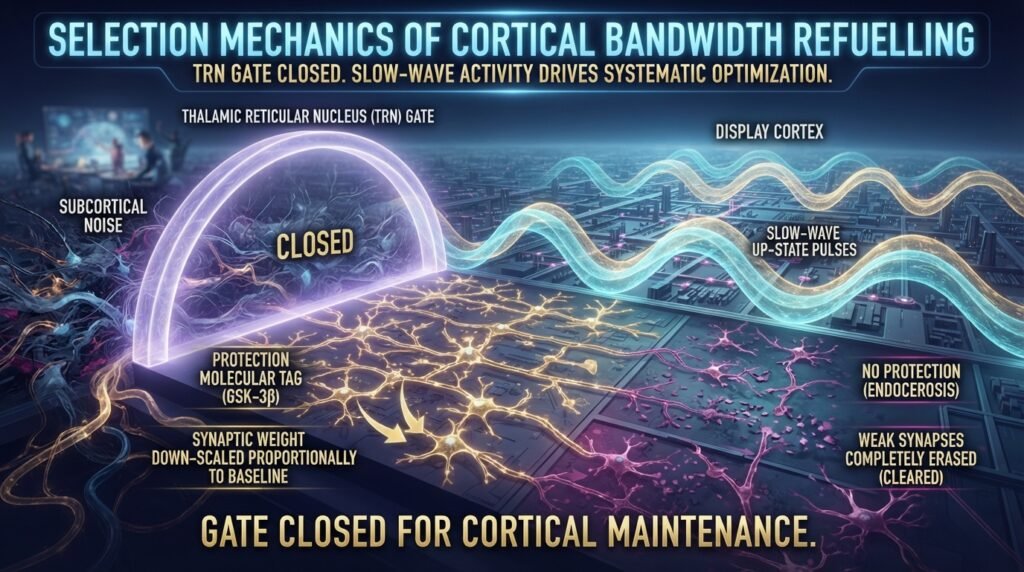
The downscaling process operates like an autonomous screen optimiser. It relies on a combination of electrical phase-locking and molecular tag systems to determine which paths are trimmed and which are entirely dropped from the active architecture.
The downscaling engine evaluates temporary pathways based on whether they are actively anchored by an organised subcortical driver during sleep, or if they are just floating, unanchored “static”.
| SLOW-WAVE UP-STATE (Electrical Pulse) | |
| Coherent Vector Drive. Synchronised to subcortical. Phase-locked firing. ▼ | Random / Weak Static. Unanchored, transient trace. Out-of-sync or silent. ▼ |
| PROTECTIVE MOLECULAR TAG. GSK-3β Phosphorylation. Synaptic weight drops proportionally to BASELINE. | NO PROTECTION (Endocytosis). Homer1a & Arc activate. AMPA receptors stripped. Signal throughput falls to ZERO (ERASED). |
A. The Proportional Trim: Stripped to Baseline
- The Biological State: These are the display pathways that were driven intensely during the day by high-priority subcortical nodes (e.g., a highly salient emotional vector from the amygdala or a sharp sensory loop from the thalamic nuclei).
- The Selection Mechanism: During Slow-Wave Sleep, the brain generates a massive, rhythmic electrical surge called an Up-State. The subcortical nodes reactivate these specific high-priority pathways in perfect synchrony with this global wave. Because these neurons fire in phase-locked harmony, they activate a protective molecular shield (driven by enzymes like GSK-3β).
- The Outcome: The protective tag prevents the pathway from being dismantled. Instead, it undergoes multiplicative downscaling. Its structural real estate is shrunk down proportionally to a stable baseline. The pathway is preserved with high structural integrity but its metabolic weight is reduced, maintaining its absolute position in psychextrics symbolic architecture while restoring future system elasticity.
B. The Total Wipe: Completely Erased
- The Biological State: These are the low-intensity, transient configurations left behind by ordinary behavioural clutter—stray thoughts, irrelevant ambient background noise, or unrepeated sensory frames.
- The Selection Mechanism: When the Slow-Wave Up-State pulses through the cortex, these pathways remain quiet or fire randomly out of sync. They completely lack a coherent subcortical driver to champion them. Because they do not match the global rhythm, they fail to trigger the protective tag.
- The Outcome: Without protection, immediate early genes (Homer1a and Arc) rapidly accumulate at these specific synapses. These proteins act like a targeted demolition crew, triggering AMPA receptor endocytosis—which physically strips away the receptors that allow information to pass across the channel. The signal throughput drops to absolute zero. The pathway dissolves back into unmapped cortical space, effectively erasing the behavioural clutter from the screen.
Under the Psychextrics framework, the selection process is a matter of Synchronised Resonance:
- Baseline Preservation: A high-salience subcortical vector maps out a pathway on the cortex screen during the day. At night, that vector replays the signal, locking it into the slow-wave rhythm. The display engine acknowledges its adaptive significance and drops its resolution to baseline to save power, but keeps the route saved.
- Complete Erasure: Random, unused, unanchored traces left on the display do not resonate with any subcortical driver during the slow-wave sweep. The display engine treats them as accumulated “pixel burn” or noise. The clearing mechanisms (Homer1a/Arc) wipe those pixels clean, freeing up raw physical real estate for the next day’s conscious rendering.
10. The Morning Reopening of Consciousness
With restoration complete, circadian chemistry once again shifts toward wakefulness. The behavioural gates reopen.
- The Thalamic Reticular Nucleus relaxes its widespread inhibition.
- The Diencephalic Thalamus resumes projecting behavioural reality.
- The Entorhinal Gateway resumes delivering indexed behavioural continuity.
- The Display Cortex once again illuminates the symbolic world.
To the conscious narrator, awareness appears simply to resume where it ended the previous evening. Within Psychextrics, however, an extraordinary transformation has occurred.
- The behavioural screen has been completely serviced.
- Bandwidth has been restored.
- Background noise has been reduced.
The symbolic interface has recovered its capacity to faithfully render another day’s behavioural civilisation.
Conclusion
The mechanics of cortical bandwidth refuelling reveal that sleep represents far more than biological inactivity. Within the Psychextric framework, it constitutes the organised restoration of the Behavioural Display Interface after an entire day of continuous symbolic projection.
While the Local-Functional Units and the Global System Cores continue preserving behavioural integrity beneath awareness, the Display Cortex temporarily withdraws from conscious rendering so that its architecture can be cleaned, recalibrated, and restored.
The Thalamic Reticular Nucleus (TRN) occupies the pivotal position within this nightly transition. By progressively closing the gates of thalamocortical display, it suspends the behavioural cinema long enough for cortical maintenance to proceed without interruption.
Through oscillatory down-states, synaptic recalibration, metabolic restoration, and intelligent behavioural selection, the cortex regains the bandwidth necessary to illuminate a new behavioural day.
Consciousness therefore awakens each morning not because behaviour has restarted, but because the behavioural screen has completed its night-time dry-cleaning and is once again prepared to render the ongoing architecture of behavioural reality.
Back to: 👇