
The Dual Gateways of the Revised Telencephalon: Establishing the Conscious Generator of the Somato-Valence Engine
BY: OMOLAJA MAKINEE
For much of modern Neuroscience, the cerebral cortex has been regarded as the executive summit of the nervous system. Perception, thought, voluntary action, language, and consciousness have traditionally been viewed as products generated within cortical tissue before descending to command the rest of the brain. Within this framework, the cortex occupies both the beginning and the end of behavioural processing.
Psychextrics proposes a fundamentally different architecture.
Once the Siencephalon is extracted from the classical Telencephalon, the revised Telencephalon becomes the Behavioural Display Interface rather than the behavioural constructor. The cortex receives behavioural reality after it has already been assembled from the Local Functional Units, integrated by the Global System Cores, emotionally authenticated by the Siencephalon, and consciously gated by the Diencephalon. Consciousness therefore appears upon the cortical screen after behaviour has already emerged beneath awareness.
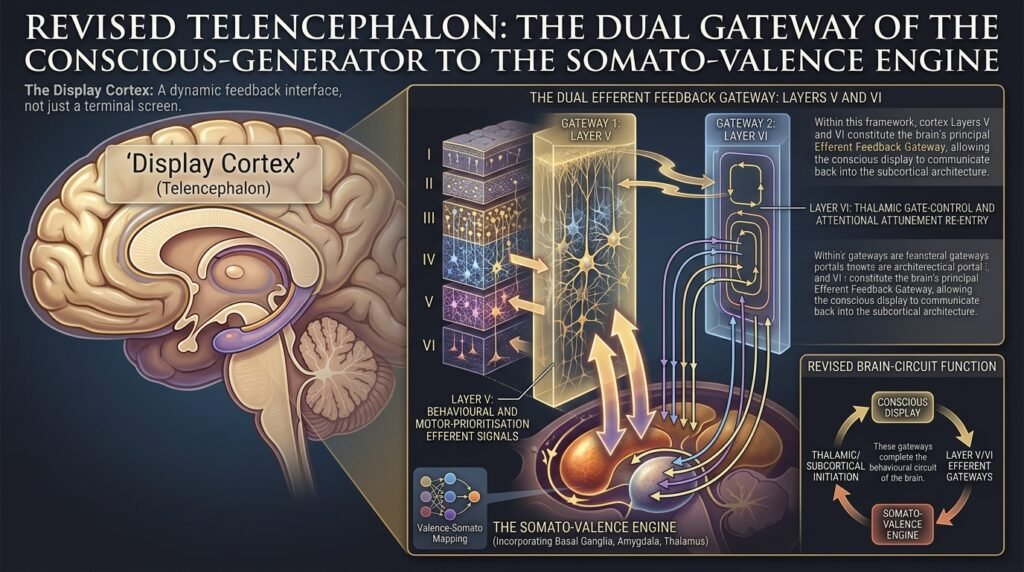
Yet the Display Cortex is not simply the terminal screen of behavioural civilisation. It also possesses two specialised gateways through which the conscious display continually communicates back into the subcortical architecture. These gateways—Layer V and Layer VI—complete the behavioural circuit of the brain.
Together they establish the revised Telencephalon as the dual gateway of the conscious-generator belonging to the Somato-Valence Engine.
1. The Display Cortex as a Behavioural Screen
The revised Telencephalon functions as the rendering surface of biological reality. It receives already-integrated behavioural information and transforms that information into the subjective experiences recognised as conscious life.
- Visual scenes become visible.
- Auditory frequencies become recognisable speech.
- Mechanical stimulation becomes tactile sensation.
- Compressed behavioural packages become symbolic thoughts.
- Integrated behavioural predictions become reflective simulations.
- Subcortical behavioural organisation becomes narrated experience.
The conscious self therefore does not observe raw neural computation. It observes a symbolic rendering generated after multiple cephalic systems have completed their respective biological responsibilities. The Display Cortex consequently resembles a sophisticated behavioural monitor.
Like every rendering interface, however, its importance does not end with presentation. Every advanced monitoring system also transmits information back toward the machinery responsible for future performance.
The cortex behaves similarly.
2. The Revised Meaning of a Gateway
Within Psychextrics, a gateway is not simply an anatomical passage through which neural signals travel.
A gateway is a specialised biological territory that regulates, formats, authorises, and redirects behavioural information as it crosses major architectural boundaries within the behavioural civilisation.
- The Myelencephalon governs the gateway of visceral vigilance.
- The Metencephalon governs the gateway of kinetic stability.
- The Mesencephalon governs the gateway of spatial orientation.
- The Entorhinal complex governs the gateway of behavioural continuity.
- The Olfactory-Bulb governs the gateway of chemically significant
- The Thalamus governs the gateway of conscious valuation.
The revised Telencephalon contributes a different category of gateway entirely. Rather than governing behavioural ascent, it governs behavioural return.
Its responsibility is not the generation of behavioural reality but the retrospective calibration of behavioural reality after conscious display has already occurred.
Within this framework, cortex Layers V and VI constitute the brain’s principal Efferent Feedback Gateway.
3. Why Layer V and Layer VI Are Genuine Gateways
Under the taxonomical laws of Psychextrics, Layer V and Layer VI satisfy every requirement necessary to qualify as gateways.
- Neither layer constructs present behaviour.
- Neither determines initial emotional valuation.
- Neither selects behavioural direction.
- Neither generates conscious illumination.
By the time their pyramidal neurons discharge, several events have already occurred.
- The Local Functional Units have completed behavioural construction.
- The amygdala has already assigned behavioural value.
- The Basal Ganglia and Subthalamic systems have already established behavioural direction.
- The Thalamus has already projected conscious awareness onto the cortical screen.
- The organism has already begun behaving.
- The conscious narrator has already started reading the behavioural display.
Layer V and Layer VI therefore never participate in the creation of the present moment. Instead, they inherit a completed behavioural product. Their biological responsibility begins only after reality has already been experienced.
This is precisely what distinguishes an Efferent Gateway from every preceding gateway within the six-cephalon architecture.
4. The Behavioural Timing of Consciousness
The temporal organisation of cortical processing demonstrates why consciousness cannot command immediate reactive behaviour.
When a behavioural event occurs, the ascending hierarchy has already completed its work before conscious awareness becomes available.
- Behaviour has been assembled.
- Behaviour has been emotionally weighted.
- Behaviour has been behaviourally indexed.
- Behaviour has been consciously displayed.
Only then do the descending cortical gateways become active.
Consequently, the cortex cannot prevent the initial behavioural response because the response belongs to an earlier biological phase. The descending gateways exist to improve future behaviour rather than alter present behaviour.
Consciousness therefore becomes biologically retrospective even while subjectively appearing immediate.
5. The Dual Gateway Architecture of the Revised Telencephalon
Once conscious experience appears upon the Display Cortex, behavioural civilisation immediately divides into two descending pathways.
- One pathway returns toward the Thalamus.
- The other returns toward the Local Functional Units.
Together they establish the dual gateway architecture of the revised Telencephalon.
- Layer VI forms the corticothalamic gateway.
- Layer V forms the corticofugal gateway.
Although both emerge from the same conscious display, each communicates with different biological systems and serves entirely different computational purposes.
6. Layer VI: Gateway of the Conscious Valuation
Layer VI projects primarily toward the Diencephalic Thalamus and the Thalamic Reticular Nucleus.
Its responsibility is not to alter the behavioural event that has already occurred. Instead, it recalibrates the machinery responsible for generating future conscious experience.
Through dense corticothalamic projections, Layer VI continuously informs the Thalamus about the accuracy, clarity, and behavioural usefulness of the recently displayed behavioural scene.
Collateral projections simultaneously engage the Thalamic Reticular Nucleus, allowing cortical feedback to regulate future sensory aperture, attentional allocation, oscillatory synchronisation, and thalamocortical gain.
Remarkably, corticothalamic fibres outnumber ascending thalamocortical fibres by approximately ten to one. This extraordinary anatomical asymmetry demonstrates that consciousness spends considerably more biological effort refining future perception than constructing present perception.
Within Psychextrics, Layer VI therefore functions as the conscious-refinement of the Somato-Valence Engine.
The Diencephalon generates consciousness. Layer VI is the conscious-mind that continually teaches the Diencephalon how that consciousness should be improved.
7. Layer V: Gateway of the Local Functional Units
Layer V serves an equally important but fundamentally different function. Rather than communicating primarily with the Thalamus, its enormous pyramidal neurons descend directly toward the Local Functional Units through the corticofugal system.
The corticofugal pathway represents the complete collection of descending cortical projections leaving the Display Cortex.
Individual branches terminate throughout the lower cephalic hierarchy.
- Corticotectal fibres communicate with the Mesencephalon.
- Corticorubral projections influence the red nucleus.
- Corticopontine fibres descend toward the Metencephalon.
- Corticobulbar projections terminate within the Myelencephalon.
- Corticospinal projections continue into the spinal cord.
These are not independent systems. They are specialised destinations within the larger corticofugal architecture.
Through this network, Layer V rebroadcasts conscious experience back into the behavioural engines responsible for future execution.
8. Retrospective Calibration Rather Than Immediate Control
The descending corticofugal system does not transmit commands for the behaviour already displayed. Instead, it performs retrospective calibration.
Suppose the Local Functional Units predicted a successful behavioural outcome. Suppose instead the organism stumbled, missed its target, or encountered an unexpected environmental obstacle. By the time consciousness recognises the discrepancy, the behavioural event has already ended.
Layer V captures the completed conscious experience. It translates symbolic awareness into biological correction.
The Local Functional Units subsequently modify future prediction thresholds, procedural expectations, kinetic timing, and survival templates.
Present behaviour remains unchanged. Future behaviour becomes more intelligent.
9. Two Gateways Serving One Behavioural Civilisation
The distinction between Layers V and VI reveals an important organisational principle.
Although both originate from the same conscious display, they influence different divisions of behavioural civilisation.
Layer VI communicates primarily with the Global System Cores. Its objective is to improve conscious valuation, attentional regulation, thalamocortical synchronisation, and behavioural awareness.
Layer V communicates primarily with the Local Functional Units. Its objective is to refine procedural execution, survival prediction, motor coordination, and behavioural adaptation.
Together they complete the downward half of behavioural civilisation.
One educates consciousness. The other educates behaviour.
10. The Closure of the Somato-Valence Engine
The Somato-Valence Engine does not terminate when conscious awareness appears. Its architecture achieves closure only after conscious experience has been rebroadcast into both the Diencephalon and the Local Functional Units.
The ascending hierarchy constructs behavioural reality. The descending hierarchy reconstructs behavioural intelligence.
- Every completed behavioural event therefore becomes biological instruction.
- Every conscious experience becomes behavioural data.
- Every reflective thought becomes future predictive architecture.
The organism continuously teaches itself without consciously realising that this teaching is occurring.
11. The Psychextric Law of Retrospective Calibration
The dual gateways of the revised Telencephalon establish one of the central laws of Psychextrics.
Consciousness cannot rewrite the present. It continually rewrites the future.
Behaviour always precedes awareness because the ascending hierarchy completes behavioural construction before conscious display appears.
Yet conscious display retains profound biological significance because every rendered experience immediately enters the descending calibration architecture.
- Layer VI continuously recalibrates the conscious-generator housed within the Diencephalic Thalamus.
- Layer V continuously recalibrates the multi-conscious behavioural generators embedded within the Local Functional Units.
Together they transform lived experience into progressively refined biological prediction.
Conclusion
The revised Telencephalon occupies a far more dynamic role than that traditionally assigned to the cerebral cortex. Rather than functioning as the executive origin of behaviour, it serves as the dual gateway through which conscious experience returns to the deeper behavioural architecture of the brain.
Layer VI operates as the gateway of the conscious-generator, continually refining the Diencephalic mechanisms responsible for conscious valuation, while Layer V functions as the gateway of the Local Functional Units, translating completed experience into biological instructions that refine future survival, movement, and orientation.
Through these complementary pathways, the Behavioural Display Interface completes the architecture of the Somato-Valence Engine.
Consciousness does not command behaviour into existence; it closes the behavioural loop by transforming the experience of the present into the predictive intelligence of the future.
The revised Telencephalon therefore represents not the beginning of human behaviour, but the biological gateway through which behavioural civilisation learns from itself.
Back to: 👇