
The Revised Telencephalon: The Display Cortex and the Shared Amygdala-Hippocampal Axis of the Six Cephalons
BY: OMOLAJA MAKINEE
The classical concept of the Telencephalon inherited an extraordinary burden. It was expected to explain conscious awareness, emotional regulation, episodic memory, behavioural planning, symbolic reasoning, language, executive control, and personality simultaneously.
As Neuroscience progressively revealed increasingly specialised subcortical systems, the traditional Telencephalon became less a coherent anatomical unit than a collection of functions that originated from multiple interacting structures.
Psychextrics resolves this architectural congestion by extracting the Siencephalon from the classical Telencephalon. Once this separation is made, the revised Telencephalon becomes structurally elegant and functionally precise. Its principal responsibility is no longer behavioural construction but behavioural display.
Memory indexing, emotional valuation, behavioural continuity, and relational integration become the responsibility of the Siencephalon, while the revised Telencephalon specialises in conscious rendering, symbolic translation, reflective narration, behavioural simulation, and perceptual visualisation.
This reconstruction raises an important neuroarchitectural question.
If emotional valuation and behavioural-memory have been reassigned to the Siencephalon, why does the Display Cortex maintain extensive direct communication with the amygdala-hippocampal axis?
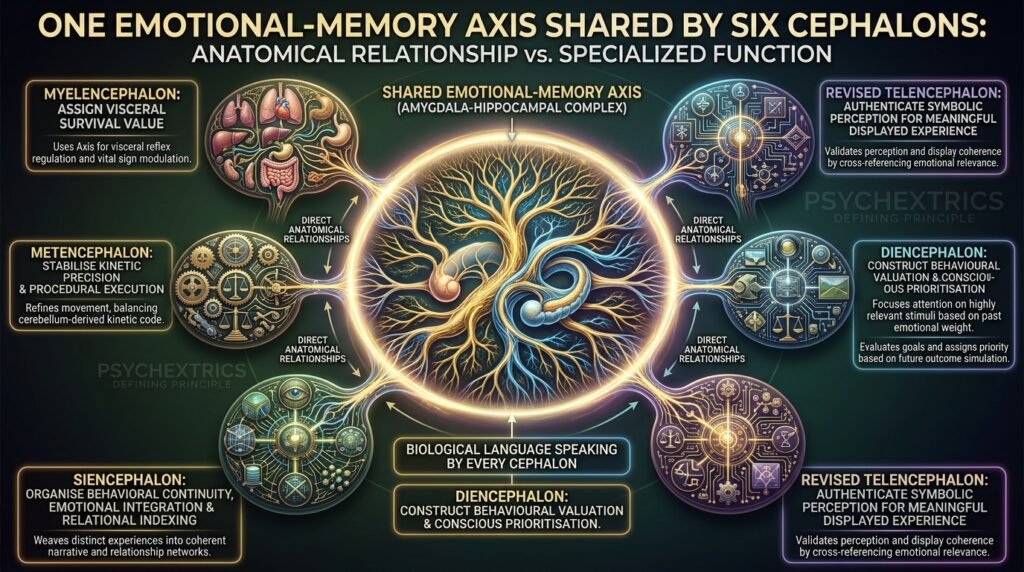
The answer reveals one of the central organisational principles of Psychextrics: every cephalon possesses its own direct relationship with the shared amygdala-hippocampal axis, but each employs that relationship for entirely different biological purposes.
1. The Behavioural Display Interface
Following the extraction of the Siencephalon, the revised Telencephalon primarily contains the sensory cortices, higher-order association cortices, symbolic integration fields, reflective narration systems, behavioural simulation networks, and the distributed architecture responsible for conscious visualisation. Collectively these structures form what Psychextrics identifies as the Behavioural Display Interface.
This designation fundamentally alters the role of the cortex.
- Rather than generating behaviour, it renders behaviour.
- Rather than constructing emotional significance, it symbolises emotional significance already computed elsewhere.
- Rather than storing behavioural continuity, it receives continuity already indexed within the Siencephalon.
Its evolutionary responsibility therefore becomes remarkably specialised. It transforms multidimensional biological computation into a species-specific symbolic experience that can be consciously observed.
The Display Cortex is consequently not the origin of consciousness but the interface through which consciousness becomes visible.
2. One Emotional-Memory Axis Shared by Six Cephalons
A defining principle of Psychextrics is that all six cephalons maintain direct anatomical relationships with the amygdala-hippocampal axis.
This shared access should not be mistaken for shared function. Each cephalon consults the same emotional-memory architecture while performing entirely different computational tasks.
- The Myelencephalon accesses the axis to assign visceral survival value.
- The Metencephalon accesses it to stabilise kinetic precision and procedural execution.
- The Mesencephalon accesses it to regulate orienting behaviour and environmental saliency.
- The Diencephalon consults it to construct behavioural valuation and conscious prioritisation.
- The Siencephalon uses it to organise behavioural continuity, emotional integration, and relational indexing.
- The revised Telencephalon employs the same axis to authenticate symbolic perception, allowing displayed experience to remain emotionally meaningful and behaviourally coherent.
The shared emotional-memory system therefore functions as the biological language spoken by every cephalon, even though each region applies that language toward its own specialised biological objectives.
3. Why the Display Cortex Requires Direct Amygdalar Access
Because consciousness depends upon behavioural authenticity rather than simple sensory representation, the Display Cortex cannot operate independently from emotional valuation.
Every perception appearing upon the cortical screen must immediately answer a fundamental biological question.
Does this perception matter?
That question is answered by the amygdala anchored at Layer I of the cortex.
The Display Cortex therefore maintains continuous bidirectional communication with the Basolateral Amygdala, allowing every symbolic representation to undergo immediate emotional authentication.
Without this relationship, conscious awareness would become emotionally detached from behavioural reality. Objects could still be recognised visually, sounds could still be processed acoustically, and language could still be decoded linguistically, but the resulting experience would lack behavioural significance.
The cortex therefore does not simply receive emotional information. It continuously negotiates emotional authenticity while constructing symbolic awareness.
4. The Laminar Organisation of Cortical-Amygdalar Communication
The remarkable precision of this communication becomes evident within the laminar architecture of the neocortex.
Communication between the Display Cortex and the amygdala is not distributed randomly across cortical tissue. Instead, ascending and descending information travels through highly specialised cortical layers that preserve the stability of conscious experience.
Descending communication originates primarily from the large pyramidal neurons occupying cortex Layers V and VI.
These neurons transmit highly processed symbolic information from the cortex back toward the Basolateral Amygdala. The descending projection continuously informs the amygdala about ongoing conscious interpretation, contextual reasoning, and behavioural expectations.
Ascending influence follows a different organisational strategy. Amygdalar projections terminate predominantly within Layers I, II, and portions of Layer V, where they modulate cortical excitability, attentional priority, vigilance, and symbolic interpretation.
This bidirectional arrangement creates a continuous authentication dialogue. The cortex symbolises. The amygdala validates. Together they stabilise conscious experience.
5. The Functional Contributions of Major Cortical Regions
Different cortical territories contribute unique forms of information to the amygdala.
The prefrontal cortex supplies behavioural context. Through projections arising primarily from the orbitofrontal and medial prefrontal cortices, conscious reasoning continuously informs emotional evaluation. Symbolic judgement therefore becomes capable of modifying behavioural significance.
The sensory association cortices contribute complex perceptual interpretation. Rather than transmitting raw sensory information, they deliver already-integrated representations of faces, voices, objects, and environmental events, allowing the amygdala to determine whether these higher-order patterns possess behavioural importance.
The insular cortex contributes interoceptive awareness. Internal bodily states—including hunger, respiration, visceral discomfort, and autonomic shifts—are integrated into emotional valuation through extensive insular-amygdalar communication.
Together these cortical systems transform emotional evaluation from a simple survival reflex into a sophisticated behavioural authentication process.
6. The High Road and the Low Road of Emotional Processing
This cortical communication operates alongside a second, evolutionarily older pathway.
The sensory thalamus projects directly toward the amygdala through rapid subcortical routes frequently described as the emotional “low road.” These pathways permit immediate defensive reactions before conscious awareness has fully developed.
Milliseconds later, the processed cortical interpretation arrives through the slower “high road.”
The amygdala therefore receives two parallel descriptions of reality.
- The first asks whether immediate survival action may be necessary.
- The second asks whether symbolic interpretation confirms or modifies that initial assessment.
The coexistence of these two routes explains how organisms can react instantly while simultaneously remaining capable of later reinterpretation.
7. The Display Cortex and Direct Hippocampal Communication
The revised Telencephalon also maintains extensive communication with the hippocampus.
Although most cortical information ultimately reaches the hippocampus through the Entorhinal Gateway, several direct pathways permit rapid behavioural synchronisation without traversing the complete multisynaptic memory circuit.
Layer III projections within the Entorhinal system establish direct access to the CA1 region and Subiculum.
Higher-order association cortices communicate through the parahippocampal and perirhinal regions, delivering integrated information concerning object identity, spatial organisation, and contextual relationships.
Long-range projections from prefrontal and medial parietal cortices establish monosynaptic communication with hippocampal structures responsible for immediate retrieval, behavioural schemas, and spatial navigation.
These connections ensure that conscious display remains continuously synchronised with behavioural continuity.
The cortex therefore does not simply remember the past. It continuously consults the hippocampal index while constructing present awareness.
8. The Longitudinal Organisation of Hippocampal Communication
Communication between the Display Cortex and hippocampus is further organised along the longitudinal axis of the hippocampus itself.
The anterior hippocampus preferentially communicates with emotional and executive cortical networks, supporting behavioural valuation, anticipation, and motivational organisation.
The posterior hippocampus interacts extensively with visual association cortices, parietal regions, retrosplenial fields, and the Default Mode Network, contributing to spatial orientation, environmental reconstruction, and behavioural continuity.
This graded organisation allows different categories of behavioural information to access specialised hippocampal territories while preserving overall coherence across conscious awareness.
9. Why Laminar Segregation Matters
The extraordinary specificity of cortical laminar organisation exists for a critical biological reason.
Consciousness requires stability.
If raw subcortical activity entered the principal sensory input layers indiscriminately, the Display Cortex would become overwhelmed by competing survival signals, behavioural memories, autonomic fluctuations, and sensory reflexes. Symbolic awareness would fragment into biological chaos.
Instead, cortical architecture confines descending authentication primarily to Layers V and VI while directing ascending modulatory influence toward Layers I and II.
This segregation allows behavioural construction to continue beneath awareness while permitting conscious display to remain coherent, emotionally weighted, and behaviourally meaningful.
The cortex therefore becomes insulated without becoming isolated. It remains continuously informed by deeper biological systems while preserving the symbolic stability required for conscious experience.
10. The Shared Axis as the Biological Language of Consciousness
The shared amygdala-hippocampal axis ultimately functions as the common biological language spoken by every cephalon.
- Each cephalon contributes different information.
- Each performs different computations.
- Each serves different evolutionary priorities.
Yet every one of them communicates through the same emotional-memory architecture before behaviour reaches conscious display.
The Display Cortex therefore represents the final interpreter rather than the original author of behavioural reality.
- It does not manufacture emotional value. It translates emotional value into conscious experience.
- It does not create behavioural continuity. It symbolises behavioural continuity.
- It does not construct memory. It renders memory into the narrative recognised as lived experience.
Conclusion
The revised Telencephalon represents one of the most significant structural refinements within Psychextrics. By separating the Siencephalon from the classical Telencephalon, the cortex becomes a dedicated Behavioural Display Interface whose primary responsibility is conscious rendering rather than behavioural construction.
Despite relinquishing responsibility for emotional integration and memory indexing, the Display Cortex maintains extensive bidirectional communication with the shared amygdala-hippocampal axis because conscious awareness cannot exist independently of behavioural authenticity.
This shared axis unifies all six cephalons into a single behavioural civilisation. Each cephalon consults the same emotional-memory architecture while pursuing its own specialised biological purpose, allowing survival, movement, orientation, valuation, continuity, and conscious representation to operate as distinct yet continuously coordinated processes.
The revised Telencephalon therefore stands not as the ruler of the brain but as its most sophisticated translator, converting the hidden computations of the entire cephalic hierarchy into the symbolic world that consciousness ultimately experiences as reality.
Back to: 👇