
Why Humans Believe in a Singular Self: The Thalamic Reticular Nucleus, Behavioural Gating, and the Construction of Unified Consciousness
BY: OMOLAJA MAKINEE
One of the most enduring assumptions in Philosophy, Psychology, and Neuroscience is that every human being possesses a single, unified conscious self directing perception, thought, memory, and behaviour.
Everyday experience appears to confirm this belief. We do not experience thousands of competing neural computations unfolding simultaneously. Instead, we experience a seamless stream of awareness. Our memories appear connected across time, our thoughts seem internally consistent, and our decisions feel as though they originate from one continuous observer.
This remarkable continuity gives rise to what most people simply call “I.”
Psychextrics proposes that this experience of a singular self is not evidence of a singular executive controller but rather the product of an extraordinarily sophisticated behavioural filtering architecture centred upon the Diencephalon.
Rather than consciousness emerging because one structure controls the entire brain, unified consciousness emerges because the Thalamus continuously compiles, synchronises, suppresses, prioritises, and formats enormous quantities of competing behavioural information before allowing only a small fraction of it to appear upon the Telencephalic Display-Cortex.
At the centre of this filtration system stands one of the most underestimated structures in behavioural Neuroscience: the Thalamic Reticular Nucleus (TRN).
Within the Psychextric framework, the TRN is not merely an inhibitory shell surrounding the Thalamus. It is the biological aperture that determines what reaches awareness and what remains permanently hidden beneath it.
By continuously suppressing background behavioural activity while amplifying selected behavioural streams, the TRN creates the powerful subjective illusion that consciousness originates from one unified thinker rather than from numerous cephalic systems operating simultaneously beneath awareness.
The singular self, therefore, is not the architect of consciousness but the final behavioural projection generated after an immense amount of subcortical editing has already occurred.
1. The Illusion of Unity
Human consciousness appears unified because behaviour reaches awareness in a highly stabilised form. At every moment, billions of neurons fire across multiple anatomical systems performing entirely different biological tasks.
- The Myelencephalon regulates visceral survival.
- The Metencephalon calculates posture, balance, and kinetic precision.
- The Mesencephalon constantly surveys spatial movement and environmental saliency.
- The Hypothalamus monitors internal chemistry for the Myelencephalon.
- The Siencephalon continuously packages behavioural continuity and memory.
Meanwhile countless autonomic adjustments occur throughout the body without conscious participation.
Despite this immense parallelism, subjective experience rarely reflects such complexity. Instead, awareness presents a single coherent scene. There appears to be:
- One observer.
- One train of thought.
- One internal voice.
- One continuous identity.
According to Psychextrics, this remarkable simplification does not occur because only one behavioural process exists. It occurs because the Thalamic system continuously filters competing behavioural streams into a single coherent behavioural narrative before they ever reach the cortical display.
2. The Diencephalon as the Behavioural Compiler
Within Psychextrics, the Diencephalon functions as the central behavioural compiler of the nervous system. Unlike lower Local Functional Units that specialise in highly specific survival operations, the Thalamus exists to organise behavioural complexity into coherent conscious representation. Every major behavioural channel eventually passes through specialised thalamic compartments before reaching the Telencephalic Display Interface.
This compiler does not simply relay sensory information.
- It categorises information.
- Weights behavioural significance.
- Determines urgency.
- Coordinates timing.
- Synchronises competing streams.
- Suppresses redundancy.
- Selects behavioural priority.
Only after these operations have been completed does information become eligible for conscious experience.
Rather than consciousness emerging directly from the cortex, the cortex displays the behavioural compilation produced by these thalamic mechanisms.
3. Parallel Architecture Beneath Unified Awareness
Although consciousness feels singular, the thalamic system itself is highly compartmentalised. Different nuclei continuously perform specialised computational roles simultaneously.
- The Anterior nuclei coordinate behavioural continuity and memory integration through extensive communication with the Siencephalic system.
- The Mediodorsal nucleus participates in higher-order behavioural strategy, contextual evaluation, and executive synchronisation.
- The Lateral nuclei organise sensorimotor transmission, habit execution, tactile processing, and spatial association.
- The Geniculate bodies continuously relay visual and auditory information.
- Intralaminar nuclei regulate vigilance, arousal, pain prioritisation, and behavioural readiness.
- Midline nuclei monitor visceral state and global homeostatic distress.
Each of these systems functions independently while remaining synchronised through the overall thalamic architecture.
Consciousness therefore emerges not because behavioural diversity disappears, but because behavioural diversity becomes continuously organised into a single display.
4. Reactive and Proactive Streams Within Consciousness
An important distinction within the Psychextric model concerns the coexistence of proactive and reactive processing inside the Diencephalon itself.
Not every thalamic nucleus participates equally in reflective consciousness. Most nuclei remain structurally devoted to reactive transmission from the lower Local Functional Units. Others maintain relative insulation from direct survival capture, allowing prospective behavioural simulation and symbolic evaluation to emerge.
Consequently, the conscious field contains both immediate reactive influence and slower proactive organisation. The observer experiences these different operations as one continuous self because their outputs converge before arriving at the cortical display.
The underlying diversity disappears beneath behavioural integration.
5. The Thalamic Reticular Nucleus: The Aperture of Consciousness
The most important mechanism responsible for this apparent unity is the Thalamic Reticular Nucleus.
Unlike virtually every other thalamic structure, the TRN does not project information directly to the cortex. Instead, it surrounds the entire thalamus like an inhibitory shell composed predominantly of GABAergic neurons.
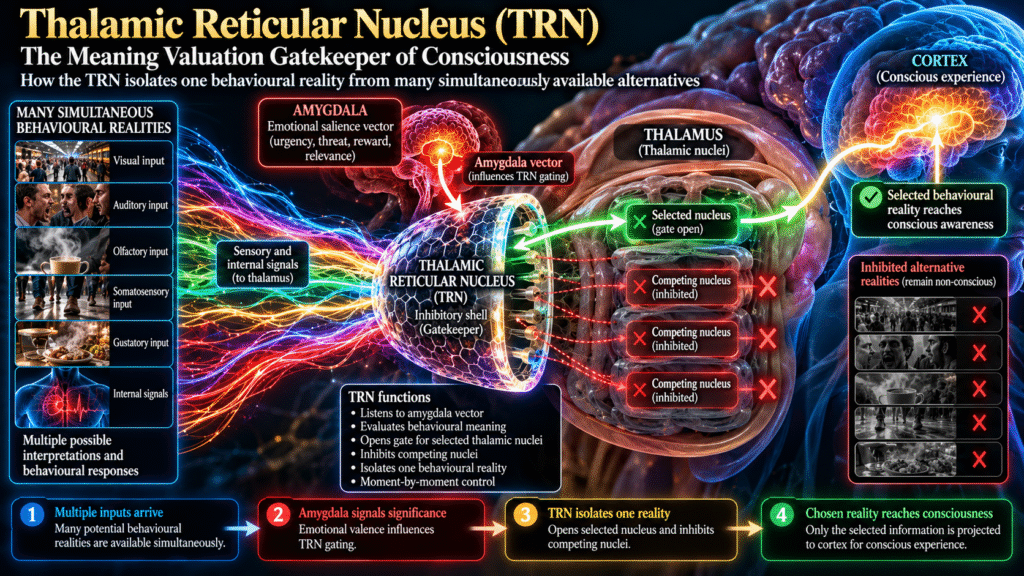
Within Psychextrics, the TRN functions as the behavioural aperture of consciousness. Just as the aperture of a camera determines how much light reaches photographic film, the TRN determines how much behavioural information reaches conscious awareness.
Its task is not to create experience. Its task is to prevent overwhelming experience. Without constant inhibitory regulation, countless behavioural streams would simultaneously compete for conscious representation.
The result would not be richer awareness. It would be behavioural chaos.
6. Dampening Behavioural Background Noise
At every moment, the organism generates enormous quantities of information.
- Internal organs report metabolic conditions.
- Muscles provide proprioceptive updates.
- Vestibular systems calculate equilibrium.
- Pain receptors monitor tissue integrity.
- Visual systems analyse movement.
- Auditory pathways monitor environmental change.
Most of this activity never enters awareness. Not because it is unimportant biologically, but because uninterrupted access to every behavioural computation would render coherent consciousness impossible.
The TRN continuously suppresses competing behavioural streams that lack immediate amygdala relevance. Only behaviour carrying sufficient biological priority from the amygdala survives this inhibitory filtering moment-by-moment.
The conscious self therefore experiences remarkable simplicity despite underlying computational complexity.
The silence experienced within ordinary awareness is not evidence that other behavioural systems are inactive. It is evidence that the TRN is successfully preventing them from overwhelming the behavioural cinema.
7. Selective Attention and Behavioural Isolation
This gating function explains one of the defining properties of consciousness: Selective Attention.
When reading a book inside a crowded café, thousands of auditory events reach the ears simultaneously.
- Conversations overlap.
- Coffee machines operate.
- Doors open and close.
- Music plays.
- Footsteps echo.
Yet awareness can become almost entirely devoted to the printed page.
The environment has not disappeared. The behavioural machinery processing those sounds has not stopped. Instead, inhibitory thalamic gating suppresses competing sensory streams, while remaining loyal to the emotional concentration of the amygdala vector by selectively amplifying one behavioural channel.
Attention therefore emerges not because consciousness expands, but because behavioural competition becomes temporarily resolved.
The TRN isolates one behavioural reality from many simultaneously available alternatives.
8. The Construction of a Singular Identity
The same mechanism responsible for Selective Attention also contributes directly to the construction of personal identity.
- Identity requires continuity.
- Continuity requires stability.
- Stability requires suppression of contradiction.
If every competing behavioural system expressed itself equally within awareness, no stable self could emerge. Instead, countless conflicting motivations, memories, emotional states, autonomic adjustments, and behavioural priorities would compete simultaneously for representation.
The TRN prevents this fragmentation.
By selectively regulating which behavioural packages receive cortical illumination at a particular frequency of amygdala vector, it allows one coherent narrative to dominate consciousness at any given moment.
This dominant behavioural narrative gradually becomes experienced as personal identity. The individual therefore mistakes behavioural continuity for behavioural authorship.
9. The Functional Typology of the Cognitive Compiler
Within the Psychextric framework, the Thalamus operates as a multi-compartment cognitive compiler whose specialised nuclei each process distinct dimensions of behavioural reality before those dimensions become conscious experience.
The Anterior Group maintains close integration with Siencephalic circuits responsible for emotional continuity, behavioural memory indexing, and motivational organisation.
- The Anteroventral nucleus relays compressed visceral information toward the cingulate system,
- the Anteromedial nucleus synchronises incoming sensory information with established emotional-memory configurations,
- while the Anterodorsal nucleus stabilises spatial continuity through extensive mammillary connectivity.
The Medial Group, particularly the Mediodorsal nucleus, anchors higher-order behavioural reasoning through extensive reciprocal communication with prefrontal cortical systems. Within Psychextrics, the MD-Parvocellular nuclei represents one of the principal proactive components supporting executive behavioural organisation.
The Lateral Group forms the largest behavioural relay territory.
- The Ventral Anterior and Ventral Lateral nuclei coordinate motor initiation and kinetic precision through communication with the Basal Ganglia and cerebellum.
- The Ventral Posterolateral and Ventral Posteromedial nuclei transmit somatosensory information from the body and face,
- while the Lateral Dorsal, Lateral Posterior, and Pulvinar nuclei integrate affective weighting, multimodal association, spatial attention, and behavioural saliency.
The Metathalamus, consisting of the Lateral and Medial Geniculate nuclei, specialises in visual and auditory relay, delivering organised sensory information toward their respective cortical display systems.
The Intralaminar Group maintains behavioural vigilance through continuous interaction with ascending brainstem systems. Structures including the Centromedian, Parafascicular, Central Medial, Paracentral, and Central Lateral nuclei sustain global cortical activation, pain prioritisation, and motor readiness.
The Midline Group serves as the principal homeostatic monitoring system. Among these structures, the Paraventricular nucleus functions as the major behavioural sentinel, integrating reactive information originating from lower Local Functional Units before distributing global distress weighting throughout the thalamic system.
Finally, surrounding every one of these compartments is the Thalamic Reticular Nucleus, acting as the inhibitory aperture regulating access to consciousness itself. Rather than generating behavioural content, it continuously shapes the contents of conscious experience by determining which behavioural streams remain silent and which become consciously illuminated.
Conclusion: The Behavioural Origin of the Self
The ordinary experience of possessing a singular conscious identity is therefore not the consequence of one anatomical structure acting as the supreme controller of behaviour. Instead, it emerges from continuous behavioural compilation.
Specialised thalamic nuclei independently process memory, movement, sensation, attention, emotion, arousal, and visceral state. The Thalamic Reticular Nucleus continuously suppresses competing behavioural activity, reducing enormous neurological complexity into one coherent behavioural projection.
The revised Telencephalon finally renders this compiled behavioural state into conscious awareness, allowing the individual to experience a seamless stream of thought, perception, and identity.
Within the Psychextrics framework, the self is therefore neither a biological commander nor an independent executive authority. It is the behavioural image projected after countless cephalic systems have negotiated, filtered, synchronised, and stabilised reality beneath awareness.
The singular “I” exists because the thalamic compiler continuously edits the behavioural world before it reaches consciousness, and because the Thalamic Reticular Nucleus relentlessly silences the background chorus of competing behavioural voices.
Consciousness does not reveal the full complexity of the brain; it reveals only the final behavioural performance that survives the gate.
Back to: 👇