
How the Thalamus Dictates Trauma: Why Shared Experiences Become Different Realities
BY: OMOLAJA MAKINEE
Trauma is often described as an emotional scar left by overwhelming experiences. Conventional explanations typically focus on the severity of an external event, assuming that sufficiently frightening situations automatically produce traumatic outcomes.
Yet everyday observation repeatedly challenges this assumption. Two individuals may stand side by side during the same event, witness identical sights and sounds, and later emerge with profoundly different psychological consequences. One may laugh about the experience for years, while the other develops persistent anxiety, avoidance behaviours, intrusive recollections, or physiological distress.
Within the Psychextrics framework, this divergence is not regarded as a mystery. Trauma is not defined solely by what objectively happens in the external world, but by how behavioural significance is assigned before conscious interpretation emerges. Behaviour precedes explanation, and emotional deployment precedes narrative. The organism reacts long before the conscious self understands what is occurring.
This principle becomes especially visible during traumatic experiences. Individuals frequently freeze before recognising danger, hyperventilate before identifying a threat, withdraw before constructing a reason, and experience overwhelming emotional flooding before language forms to explain the experience. Rather than demonstrating conscious control, trauma reveals the opposite. It exposes the architecture of preconscious behavioural construction.
The central proposition advanced by Psychextrics is therefore that trauma is fundamentally an act of Diencephalic valuation. While the Siencephalon faithfully records and indexes behavioural continuity, it is the Diencephalon—through its thalamic gating architecture—that determines the meaning assigned to an experience. That assigned meaning becomes the behavioural reality experienced by the organism.
1. Trauma Begins Before Conscious Recognition
Traumatic reactions rarely wait for conscious permission.
An unexpected sound, an abrupt movement, or a sudden social disruption immediately activates survival networks before the conscious mind has identified what is happening. The organism begins preparing for action while awareness is still attempting to determine whether any danger exists.
This sequence reflects the broader behavioural principle established throughout the Psychextrics model:
Behavioural activation precedes conscious narration.
When a traumatic trigger is encountered, the nervous system does not first ask whether the event deserves fear. Instead, behavioural systems rapidly compare incoming sensory information against previously established survival templates. Physiological mobilisation begins immediately, while consciousness gradually assembles an explanation afterward.
Consequently, trauma demonstrates that behavioural reality is constructed beneath awareness. The conscious self often discovers fear only after the body has already committed to behaving as though danger exists.
2. The Diencephalon as the Architect of Meaning
Within the proposed architecture of Psychextrics, the Siencephalon and Diencephalon perform complementary but fundamentally different functions.
The Siencephalon is responsible for preserving behavioural continuity. It packages behavioural experiences, indexes contextual relationships, and continuously rebroadcasts predictive memory into present perception. It provides continuity across time.
The Diencephalon performs an entirely different operation. Rather than storing behavioural history, it assigns behavioural meaning.
Every sensory packet ultimately reaching the revised Telencephalon passes through Diencephalic valuation systems before becoming consciously experienced, both new encoding of an engram and recalled memory. The thalamic relay does not merely transport information; it determines how that information will appear within conscious awareness.
The same sensory event can therefore produce entirely different behavioural realities depending upon the meaning assigned during this subcortical valuation process.
Within this framework, trauma is not simply remembered experience. Trauma is remembered meaning.
3. One Event, Two Different Realities
The distinction between objective events and subjective valuation becomes especially clear during shared public experiences.
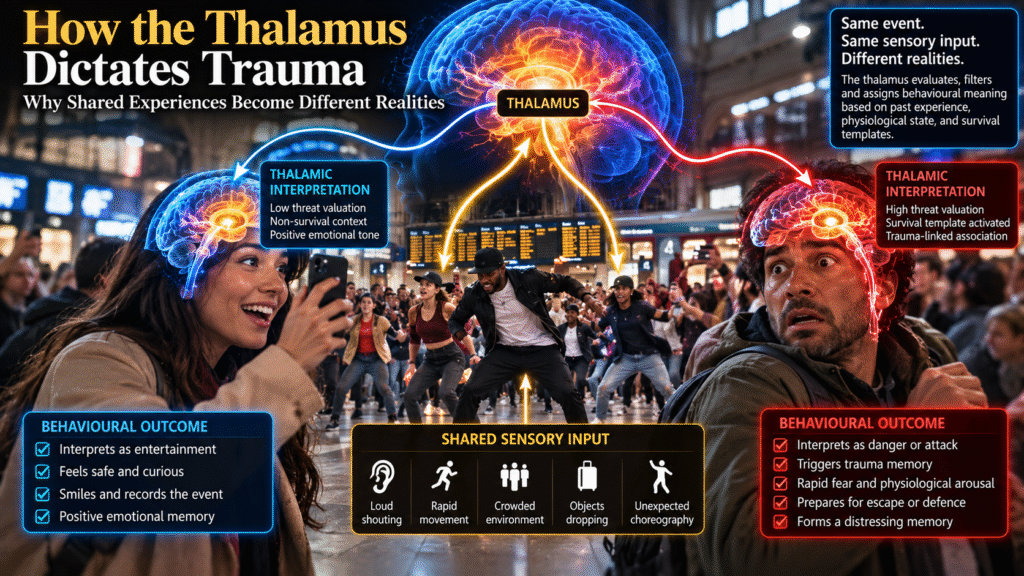
Imagine an unannounced flash mob unfolding inside a busy railway station. Without warning, individuals begin shouting, running, dropping objects, and suddenly performing a carefully choreographed dance routine. Hidden cameras record the reactions of unsuspecting pedestrians.
Every observer receives essentially the same sensory information. The acoustic environment changes abruptly. Movement increases dramatically. Social expectations are violated. Attention is instantly captured. Yet behavioural outcomes vary enormously.
One observer quickly interprets the disruption as harmless entertainment. The unexpected choreography appears humorous, creative, and emotionally refreshing. Curiosity replaces uncertainty. Smiles emerge. Mobile phones are lifted to record the performance. The event becomes a pleasant memory.
Standing only a few metres away, another observer experiences something entirely different.
Perhaps years earlier this individual survived a violent public assault or witnessed a mass emergency. Before conscious reasoning has sufficient time to analyse the scene, behavioural systems begin operating according to previously established survival templates.
Rapid shouting becomes interpreted as panic. Sudden movement resembles escape. Objects falling to the ground resemble violence. Crowd acceleration resembles imminent catastrophe.
Long before the prank is recognised as harmless, breathing accelerates, muscles tighten, heart rate rises, attention narrows, and overwhelming fear dominates conscious experience.
Objectively, both individuals witnessed the same event. Behaviourally, they inhabited entirely different realities.
According to Psychextrics, this divergence originates not within the event itself but within Diencephalic assignment of meaning.
4. How the Thalamus Assigns Behavioural Reality
The behavioural significance of incoming information depends upon how the Diencephalon evaluates it before conscious narration begins.
The Siencephalon contributes indexed behavioural continuity by supplying contextual relationships assembled from previous behavioural experience.
Simultaneously, incoming sensory information ascends through lower cephalic pathways toward specialised thalamic gating systems. These pathways converge upon Diencephalic relay structures responsible for determining urgency, behavioural relevance, and conscious priority.
Rather than projecting raw sensory information directly toward awareness, the thalamic system evaluates the behavioural significance of that information. If current sensory input sufficiently resembles previously established behavioural threat templates, high-priority gating rapidly dominates cortical representation.
Conscious awareness therefore receives not neutral sensory information but behaviourally weighted reality. The individual does not consciously choose to experience terror. The behavioural meaning has already been assigned.
5. The Visceral Pathway That Builds Emotional Reality
The assignment of behavioural meaning is continuously informed by communication between the body and the Diencephalon.
Visceral organs constantly transmit physiological information through specialised sensory pathways.
- Chemoreceptors monitor blood chemistry.
- Baroreceptors monitor cardiovascular pressure.
- Respiratory sensors monitor oxygen and carbon dioxide balance.
These signals ascend primarily through vagal pathways toward the Myelencephalon before being relayed through brainstem nuclei toward specialised thalamic systems.
Within the Psychextrics framework, this ascending pathway provides continuous information regarding the organism’s internal biological state. The Diencephalon therefore evaluates not only external sensory events but also the physiological condition accompanying those events.
Meaning emerges from the integration of both external and internal realities. An identical external event accompanied by stable physiology may be interpreted as harmless curiosity. The same event accompanied by rapidly escalating autonomic activation may become interpreted as immediate existential danger.
6. When Physiology Overwrites Conscious Experience
The influence of thalamic valuation becomes particularly apparent during acute physiological emergencies.
Consider an athlete running at maximum intensity.
Under normal circumstances, increasing oxygen-demand produces predictable physiological adjustments. Signals ascend from the cardiovascular and respiratory systems through the Myelencephalon toward higher regulatory centres. The Diencephalon coordinates adaptive responses through hypothalamic regulation while the Thalamus presents these physiological changes as ordinary exertion.
The conscious experience remains coherent. The runner simply experiences effort.
Now imagine oxygen delivery suddenly becomes compromised. Perhaps airway obstruction develops unexpectedly. Perhaps environmental oxygen rapidly decreases. The physiological situation changes immediately.
Within the Psychextrics model, hypothalamic systems recognise catastrophic deviation from metabolic stability and generate emergency signalling toward the thalamic gating architecture.
Rather than maintaining ordinary interoceptive representation, the Thalamus now prioritises survival.
Normal conscious activity is interrupted. The revised Telencephalic display becomes dominated by overwhelming suffocation. The conscious self experiences raw terror.
Importantly, the terror does not arise because the individual consciously reasons about oxygen deprivation. The terror appears because the Diencephalon has reassigned behavioural meaning. Physiological collapse becomes consciously experienced as existential threat.
7. Trauma as a Failure of Meaning Regulation
This perspective provides an alternative understanding of traumatic persistence.
Following an overwhelming experience, the Siencephalon faithfully preserves behavioural continuity through indexed memory. However, future encounters become traumatic only when thalamic valuation repeatedly assigns catastrophic significance to incoming sensory information.
The traumatic memory itself remains behaviourally inert until contemporary sensory information activates corresponding valuation systems.
Consequently, trauma is continually recreated rather than merely remembered. Each new encounter passes once again through the behavioural meaning architecture of the Diencephalon.
The organism therefore behaves toward the present according to meanings inherited from the past.
8. Implications for Behavioural Diagnosis
Within Psychextrics, behavioural diagnosis extends beyond analysing verbal reports or conscious recollections.
Because different thalamic nuclei contribute to distinct behavioural domains, disruptions in sensory experience, temporal continuity, or motor regulation may reflect alterations within specific gating systems rather than abnormalities of conscious awareness itself.
From this perspective, diagnostic interpretation shifts toward identifying where behavioural meaning assignment has become dysregulated.
- Sensory attenuation suggests compromised sensory gating.
- Temporal disorganisation suggests disruption of chronological integration.
- Motor dysregulation suggests instability within movement gating architectures.
The psychextrician therefore investigates behavioural architecture rather than subjective description.
Conclusion: The Sovereignty of Thalamic Valuation
The flash mob illustrates a profound principle running throughout the Psychextrics model.
The external event remains constant. The behavioural realities diverge.
One observer experiences spontaneous enjoyment. Another experiences genuine terror. The difference lies not in the choreography unfolding before them but in the meaning assigned before conscious interpretation begins.
According to Psychextrics, the Siencephalon faithfully preserves behavioural continuity by recording, organising, and rebroadcasting indexed experience. Yet those stored behavioural records remain functionally silent until the Diencephalon evaluates incoming sensory information and determines what behavioural significance should be assigned to it.
In this sense, trauma is governed as much by valuation as by experience itself. The objective event provides the sensory input, but the Diencephalon determines the behavioural reality that consciousness ultimately witnesses.
Within this framework, human suffering cannot be explained solely by external events. Behaviour is shaped by the interaction between memory continuity and present valuation, with the Thalamus acting as the principal gate through which experience acquires meaning.
By the time consciousness attempts to explain why fear has appeared, the behavioural architecture has already completed its work, leaving the conscious self to narrate a reality that has already been assigned beneath awareness.
Author’s Note: The assignment of exclusive “meaning” functions to the Thalamus, the proposed diagnostic architecture, and the specific routing model, extend beyond current mainstream Neuroscience and should be understood as components of the Psychextrics theoretical model rather than established scientific consensus.
Back to: 👇