
The True Executive Nuclei: From Structural Autonomy to Behavioural Prognosis
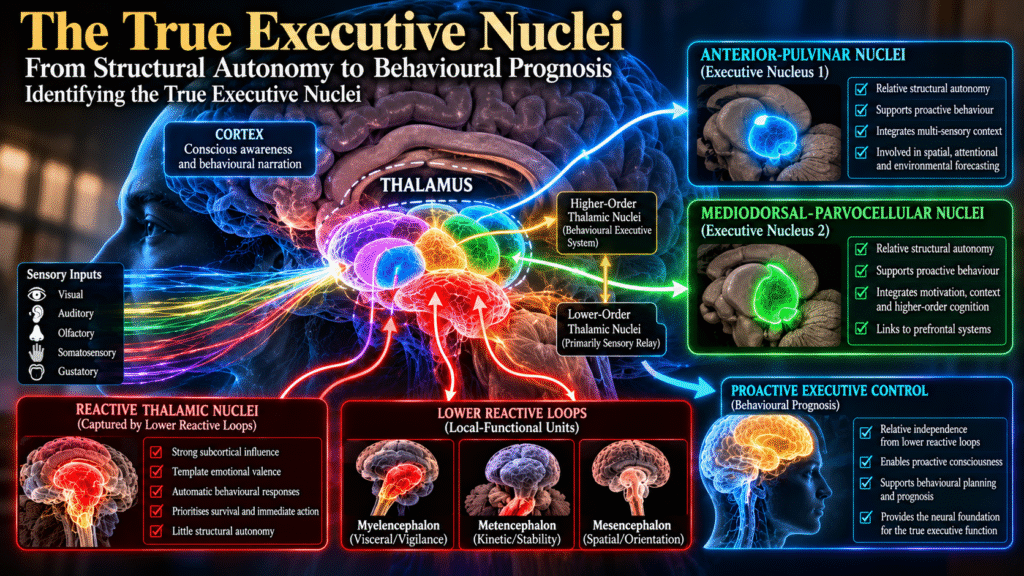
Identifying the True Executive Nuclei
BY: OMOLAJA MAKINEE
If proactive consciousness depends upon relative structural independence from the lower reactive loops, then a fundamental anatomical question naturally follows:
Which thalamic nuclei possess the greatest degree of functional autonomy?
Within the Psychextrics framework, the answer does not depend upon which nuclei are the most anatomically connected, but upon which are the least constrained by deterministic survival circuits. Every thalamic nucleus participates in behavioural integration to varying degrees, yet not every nucleus enjoys the same freedom to participate in prospective behavioural modelling. Many remain committed to specialised sensory, motor, emotional, or autonomic responsibilities inherited through their close relationships with the lower Local-Functional Units (LFUs).
Consequently, Psychextrics distinguishes between nuclei that primarily relay specialised biological operations and those capable of supporting higher-order behavioural coordination. Executive capacity is therefore interpreted as a spectrum of structural autonomy rather than an absolute property possessed by the thalamus as a whole.
From this perspective, the thalamic architecture resembles an administrative system composed of specialised departments. Some divisions remain permanently occupied with maintaining the organism’s immediate biological requirements, while others retain sufficient independence to coordinate planning, behavioural flexibility, and symbolic organisation across multiple systems simultaneously.
This distinction becomes particularly important when attempting to explain why conscious planning sometimes succeeds yet sometimes collapses under pressure. The answer lies not within consciousness itself, but within the anatomical relationships between these executive nuclei and the reactive systems surrounding them.
1. Mapping Structural Independence Across the Thalamus
When the principal thalamic nuclear groups are examined according to their direct relationships with the lower cephalic gateways, a striking organisational pattern begins to emerge.
Several nuclei remain heavily integrated with visceral regulation, autonomic maintenance, first-order sensory relay, or automatic motor coordination. Their principal responsibility is not behavioural deliberation but biological continuity. Their activity is therefore constrained by specialised survival circuitry that evolved to guarantee rapid adaptation rather than flexible reflection.
The Anterior Thalamic Group, for example, maintains extensive reciprocal communication with hypothalamic and mammillary systems involved in memory, emotion, and autonomic regulation. Although highly sophisticated, these nuclei remain deeply embedded within subcortical behavioural networks and therefore cannot be regarded as completely insulated executive structures.
Likewise, the ventral thalamic nuclei participate extensively in motor coordination through their relationships with basal-ganglia and cerebellar systems. Their contribution is indispensable for smooth movement, yet their computations remain closely tied to automatic motor regulation rather than independent behavioural planning.
The ventral posterior nuclei exhibit a similar pattern within the sensory domain. Acting as primary gateways for somatosensory information ascending from the lower brainstem, they faithfully transmit bodily information toward the cortex while remaining structurally committed to first-order sensory processing.
Other groups, including the intralaminar nuclei and much of the midline complex, function primarily as regulators of arousal, vigilance, pain, and motivational state. Their architecture serves the continuous maintenance of organismic readiness rather than the generation of flexible behavioural simulations.
Viewed collectively, these nuclei demonstrate the remarkable diversity of thalamic organisation. Rather than operating as a single executive centre, the thalamus consists of multiple specialised systems, each occupying a different position along the continuum between reactive necessity and prospective behavioural flexibility.
2. The Mediodorsal Parvocellular Nucleus
Against this broader anatomical landscape, one nuclear group assumes particular importance within the Psychextrics model.
The Mediodorsal Parvocellular nucleus occupies a comparatively insulated position relative to many neighbouring thalamic systems. Rather than functioning as a first-order sensory relay or a direct extension of lower motor circuitry, it participates predominantly in reciprocal communication with association regions responsible for executive organisation, active memory, behavioural sequencing, and cognitive flexibility.
Within Psychextrics, this relative independence makes the Mediodorsal Parvocellular nucleus one of the principal candidates for supporting proactive behavioural organisation.
Because its computations are not dominated by continuous autonomic emergencies or rapid survival reflexes, it possesses the temporal stability required for maintaining prospective behavioural simulations over extended periods. Competing possibilities may be compared, behavioural alternatives evaluated, and symbolic representations maintained without constant interruption from immediate physiological demands.
This capacity does not imply unlimited authority over the organism. Rather, it provides a structural platform upon which proactive consciousness can emerge as an organised behavioural process rather than merely a reactive survival mechanism.
3. The Anterior-Pulvinar and the Coordination of Conscious Attention
A second executive network emerges through the remarkable expansion of the Lateral Pulvinar Group: Consisting of the (Anterior, Inferior, Lateral, and Medial) Pulvinar.
Although maintaining evolutionary connections with the superior-colliculus of the Mesencephalon and visual orienting systems, the Pulvinar Group has undergone extraordinary development in the human brain. Its extensive reciprocal communication with widespread association cortices allows it to coordinate complex patterns of attentional selection extending far beyond innate visual tracking.
Within the Psychextrics framework, this broad connectivity grants the Anterior-pulvinar considerable freedom from direct domination by lower survival loops.
Instead of merely detecting environmental change, it contributes to organising conscious attention across multiple behavioural domains simultaneously. Competing sensory streams may be prioritised, contextual relationships coordinated, and behavioural focus redistributed according to ongoing cognitive demands rather than immediate survival alone.
Together with the Mediodorsal Parvocellular nucleus, the Anterior-pulvinar represents an anatomical foundation upon which proactive consciousness can coordinate behaviour without being completely overwhelmed by continuously changing subcortical emergencies.
These two executive systems therefore occupy a distinctive position within the behavioural hierarchy. They do not abolish reactive processing, but they provide the structural flexibility necessary for negotiating with it.
4. Executive Behaviour as Negotiation Rather Than Domination
One of the central implications of this architecture is that executive behaviour should not be interpreted as absolute control over the lower brain.
Instead, conscious organisation resembles continuous negotiation between relatively autonomous thalamic systems and deeply embedded reactive networks that evolved for immediate biological survival.
Under ordinary conditions this negotiation proceeds smoothly. Prospective simulations generated within the higher behavioural architecture remain sufficiently synchronised with lower cephalic processing to produce the subjective impression of unified conscious control.
During high emotional load, however, the balance shifts.
As reactive pathways accelerate through specialised Local-Functional Units, the behavioural authority available to proactive systems progressively narrows. The executive nuclei continue generating organised behavioural strategies, yet the lower cephalic hierarchy increasingly dictates which of those strategies remain biologically executable.
Consciousness therefore experiences itself as losing control not because executive systems disappear, but because their negotiating position within the behavioural hierarchy becomes progressively weakened by rapidly escalating survival computations occurring beneath awareness.
5. The Role of the Psychextrician
This structural interpretation fundamentally reshapes the role assigned to behavioural analysis.
Within Psychextrics, the objective of the psychextrician is not merely to interpret verbal reports, personality descriptions, or subjective introspection. Language represents only the symbolic surface displayed after deeper behavioural computations have already taken place.
Instead, the psychextrician attempts to reconstruct the hidden architecture responsible for producing observable behaviour.
This analytical process begins by identifying the individual’s dominant reactive vectors. Rather than asking only what a person says they intend to do, attention is directed toward determining which Local-Functional Units repeatedly assume behavioural control under specific environmental conditions.
- Patterns of Hypothalamic activation reveal characteristic autonomic tendencies.
- Subthalamic disruption exposes recurrent kinetic vulnerabilities.
- Epithalamic modulation highlights characteristic patterns of attentional withdrawal, environmental avoidance, or behavioural inhibition.
Together these reactive signatures reveal the underlying structural landscape beneath conscious narration.
The second stage of analysis focuses upon the behavioural buffer systems established through experience. Here the psychextrician evaluates the degree to which epigenetic adaptation has strengthened or weakened resistance to emotional disruption. Repeated behavioural exposure, environmental conditioning, and experiential learning gradually reshape these buffering mechanisms, altering the stability with which proactive organisation can withstand reactive interference.
Finally, these observations are synthesised into a behavioural prognosis.
Rather than predicting behaviour from personality labels or subjective intentions, the Psychextrics framework proposes forecasting behaviour by estimating where structural friction is most likely to emerge between proactive organisation and reactive deployment.
Under this approach, behavioural prediction becomes an exercise in modelling architectural stability rather than interpreting conscious declarations.
Conclusion: Behaviour as an Architectural Problem
The broader implication of this framework is that behavioural reliability depends less upon conscious determination than upon the structural relationship between executive organisation and reactive biological architecture.
Individuals frequently believe they possess complete control over future actions because prospective simulations generated within executive thalamic systems appear coherent, organised, and internally convincing. Yet these simulations remain constrained by the deeper biological architecture that ultimately governs behavioural deployment under changing environmental conditions.
The apparent unity of conscious intention therefore conceals a continuous negotiation occurring beneath awareness, between proactive planning and reactive survival.
Within Psychextrics, this negotiation becomes the central object of Behavioural science. Human action is interpreted neither as unrestricted freewill nor as rigid biological determinism, but as the dynamic interaction between structurally autonomous executive systems and specialised reactive networks operating across the cephalic hierarchy.
The task of the psychextrician is to reveal this hidden architecture, identify where stability exists, determine where behavioural fracture is most likely to occur, and construct a structural prognosis capable of explaining not merely what individuals believe they will do, but what their cephalic organisation makes possible when behaviour is finally called upon to emerge.
Back to: 👇