
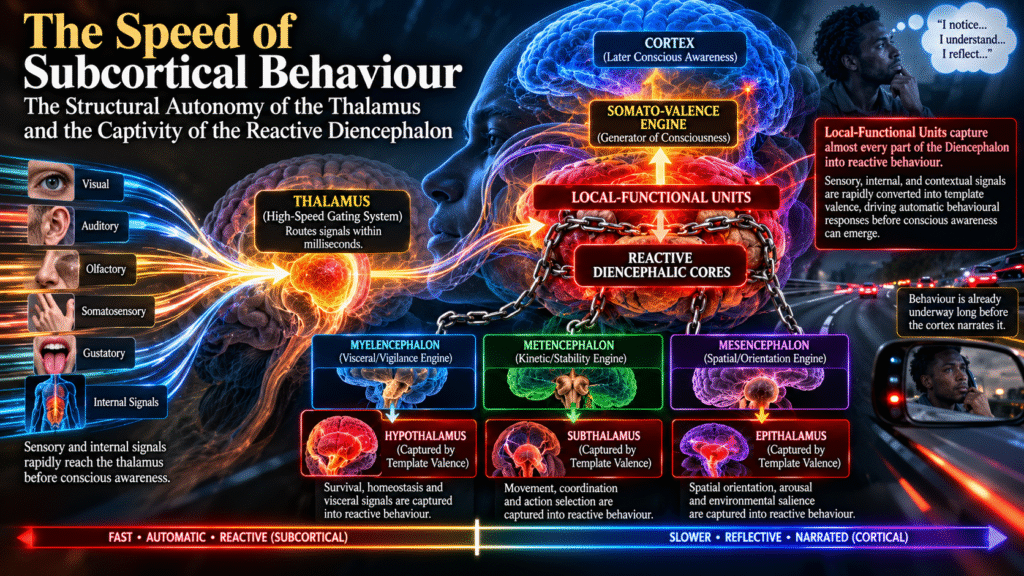
The Speed of Subcortical Behaviour: The Structural Autonomy of the Thalamus and the Captivity of the Reactive Diencephalon
BY: OMOLAJA MAKINEE
One of the enduring assumptions in modern Neuroscience is that conscious awareness occupies the highest level of behavioural control. Although many unconscious processes are acknowledged, the prevailing picture still portrays consciousness as the executive authority that ultimately decides which behaviours will occur.
Within this framework, subcortical structures are often viewed as supportive mechanisms that supply information to a conscious brain capable of overriding instinct whenever circumstances require.
The Psychextrics framework proposes a fundamentally different architecture. Rather than placing consciousness at the beginning of behavioural construction, it locates conscious awareness near the end of an already unfolding biological process.
Behaviour emerges through a hierarchy of cephalic systems operating at different temporal scales, each contributing specialised computations before awareness ever encounters the finished behavioural product. Consciousness therefore observes a reality that has already undergone multiple stages of survival analysis, emotional weighting, spatial organisation, motor preparation, and contextual integration.
This temporal separation explains why subcortical behaviour consistently outpaces conscious explanation. Long before the conscious narrator identifies danger, the organism has already begun adjusting posture, shifting attention, modifying autonomic tone, preparing muscles, and selecting behavioural priorities.
The conscious mind eventually experiences these adjustments as if they were its own deliberate decisions, yet according to Psychextrics, they are the visible consequences of computations completed beneath the threshold of awareness.
Understanding this behavioural precedence requires examining the internal organisation of the Diencephalon itself. Rather than functioning as a single homogeneous centre, Psychextrics distinguishes between nuclei devoted primarily to prospective behavioural coordination and neighbouring nuclei structurally dedicated to immediate survival deployment.
This distinction forms the foundation of what the theory describes as the architectural split between proactive and reactive processing.
1. Why Subcortical Behaviour Always Arrives First
Biological survival depends upon speed. Every organism must constantly evaluate whether its environment contains opportunity or danger while simultaneously maintaining physiological stability. Waiting for conscious deliberation before every behavioural adjustment would impose unacceptable delays upon systems responsible for maintaining life.
For this reason, the lower cephalic hierarchy operates through rapid recursive loops that continuously process incoming information beneath conscious awareness. These systems perform four fundamental operations simultaneously.
- First, they prioritise survival by continuously monitoring physiological stability and environmental threat.
- Second, they negotiate saliency by determining which incoming signals deserve immediate behavioural attention.
- Third, they integrate behavioural continuity by ensuring that posture, movement, memory, and environmental orientation remain coherent despite constantly changing sensory conditions.
- Finally, they stabilise prediction by comparing present circumstances with inherited biological templates and accumulated behavioural experience.
These computations occur continuously regardless of whether the individual becomes consciously aware of them. Consciousness enters only after these operations have already produced an integrated behavioural state suitable for symbolic interpretation.
Within the Psychextrics model, the speed difference between these systems is not accidental. Symbolic consciousness necessarily requires behavioural translation. Before awareness can say, “I am frightened,” the organism must first determine that a threat exists, adjust physiology accordingly, alter motor readiness, and establish behavioural priority. Only then can the conscious narrator transform these biological events into language.
Behaviour therefore consistently precedes explanation because biological execution operates at a fundamentally different computational level from symbolic narration.
2. The Architectural Division Within the Diencephalon
The speed advantage of subcortical behaviour raises an important structural question.
If reactive systems operate with such overwhelming efficiency, how can deliberate planning ever emerge?
Psychextrics answers this question by proposing that the Diencephalon itself contains two fundamentally different organisational domains.
- The first comprises thalamic nuclei responsible for prospective behavioural organisation. These nuclei participate in constructing future-oriented simulations, coordinating higher-order behavioural planning, and maintaining symbolic continuity with the revised Telencephalic display interface.
- The second comprises the Hypothalamic, Subthalamic, and Epithalamic complexes, which remain directly coupled to specialised lower cephalic survival systems. Their function is not to simulate future possibilities but to execute immediate physiological and behavioural adjustments whenever environmental conditions demand rapid action.
This distinction creates two complementary behavioural architectures operating within the same anatomical region.
The proactive superstructure consists principally of thalamic systems capable of sustaining recursive behavioural modelling across extended temporal horizons. These nuclei support planning, evaluation, behavioural sequencing, and symbolic organisation.
Alongside them exists the reactive receptacle matrix. The Hypothalamus, Subthalamus, and Epithalamus remain structurally coupled to specific lower cephalic gateways responsible for visceral regulation, kinetic stability, and spatial orientation. Their computations are immediate rather than reflective, biological rather than symbolic, and survival-driven rather than prospective.
From the perspective of Psychextrics, these two architectures coexist because biological organisms must simultaneously survive the present while preparing for the future.
3. The Captivity of the Reactive Diencephalon
The concept of captivity describes the degree to which particular Diencephalic structures remain structurally bound to specialised lower cephalic processing loops.
Unlike prospective thalamic processing, these nuclei cannot freely construct behavioural simulations detached from immediate physiological demands. Their computations remain anchored to inherited survival templates and ongoing environmental conditions.
| MYELENCEPHALON (Visceral/Vigilance Engine) | ├────►│ | HYPOTHALAMUS (Captured by Template Valence) |
| METENCEPHALON (Kinetic/Stability Engine) | ├────►│ | SUBTHALAMUS (Captured by Template Valence) |
| MESENCEPHALON (Spatial/ Orientation Engine) | ├────►│ | EPITHALAMUS (Captured by Template Valence) |
A. The Hypothalamus and the Myelencephalic Axis
Within this framework, the Hypothalamus functions as the principal neuroendocrine extension of the Myelencephalon’s survival vigilance architecture.
Whenever lower brainstem systems detect physiological instability, the Hypothalamus rapidly deploys endocrine and autonomic adjustments that preserve internal equilibrium. Blood pressure regulation, stress hormone mobilisation, cardiovascular acceleration, thermoregulation, and metabolic adaptation occur without waiting for symbolic evaluation.
Rather than deliberating between behavioural alternatives, this axis operates through immediate biological necessity. Its primary responsibility is maintaining organismic viability, not generating conscious choice.
Consequently, conscious awareness frequently discovers Hypothalamic activation only after visceral changes have already begun.
B. The Subthalamus and the Metencephalic Axis
The relationship between the Subthalamus and the Metencephalon illustrates another specialised survival partnership.
The Metencephalon continuously evaluates posture, coordination, balance, and kinetic stability. Whenever unexpected mechanical disruption threatens ongoing movement, these computations rapidly engage subthalamic circuits associated with Basal Ganglia regulation.
Within the Psychextrics framework, this partnership permits immediate interruption, redirection, or stabilisation of motor behaviour before higher symbolic systems have completed conscious interpretation.
A sudden loss of balance, unexpected obstacle, or rapid postural disturbance therefore initiates corrective behaviour through deeply integrated kinetic loops operating independently of conscious narration.
Only after the corrective movement has begun does awareness reconstruct the behavioural sequence into a coherent explanation.
C. The Epithalamus and the Mesencephalic Axis
The Epithalamus forms the third major reactive partnership.
Its behavioural relationship with the Mesencephalon allows rapid environmental saliency to influence broader neurochemical regulation before detailed conscious recognition occurs.
Within this framework, low-resolution visual changes, unexpected auditory signals, or abrupt alterations in environmental geometry immediately influence behavioural orientation and avoidance systems through habenular and associated epithalamic pathways.
Instead of waiting until conscious perception identifies the stimulus, behavioural priority is adjusted almost instantly according to inherited and learned survival templates.
This rapid modulation allows organisms to redirect attention toward potentially significant environmental changes without sacrificing valuable reaction time to prolonged symbolic analysis.
Conclusion: The Relative Autonomy of the Thalamus
Against this background of tightly coupled reactive systems, the Thalamus occupy a distinctive position within the cephalic hierarchy.
Psychextrics does not describe the Thalamus as completely independent of lower behavioural systems. Rather, it proposes that specific thalamic networks possess a comparatively greater degree of structural autonomy because they are not uniformly bound to any single Local-Functional Unit.
This relative freedom permits the generation of behavioural simulations extending beyond immediate survival requirements.
Instead of responding exclusively to ongoing physiological demands, these thalamic systems participate in evaluating possible futures, maintaining behavioural continuity across time, comparing competing alternatives, and coordinating long-range strategies before movement is finally deployed.
This autonomy makes proactive consciousness possible.
Rather than functioning solely as another survival reflex, the Thalamus becomes capable of negotiating between competing behavioural possibilities while simultaneously interacting with the Siencephalon’s integrated behavioural packages and the revised Telencephalic display interface.
Within the Psychextrics model, conscious intention therefore represents neither unrestricted executive authority nor complete behavioural helplessness. It emerges from a structurally autonomous—but not absolutely independent—thalamic architecture attempting to coordinate biological systems that evolved primarily for rapid survival rather than reflective deliberation.
As the behavioural hierarchy ascends toward conscious awareness, this balance between reactive necessity and proactive organisation becomes increasingly evident. Understanding precisely which thalamic nuclei remain relatively insulated from lower survival loops, and how those specialised nuclei contribute to executive behavioural coordination, provides the next step in explaining how symbolic consciousness acquires its remarkable—but ultimately limited—capacity for prospective behavioural control.
Back to: 👇