
Emotional Activation Before Consciousness: Why the Organism Feels Before the Mind Understands
BY: OMOLAJA MAKINEE
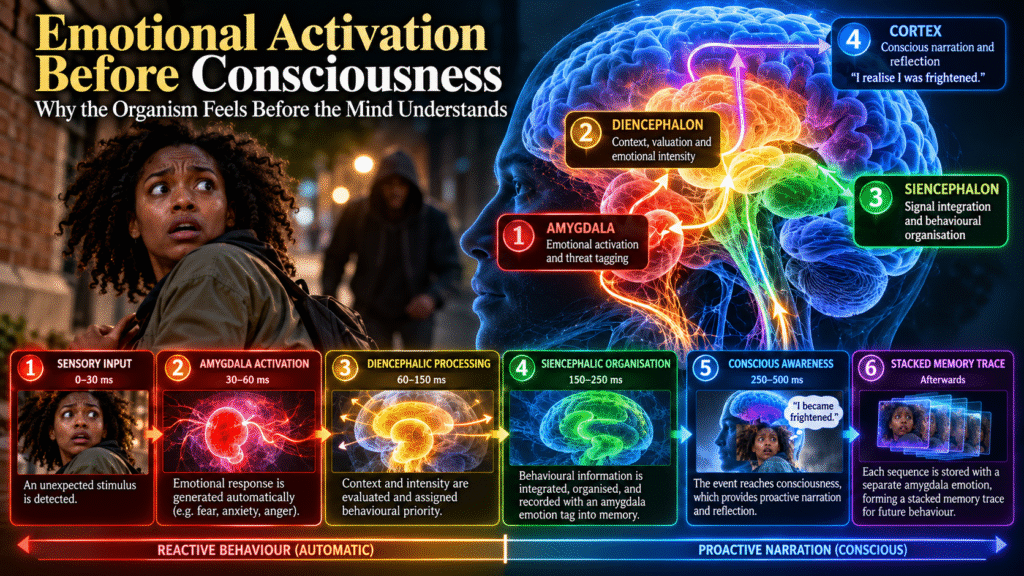
One of the greatest assumptions about human consciousness is that emotion begins at the moment we become aware of it. We instinctively believe that we first recognise a feeling and then respond to it. We say, “I became frightened,” “I suddenly felt anxious,” or “I realised I was angry,” as though consciousness were the birthplace of emotional experience.
Yet everyday life repeatedly contradicts this assumption. A loud bang causes the body to jolt before the mind identifies the source. A stranger evokes immediate attraction before any conscious reasoning begins. Disgust emerges before explanation, while anxiety often settles into the body long before the individual can articulate its cause.
These experiences suggest that emotional life unfolds on a timescale that precedes conscious awareness. The organism appears to know something before the conscious self does.
Within the Psychextrics framework, this observation is not treated as an illusion or an anomaly. It is regarded as one of the defining characteristics of behavioural organisation. Emotion is not viewed as the product of reflective consciousness but as the consequence of biological systems that continuously evaluate, prioritise, and organise behavioural significance beneath awareness.
By the time consciousness encounters an emotional state, the organism has already completed a substantial amount of behavioural work.
Rather than constructing emotion, consciousness discovers it.
1. Behaviour Before Feeling
The traditional tendency to place consciousness at the centre of emotional experience overlooks an important biological reality. Every moment, the organism is bombarded by enormous quantities of sensory, visceral, hormonal, and environmental information. Waiting for conscious deliberation before responding to every event would impose an intolerable delay upon survival.
Evolution therefore favours systems capable of making rapid behavioural decisions before reflective awareness has an opportunity to intervene.
Within Psychextrics, emotional activation represents precisely this form of rapid behavioural organisation. Before a person consciously experiences fear, attraction, disgust, uncertainty, or comfort, numerous subcortical systems have already begun evaluating the behavioural importance of the incoming situation. These systems continuously compare present experiential sensory information against inherited biological tendencies, accumulated behavioural memories, and current physiological conditions.
The resulting behavioural weighting determines whether an event deserves immediate attention, cautious observation, avoidance, investigation, or no response at all. Only after this weighting process has progressed sufficiently does conscious awareness experience what is interpreted as emotion.
From this perspective, emotion becomes the conscious reflection of behavioural significance rather than its origin.
This distinction fundamentally alters the relationship between behaviour and consciousness. Instead of asking why emotions influence behaviour, Psychextrics proposes that behaviour itself gives rise to emotional awareness. The behavioural organisation comes first; the emotional experience follows.
2. The Siencephalic-Diencephalic Partnership
According to Psychextrics, this early behavioural organisation is accomplished through the coordinated activity of the Siencephalon and the Diencephalon.
The Siencephalon functions as the principal integration architecture responsible for collecting behavioural information from multiple cephalic systems. Through its distributed networks—including the amygdalar, hippocampal, perirhinal, parahippocampal, and Entorhinal systems—it continuously assembles behavioural significance from incoming environmental signals.
Simultaneously, the Diencephalon contributes behavioural weighting by assigning salience, urgency, and biological relevance to these integrated signals before they are consciously represented.
Together, these systems establish the behavioural value of an event long before symbolic narration emerges.
A sudden movement in peripheral vision illustrates this relationship well.
Before consciousness can formulate the question, “What moved?“, multiple behavioural computations have already occurred. The organism has redirected attention, adjusted muscular readiness, altered autonomic activity, modified emotional priority, and prepared potential behavioural responses. By the time conscious awareness arrives, the deeper behavioural architecture has already decided that the event deserves immediate investigation.
The conscious self therefore experiences the outcome of behavioural evaluation rather than participating in its initial construction.
3. The Hidden Architecture of Behavioural Vulnerability
Although emotional activation appears seamless from the perspective of conscious awareness, Psychextrics argues that the underlying behavioural architecture is remarkably modular.
The Somato-Valence Engine is not presented as a single unified processor. Instead, it consists of a tripartite specialised Local-Functional Units (LFUs), each responsible for managing specific categories of behavioural information through its own dedicated behavioural circuitry.
Each Local-Functional Unit possesses its own behavioural history, inherited biological organisation, emotional weighting patterns, and adaptive tendencies.
Consequently, no two behavioural systems within the organism possess identical operational characteristics.
Some pathways demonstrate remarkable resilience under stress, while others remain highly vulnerable to rapid behavioural destabilisation. Some respond primarily to visceral disturbances, others to spatial uncertainty, motor instability, social threat, or environmental novelty.
Rather than behaving as one enormous survival machine, the lower cephalic architecture behaves as an organised federation of specialised behavioural processors.
Each processor contributes independently to the construction of behaviour while remaining coordinated through higher integration systems.
4. The EIM-HFI Behavioural Architecture
Psychextrics proposes that the long-term behaviour of every Local-Functional Unit is shaped through the interaction of four major biological indices.
- The Genetic Index Marker (GIM) represents the inherited structural architecture that establishes the organism’s biological starting point.
- The Hormonal Index Marker (HIM) reflects the underlying biochemical organisation that determines receptor sensitivity and physiological responsiveness.
- The Epigenetic Index Marker (EIM) represents the cumulative behavioural imprint created through experience, adaptation, learning, and environmental exposure.
- Finally, the Hormonal Fluidity Index (HFI) describes the constantly changing neurochemical environment through which behavioural systems operate from moment to moment.
These four biological dimensions continuously interact throughout life.
- Inherited biology establishes the behavioural framework we call personality potentials.
- Experience modifies that framework into a stable personality.
- Hormonal organisation regulates its responsiveness between likes and dislikes, attraction and aversion.
- Moment-to-moment chemistry determines its present operational state.
No behavioural response can therefore be understood through genetics alone or through experience alone. Behaviour emerges from the continuous interaction between biological inheritance, accumulated adaptation, and current physiological conditions.
Within Psychextrics, this interaction determines whether behavioural organisation remains stable or collapses under pressure.
5. The Neuro-Architectural Split Within the Diencephalon
The distinction between proactive and reactive behaviour forms one of the central principles of the Psychextrics model.
Although the Diencephalon is traditionally considered as a single anatomical region, Psychextrics proposes that its internal organisation reflects two fundamentally different behavioural responsibilities.
The proactive systems are centred upon thalamic nuclei capable of participating in prospective behavioural simulation. These nuclei contribute to planning, behavioural evaluation, symbolic anticipation, and the generation of future-oriented behavioural scenarios within the Cognito-Recursive Axis.
Reactive systems, by contrast, are represented by Hypothalamic, Epithalamic, and Subthalamic structures that remain tightly coupled to most of the thalamic nuclei and the immediate biological requirements of survival within the Local Functional Units (LFUs).
These reactive systems do not negotiate future possibilities. They deploy immediate physiological responses. Their function is not symbolic prediction but biological execution.
This distinction explains why carefully rehearsed behavioural plans frequently disintegrate when environmental stress suddenly increases.
The proactive simulation may remain perfectly coherent, yet its successful execution ultimately depends upon the stability of the reactive behavioural architecture operating beneath it.
No amount of conscious planning can completely ignore the biological limits imposed by the organism itself.
6. The Local-Functional Unit Breakdown Threshold
If every Local-Functional Unit possesses unique biological organisation, then every behavioural system must also possess its own unique threshold beyond which proactive behavioural organisation begins to deteriorate.
Psychextrics formalises this relationship through the concept of the Local-Functional Unit Breakdown Threshold, represented mathematically as Ωbreak.
Rather than treating behavioural collapse as random, the framework proposes that each behavioural pathway possesses a measurable relationship between structural resilience and neurochemical volatility.
- Inherited biological organisation contributes to behavioural stability. Accumulated experience strengthens or weakens that stability.
- Current hormonal organisation modifies responsiveness. Rapid hormonal fluctuations challenge the entire system.
When neurochemical volatility exceeds the buffering capacity established by these interacting biological systems, the Local-Functional Unit crosses its operational threshold.
At that point, proactive behavioural organisation gives way to reactive deployment. The behavioural pathway temporarily disengages from broader strategic coordination and instead executes its own evolutionarily prioritised survival programme.
From the perspective of consciousness, this transition often feels like losing control. From the perspective of behavioural architecture, however, the system has simply shifted operational priorities.
Survival temporarily becomes more important than strategy.
7. The EIM-HFI Buffer System
If behavioural collapse results from the interaction between structural organisation and neurochemical volatility, then behavioural resilience must depend upon strengthening that structural organisation before high-stress situations occur. This is precisely the function assigned to the EIM-HFI Buffer System within Psychextrics.
Rather than attempting to suppress emotional reactions after they emerge, the objective is to reshape the behavioural architecture that determines how those reactions are organised in the first place.
Repeated exposure to controlled, progressively demanding environments gradually strengthens behavioural stability across the Local-Functional Units. Each successful encounter reinforces the organism’s capacity to preserve integrated behavioural processing despite increasing physiological activation.
The result is not the absence of fear or stress. Instead, it is the preservation of organised behavioural function while fear and stress continue to exist.
Training therefore becomes an architectural process rather than a motivational one. Its purpose is to build biological insulation between proactive behavioural organisation and reactive behavioural deployment.
8. Tactical Insulation Against Behavioural Hijacking
Psychextrics proposes three complementary mechanisms through which this insulation develops.
A. The first involves Epigenetic Transcription Hardening. Repeated exposure to realistic behavioural challenges gradually modifies the biological responsiveness of behavioural pathways, reducing excessive sensitivity to stress while strengthening inhibitory stabilisation mechanisms.
B. The second involves Hormonal Fluidity Stabilisation. As experience accumulates, sudden neurochemical surges become less disruptive to behavioural organisation. Hormonal volatility continues to occur, but its capacity to fragment behavioural integration is progressively reduced.
C. The third involves Preserving the Proactive Command Window. Because lower Local-Functional Units remain behaviourally stable under increasing physiological pressure, the Siencephalon is able to complete its integration cycle without interruption. Incoming behavioural information continues flowing through the Entorhinal relay, where it is compressed, organised, and transmitted to the Thalamic (TRN) gating systems before reactive behavioural loops seize independent control.
This preserved continuity allows proactive behavioural simulations to remain synchronised with real-world execution.
Planning and behaviour remain connected. The behavioural script survives contact with reality.
9. Why Experience Changes Behaviour
The practical implications of this framework extend far beyond laboratory models.
Highly experienced emergency responders, military personnel, surgeons, elite athletes, firefighters, and rescue professionals frequently appear calm under conditions that overwhelm untrained individuals.
Within Psychextrics, their advantage does not arise because they experience less fear. Instead, repeated exposure has progressively strengthened the behavioural architecture responsible for maintaining integration under intense physiological conditions.
The same hormonal changes may occur. The same environmental threats may exist. Yet the behavioural organisation responsible for coordinating those responses has become increasingly resistant to fragmentation.
Experience therefore changes behaviour not simply by increasing knowledge but by restructuring the biological organisation through which future behaviour is constructed.
Training becomes behavioural architecture.
10. Rethinking Emotional Regulation
This interpretation also transforms our understanding of emotional regulation.
Conventional discussions often describe emotional regulation as controlling or suppressing feelings. Psychextrics proposes something fundamentally different.
Emotional regulation is the preservation of behavioural integration while emotional activation unfolds.
- Fear does not disappear.
- Anxiety is not erased.
- Stress continues to exist.
What changes is the structural relationship between those emotions and the behavioural systems responsible for executing action. The organism remains emotionally activated while behaviour continues to operate coherently.
This distinction explains why emotionally resilient individuals often acknowledge intense fear while simultaneously demonstrating exceptional behavioural control.
Their emotional systems remain active. Their behavioural architecture simply remains integrated.
Conclusion: Emotion as Behavioural Discovery
Emotional activation represents one of the clearest demonstrations that the organism operates ahead of conscious awareness.
Before the conscious mind labels fear, attraction, anxiety, disgust, or uncertainty, deeper behavioural systems have already evaluated environmental significance, reorganised physiological priorities, adjusted behavioural readiness, and initiated adaptive preparation.
The conscious self arrives after these processes have already begun.
Within the Psychextrics framework, emotion therefore becomes evidence that behaviour is assembled before it is consciously experienced. The Siencephalic and Diencephalic systems continuously negotiate behavioural significance beneath awareness, while the Local-Functional Units balance inherited biology, accumulated experience, and moment-to-moment neurochemical change to determine whether proactive organisation or reactive deployment will dominate behaviour.
The strength of this behavioural architecture ultimately determines whether the organism preserves strategic coherence or fractures into reflexive survival responses when confronted with uncertainty. Consciousness may eventually explain what happened, but it does so only after the organism has already acted upon the world.
Emotional life, therefore, is not the beginning of behaviour but one of its earliest visible expressions, revealing that the biological construction of reality is already well underway before the conscious self becomes aware that anything has happened at all.
Back to: 👇