
The Behavioural Ladder of Emergence: The Dual-Intelligence Engine of the Diencephalon and Siencephalon
BY: OMOLAJA MAKINEE
One of the most enduring assumptions in the history of Neuroscience has been the belief that intelligence is a singular property emerging from the cerebral cortex. The cortex has traditionally been portrayed as the principal architect of reasoning, planning, memory, decision-making, and conscious thought, while the subcortical brain has largely been characterised as a collection of supporting systems responsible for instinct, reflex, and physiological maintenance. Within this framework, intelligence ascends only when information reaches the cortex.
Psychextrics proposes a fundamentally different interpretation.
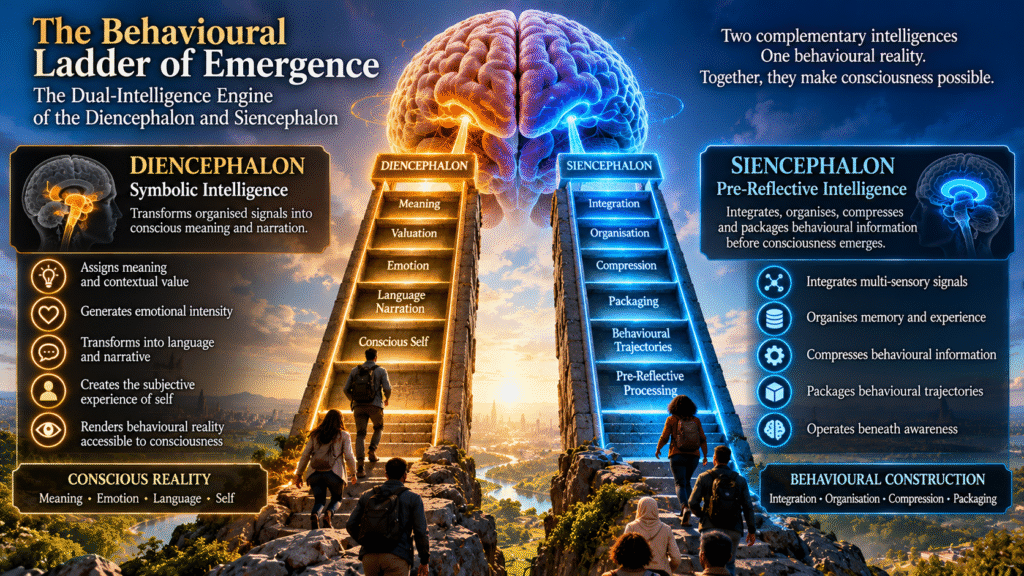
Rather than treating intelligence as a single cortical phenomenon, the six-Cephalon Model argues that behavioural construction depends upon two complementary forms of biological intelligence operating sequentially within the higher brain.
- The first is a pre-reflective intelligence centred upon the Siencephalon, responsible for integrating, organising, compressing, and packaging behavioural information before consciousness emerges.
- The second is a symbolic intelligence centred upon the Diencephalon, responsible for transforming that organised behavioural package into conscious meaning, linguistic narration, and the subjective experience of the self.
Together, these two systems form what Psychextrics describes as the Dual-Intelligence Engine of the higher brain. One constructs behavioural reality beneath awareness; the other renders that reality accessible to consciousness.
1. The Behavioural Ladder of Emergence
Behaviour does not suddenly appear within consciousness. It emerges progressively through a hierarchical sequence of specialised cephalic systems, each contributing a distinct layer of biological organisation.
- The Myelencephalon establishes survival vigilance by continuously monitoring the organism for immediate threats to life.
- The Metencephalon transforms this vigilance into kinetic stability, maintaining posture, coordination, and motor equilibrium.
- The Mesencephalon extends behavioural processing into spatial orientation, directing attention toward environmental change while organising rapid sensorimotor responses.
Above these foundational systems, the Diencephalon evaluates biological significance by assigning contextual meaning, survival priority, and physiological value to incoming information.
Finally, the Siencephalon integrates these distributed behavioural streams into coherent relational structures capable of supporting memory, prediction, familiarity, and behavioural continuity.
Only after this ascending biological construction is complete does the revised Telencephalon display the finished behavioural product as conscious experience.
Consciousness therefore occupies the summit of the behavioural ladder rather than its foundation. It is the destination of behavioural emergence rather than its origin.
2. From Reaction to Organisation
The distinction between lower and higher cephalic processing is not merely anatomical; it represents a transition between fundamentally different forms of behavioural computation.
The lower Cephalons (comprising the Myelencephalon, Metencephalon, Mesencephalon, and immediate Diencephalic homeostatic triggers) are the Somato-Valence Engine. Their primary responsibility is rapid behavioural deployment. They detect danger, preserve equilibrium, orient attention, regulate physiology, and initiate immediate survival responses. Their operations are necessarily fast, localised, and largely reflexive.
Such processing, however, remains incomplete.
Reacting to the environment is not equivalent to understanding it. Immediate behavioural deployment must eventually be organised into coherent behavioural strategies capable of extending beyond the present moment. This transformation occurs within the Siencephalon.
The Entorhinal gateway receives the distributed outputs of the lower Cephalons and converts fragmented behavioural reactions into integrated behavioural architecture. Rather than responding only to the present, the organism begins constructing predictive relationships linking past experience, present conditions, and anticipated future outcomes.
Behaviour thus evolves from simple reaction into organised behavioural intelligence.
3. The Structural Transition to the Cognito-Recursive Axis
The emergence of higher behavioural organisation depends upon the Cognito-Recursive Axis (comprising of the Siencephalon and the revised Telencephalon).
Unlike the Somato-Valence Engine, which prioritises immediate behavioural execution, the Cognito-Recursive Axis specialises in integrating multiple behavioural dimensions into unified representations capable of recursive evaluation.
Within this architecture, sensory information is no longer processed as isolated events.
- Visual orientation becomes environmental navigation.
- Motor correction becomes coordinated behavioural planning.
- Physiological arousal becomes strategic preparation.
- Emotional significance becomes relational memory.
Through recursive integration, behavioural information acquires continuity across time rather than remaining confined to isolated reactions.
The Entorhinal gateway occupies the centre of this transformation. Acting as the principal integrative relay of the Siencephalon, it gathers spatial organisation, contextual associations, object familiarity, behavioural history, and ongoing physiological conditions into a single behavioural framework before forwarding this compressed representation toward hippocampal indexing and eventual cortical display.
This packaging process represents one of the defining operations of higher behavioural organisation.
4. The Four Pathways of Siencephalic Integration
The transition from reactive behaviour to organised behavioural intelligence occurs through four major integration pathways linking the lower Cephalons with specialised Siencephalic structures.
- The first pathway connects the Myelencephalon with the Cingulate Gyrus.
At the level of the brainstem, behavioural output remains dominated by immediate autonomic vigilance. The organism responds rapidly to disturbances affecting survival without requiring conscious deliberation. When these signals ascend into the Cingulate Gyrus, they are reorganised into broader behavioural strategies. Physiological distress is transformed into goal-directed action, allowing survival behaviour to become structured rather than merely reactive.
- The second pathway links the Metencephalon with the Basal Ganglia Striatum.
The Metencephalon continuously stabilises posture, balance, and coordinated movement. The Striatum extends these kinetic corrections into organised procedural sequences. Individual motor adjustments are assembled into coherent behavioural routines, enabling complex actions to unfold smoothly rather than as disconnected muscular corrections.
- The third pathway connects the Mesencephalon with the Parahippocampal Fields.
Where the Mesencephalon rapidly orients attention toward environmental change, the Parahippocampal system embeds those orienting responses within broader spatial representations. A sudden movement detected in peripheral vision becomes integrated into an evolving environmental map capable of supporting intelligent navigation through changing surroundings.
- The fourth pathway links the Diencephalon with the Perirhinal Relay.
The Diencephalon initially evaluates incoming information according to biological significance, distinguishing conditions favourable or unfavourable to survival. The Perirhinal system subsequently associates this behavioural valuation with specific environmental objects to inform previously encountered experiences. Innate attraction or avoidance therefore develops into organised object recognition, allowing the organism to recognise not simply danger or opportunity, but precisely what generated those behavioural evaluations.
Collectively, these four pathways elevate behavioural processing from immediate physiological adaptation into integrated behavioural organisation.
5. The Entorhinal Relay as the Packaging Engine
Although these pathways perform distinct computational roles, their outputs ultimately converge upon a single integrative gateway.
The Entorhinal relay functions as the central packaging engine of the Siencephalon.
Rather than generating isolated behavioural responses, it continuously compresses sensory information, contextual relationships, spatial organisation, emotional weighting, procedural sequences, and memory associations into unified behavioural packets.
Its forward relay delivers these integrated representations into hippocampal recording through the perforant pathway, establishing coherent behavioural continuity across experience.
Its feedback relay subsequently retrieves these indexed behavioural packages and broadcasts them toward the revised Telencephalon, allowing organised behavioural reality to become consciously accessible.
Without this packaging process, behavioural information would remain fragmented across numerous specialised systems. The organism might still react successfully to environmental events, yet those reactions would lack the integrated coherence necessary for reflective behavioural continuity.
The Entorhinal gateway therefore functions as the principal organiser of behavioural architecture before conscious awareness emerges.
6. The First Intelligence: Siencephalic Intelligence
Within Psychextrics, the first component of the Dual-Intelligence Engine is the Siencephalic Intelligence.
This intelligence operates entirely beneath conscious awareness.
Its primary function is not symbolic reasoning but structural organisation. It integrates distributed behavioural information, resolves competing sensory streams, compresses relational patterns, indexes contextual continuity, and assembles coherent behavioural strategies before consciousness becomes involved.
Importantly, this intelligence does not communicate through language.
Its computational language is composed of spatial relationships, temporal organisation, contextual associations, behavioural prediction, and relational indexing. It constructs behavioural solutions rather than verbal explanations.
Long before the conscious mind understands why it has moved, hesitated, avoided, or approached, the Siencephalic Intelligence has already organised the behavioural architecture responsible for that outcome.
In this sense, it serves as the hidden engineer of behavioural emergence.
7. The Second Intelligence: Diencephalic Intelligence
Once behavioural organisation has been completed, a second form of intelligence assumes responsibility.
The Diencephalic Intelligence, centred upon the thalamic relay, governs the emergence of symbolic meaning. Unlike the Siencephalic Intelligence, which organises behaviour, the Diencephalic Intelligence interprets it.
As integrated behavioural packets arrive upon the revised Telencephalic display, the thalamic relay serialises these representations into coherent sequences capable of supporting conscious awareness, symbolic reasoning, internal dialogue, and linguistic narration.
Within this architecture, consciousness does not construct behaviour. It observes behaviour already organised by the Siencephalic system and immediately transforms that behavioural display into meaningful subjective experience.
The familiar experience of thinking, “I chose to do this because…” therefore represents a symbolic narration emerging after behavioural organisation has already occurred.
Meaning follows organisation. Narration follows construction. The conscious self inherits behavioural reality rather than creating it.
8. The Partnership Between Two Biological Intelligences
The revised Telencephalon therefore operates neither through isolated reflexes nor through a singular conscious executive.
Instead, it functions through continuous cooperation between two specialised biological intelligences.
- The Siencephalic Intelligence constructs behavioural architecture.
- The Diencephalic Intelligence constructs behavioural meaning.
One organises. The other narrates.
One packages behavioural reality. The other translates that packaged reality into conscious experience.
Neither system replaces the other.
Together they create the complete behavioural ladder through which unconscious biological computation gradually becomes conscious human awareness.
Only after this dual processing sequence has been completed does the revised Telencephalon display behaviour as the subjective experience commonly identified as thought.
Conclusion: Intelligence Before Consciousness
The Behavioural Ladder of Emergence fundamentally redefines how intelligence itself should be understood within the Psychextric framework.
Rather than locating intelligence exclusively within conscious cognition, Psychextrics proposes that behavioural intelligence begins long before consciousness appears.
- The lower Cephalons provide the biological foundations of survival and behavioural deployment.
- The Siencephalon transforms these distributed reactions into integrated behavioural architecture through recursive organisation, contextual indexing, and predictive packaging.
- The Diencephalon then converts these organised behavioural structures into symbolic meaning, conscious narration, and the subjective experience of intentional thought.
- The revised Telencephalon contributes neither behavioural construction nor executive command. Its role is to display the completed work of these deeper biological systems, allowing the organism to experience behaviour as conscious awareness.
Within this model, intelligence is not a single event occurring inside the conscious mind. It is a layered biological process ascending through the cephalic hierarchy, culminating in the partnership of two complementary computational systems.
The Siencephalic Intelligence silently assembles the architecture of behaviour, while the Diencephalic Intelligence gives that architecture a symbolic voice.
Together they form the Dual-Intelligence Engine through which behaviour first becomes organised and only then becomes consciously known.
Author’s note: One point readers may interpret differently is the use of the term “Intelligence.” Within this essay it functions as a functional descriptor—referring to two distinct classes of information processing (integration/packaging versus symbolic narration)—rather than implying that the Entorhinal relay or Thalamus are themselves independently conscious or intelligent agents. That interpretation is clear within the Psychextrics framework, but this brief defining sentence is simply to reduce ambiguity for first-time readers.
Back to: 👇