
The Delay Problem of Consciousness: Why Behaviour Always Arrives Before Awareness
BY: OMOLAJA MAKINEE
One of the most persistent assumptions in the study of the human mind is that conscious awareness precedes behaviour. Every major intellectual tradition has largely accepted the idea that individuals first become aware of a situation, consciously evaluate it, make a deliberate decision, and then execute an action. From this perspective, consciousness functions as the executive authority of human behaviour, issuing commands that the body subsequently obeys.
Yet everyday experience repeatedly challenges this assumption.
- A hand withdraws from a hot surface before the pain is consciously recognised.
- An uneasy feeling emerges long before an individual can explain why they feel anxious.
- Attraction often appears before any logical justification can be constructed.
- A person hesitates before consciously identifying the hidden danger that caused the pause.
- Even voluntary movement frequently begins before the conscious experience of deciding to move.
These are not isolated curiosities. They represent one of the most consistent properties of human behaviour.
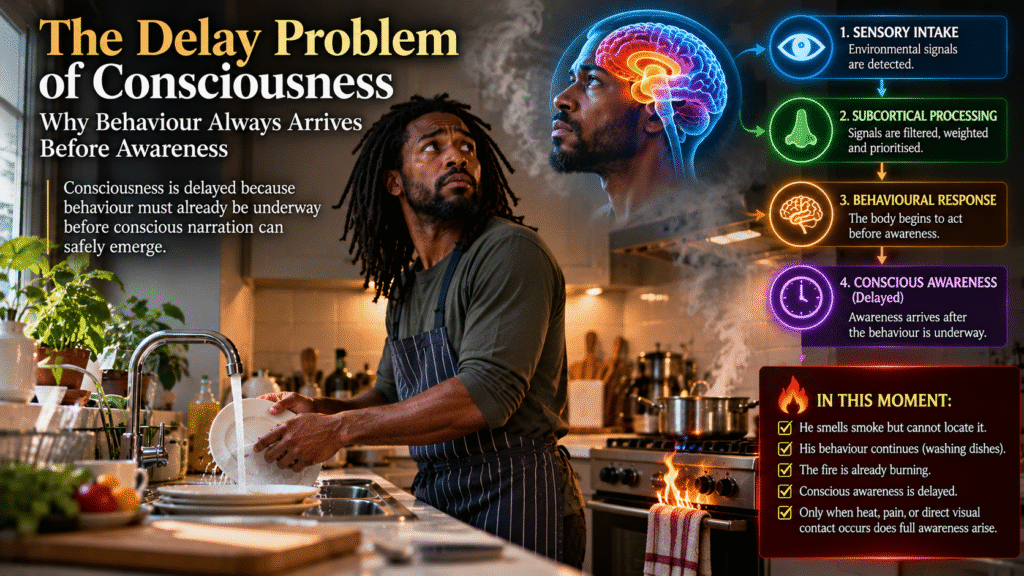
Psychextrics identifies this phenomenon as the Delay Problem of Consciousness—the systematic temporal separation between behavioural construction and conscious awareness. Rather than viewing this delay as an imperfection of the nervous system, the six-Cephalon architecture proposes that it is an essential biological principle.
Consciousness is delayed because behaviour must already be underway before conscious narration can safely emerge.
1. The Great Misconception About Conscious Time
Human beings naturally assume that consciousness unfolds in real time. The world appears before us as though every perception, decision, and movement occurs simultaneously. Subjectively, there seems to be no measurable gap between sensing reality and consciously experiencing it.
This impression, however, is itself part of the illusion.
According to Psychextrics, consciousness does not observe behaviour as it is being constructed. Instead, it observes behaviour after multiple cephalic systems have already completed a remarkable sequence of operations.
- Survival detection,
- spatial orientation,
- contextual valuation,
- emotional weighting,
- memory indexing,
- behavioural selection,
- and motor preparation
all occur beneath the threshold of awareness before the revised Telencephalon receives the information necessary to construct conscious experience.
The conscious self therefore exists slightly behind its own biology. It experiences only the completed behavioural broadcast rather than the biological construction process that produced it.
2. Why Consciousness Must Be Delayed
The delay in consciousness is not a design flaw. It is a biological necessity.
An organism waiting for conscious deliberation before responding to danger would rarely survive. Every fraction of a second matters when avoiding injury, escaping predators, maintaining balance, or responding to rapidly changing environments.
Consequently, evolution favours behavioural systems capable of operating independently of conscious reflection.
The lower Cephalons continuously monitor the external environment, internal physiology, body position, and behavioural context. They compare incoming sensory information with inherited biological templates, acquired behavioural history, hormonal conditions, and ongoing physiological demands. These computations occur automatically because survival cannot afford to wait for symbolic reasoning.
Only after behaviour has already been organised do the Master Relay systems broadcast the completed biological representation to the cortical display.
Consciousness therefore follows behaviour because behaviour cannot wait for consciousness.
3. The Spectral Quantisation of Conscious Delay
Although every human being experiences this temporal delay, Psychextrics argues that the delay itself is not identical across individuals.
The biological infrastructure responsible for delayed awareness is universal, but the magnitude, velocity, and subjective character of the delay are individually unique.
This variation arises through the interaction of four fundamental biological indices.
- Genetic Index Markers (GIM) establish the inherited structural architecture of behavioural processing.
- Hormonal Index Markers (HIM) determine the real-time chemical gain operating upon those inherited structures.
- Epigenetic Index Markers (EIM) represent behavioural modifications acquired through lived experience.
- Hormonal Fluidity Index (HFI) reflects the continuously changing hormonal environment within which behavioural processing occurs.
Together these four systems create what Psychextrics describes as the Spectral Quantisation of Consciousness. The temporal distance separating behavioural activation from conscious awareness is therefore not fixed but dynamically shaped by inherited biology, developmental history, hormonal state, and ongoing physiological adaptation.
No two nervous systems experience identical behavioural latency because no two biological architectures possess identical spectral configurations.
4. Why Modalities Alone Cannot Explain Behaviour
Traditional Psychology generally classifies perception according to broad sensory modalities such as vision, hearing, touch, smell, and taste.
Psychextrics argues that these categories are far too coarse to explain behavioural variation.
Behaviour does not emerge from general sensory modalities. It emerges from highly specialised submodalities operating within those broader systems. Somatosensation illustrates this distinction clearly.
The detection of sharp mechanical pain, gentle pressure, and cool air all belong to the broader sensory category of touch. Yet each relies upon different peripheral receptors, distinct neural pathways, specialised relay velocities, and separate behavioural priorities.
To classify all of these experiences simply as “touch” conceals the biological complexity responsible for behavioural diversity.
The nervous system responds to individual submodalities rather than to broad sensory labels.
Consequently, behavioural latency must be understood at the submodality level rather than at the level of traditional sensory classification.
5. The Failure of Uniform Psychometrics
This distinction exposes one of the major limitations of conventional behavioural measurement.
Psychological assessment frequently assumes that subjective experiences can be quantified using uniform numerical scales. Individuals are routinely asked to rate pain, anxiety, sadness, or discomfort on scales ranging from one to ten.
Psychextrics argues that this assumption overlooks the biological individuality of sensory architecture.
An intensity score possesses meaning only within the unique spectral configuration of a particular nervous system.
What one individual experiences as overwhelming sensory distress may represent only a mild biological signal within another person’s neural architecture. Likewise, identical environmental stimuli may activate entirely different submodality networks depending upon inherited receptor density, hormonal modulation, previous learning, and current physiological state.
Behaviour therefore cannot be measured accurately through universal psychometric scales because the biological templates generating behaviour are themselves spectrally unique.
The nervous system measures significance structurally rather than numerically.
6. Submodality Divergence and Neurodiversity
The importance of submodalities becomes particularly evident when examining neurodivergent behavioural profiles.
Within Psychextrics, behavioural diversity does not necessarily arise because an entire sensory modality functions differently. Instead, divergence frequently originates within highly specific submodality channels.
A particular auditory frequency may trigger overwhelming behavioural activation while neighbouring frequencies remain relatively insignificant.
A specific tactile texture may immediately activate survival behaviour whereas other forms of touch produce little reaction.
Certain visual geometries, patterns, or movements may acquire exceptional behavioural salience despite otherwise typical visual processing.
This perspective reframes neurodiversity as a variation in spectral architecture rather than a simple alteration of broad sensory systems.
Inherited Genetic Index Markers distribute behavioural sensitivity unevenly across different submodalities, while hormonal conditions continuously modify their operational gain.
Consequently, behavioural diversity emerges naturally from the biological individuality of sensory architecture rather than from uniform alterations affecting entire modalities.
7. Five Demonstrations of Conscious Delay
The Delay Problem of Consciousness becomes most visible when examining common behavioural phenomena.
A. Reflex Withdrawal Before Pain
Perhaps the clearest demonstration occurs when touching a dangerously hot surface.
Protective withdrawal begins almost immediately through rapid spinal and lower cephalic circuitry. Only afterwards does conscious awareness announce that pain has occurred.
The behavioural response precedes the conscious explanation because survival depends upon movement occurring before symbolic interpretation.
B. Emotional Discomfort Before Explanation
People frequently experience anxiety, dread, or unease without immediately knowing why.
Within the Psychextric model, subcortical systems detect physiological or environmental irregularities through rapid interoceptive processing.
Hormonal deployment alters cardiovascular activity, respiration, and autonomic regulation before conscious awareness identifies an external cause.
The conscious mind subsequently constructs a narrative explaining an emotional state that already exists.
C. Instinctive Attraction Before Rationalisation
Human attraction often illustrates the same temporal sequence.
Visual geometry, vocal characteristics, pheromonal signals, and behavioural familiarity may activate reproductive or social orientation before conscious reasoning begins.
Only afterwards does the symbolic mind generate logical explanations describing personality, appearance, compatibility, or preference.
Reason therefore frequently justifies behavioural orientation rather than initiating it.
D. Behavioural Hesitation Before Reflection
Individuals occasionally stop, hesitate, or freeze without immediately recognising why.
Within Psychextrics, conflicting contextual memories detected by hippocampal-entorhinal circuitry may temporarily inhibit behavioural progression.
The pause occurs first. Conscious recognition of the hidden inconsistency appears only later.
E. Motor Preparation Before Intention
One of the most striking demonstrations concerns voluntary movement itself.
Behavioural preparation begins within lower motor systems before conscious intention appears on the cortical display.
The readiness to act therefore precedes the conscious experience of deciding.
What consciousness experiences as voluntary choice is, within this framework, the narrated presentation of behavioural preparation already underway.
8. Behaviour Begins Beneath Conscious Awareness
These examples collectively illustrate a central principle of the six-Cephalon architecture.
Behaviour is not initiated by conscious thought. Instead, behavioural construction begins beneath awareness through continuous cooperation among the lower Cephalons.
- The Myelencephalon monitors survival.
- The Metencephalon stabilises movement.
- The Mesencephalon continuously orients attention toward environmental salience.
- The Diencephalon evaluates contextual significance and biological priority.
- The Siencephalon integrates behavioural continuity through memory, emotional weighting, and relational indexing.
Only after these distributed operations have converged does the revised Telencephalon receive the completed behavioural representation through the Master Relay systems.
The conscious organism therefore experiences behaviour after it has already become biologically organised.
9. The GIM-HIM Architecture of Behavioural Latency
The interaction between Genetic Index Markers and Hormonal Index Markers provides the biological foundation for this pre-reflective processing.
GIM establishes the structural blueprint of each behavioural channel. It determines receptor density, neural connectivity, conduction architecture, synaptic organisation, and baseline processing capacity.
HIM functions as the dynamic chemical modifier operating upon that inherited blueprint. Hormonal activity adjusts neural responsiveness, alters firing thresholds, modifies transmission velocity, and changes behavioural sensitivity according to the organism’s current physiological condition.
Together these systems operate as a blueprint-and-gain architecture.
The structural pathway may remain constant while its behavioural responsiveness fluctuates continuously according to changing hormonal conditions.
Consequently, behavioural latency itself becomes biologically dynamic rather than mechanically fixed.
10. The Asymmetry of Conscious Experience
Because inherited genetic recombination distributes sensory architecture unevenly across individuals, no nervous system possesses perfectly symmetrical behavioural processing.
One individual may exhibit exceptionally rapid responses to visual threat while demonstrating relatively slow processing of auditory information.
Another may possess heightened sensitivity to internal physiological change but relatively modest responsiveness to tactile stimulation.
Still another may demonstrate extraordinary olfactory discrimination alongside comparatively ordinary vestibular processing.
Each behavioural profile therefore represents a unique spectral landscape rather than a standard neurological template.
The conscious experience arising from these architectures inevitably differs because consciousness inherits whatever behavioural processing the lower cephalic systems have already constructed.
No two individuals therefore inhabit precisely the same conscious world.
Conclusion: Consciousness Lives Behind Behaviour
The Delay Problem of Consciousness fundamentally alters the relationship between awareness and behaviour.
Rather than initiating action, consciousness follows it.
Rather than directing behavioural construction, consciousness narrates biological decisions already assembled through the coordinated activity of the lower Cephalons. Every movement, hesitation, attraction, emotional shift, protective withdrawal, and physiological adjustment begins within subcortical architecture before becoming available to conscious experience.
This delay is not accidental. It is the very mechanism that allows the nervous system to balance survival with awareness. The organism first adapts to reality, then becomes conscious of the adaptation.
Moreover, this temporal gap is never uniform. It is individually quantified through the interaction of Genetic Index Markers, Hormonal Index Markers, Epigenetic Index Markers, and the Hormonal Fluidity Index, producing a unique behavioural latency profile for every individual. Behaviour therefore emerges from a spectrally organised biological architecture long before it appears as conscious thought.
Within the Psychextric model, consciousness is always looking backward by a fraction of biological time. The living organism has already sensed, evaluated, weighted, remembered, selected, and often acted before the conscious self finally declares, “I knew what I was doing.”
The Delay Problem of Consciousness therefore reveals one of the central principles of cephalic integration:
The brain does not wait for awareness to begin behaving. Awareness is simply the latest arrival to a biological process that has already been unfolding beneath its gaze.
Back to: 👇