
The Great Reversal: The Eight Sensory Modalities and the Three Architectures of Perception
BY: OMOLAJA MAKINEE
For centuries, one assumption has remained deeply embedded within the intellectual foundations of civilisation:
Consciousness is the origin of behaviour.
Philosophy has treated conscious thought as the birthplace of human action. Psychology has largely investigated behaviour as the outward expression of conscious cognition. Law presumes that individuals knowingly choose before they act. Religion frequently measures moral responsibility through conscious intention, while even modern Neuroscience often begins with conscious perception before examining the biological mechanisms that support it.
This assumption has shaped humanity’s understanding of freewill, responsibility, intelligence, learning, and identity. Human beings naturally experience themselves as conscious agents who first perceive the world, then analyse what they perceive, make deliberate decisions, and finally produce behaviour. Consciousness appears to occupy the driver’s seat of the human organism.
Psychextrics proposes a fundamentally different model.
Rather than positioning consciousness at the beginning of behavioural production, Psychextrics places it near the end of an immense biological construction process. Behaviour does not originate from conscious thought; instead, conscious thought emerges from behaviour already being assembled beneath awareness.
The nervous system is constantly detecting, comparing, predicting, prioritising, valuing, and integrating information before conscious experience ever appears. What consciousness ultimately experiences is not raw reality, but the completed biological product of countless unconscious operations distributed throughout the six-Cephalon architecture.
This proposition represents one of the greatest conceptual reversals in the study of human behaviour. It suggests that the conscious mind functions less as an executive commander than as the symbolic display through which biological processing becomes narratively accessible.
To understand why this reversal is necessary, one must first understand how the brain receives information from the world. Every behavioural response begins with perception, but perception itself is far more sophisticated than the traditional doctrine of the five senses suggests.
1. Beyond the Classical Five Senses
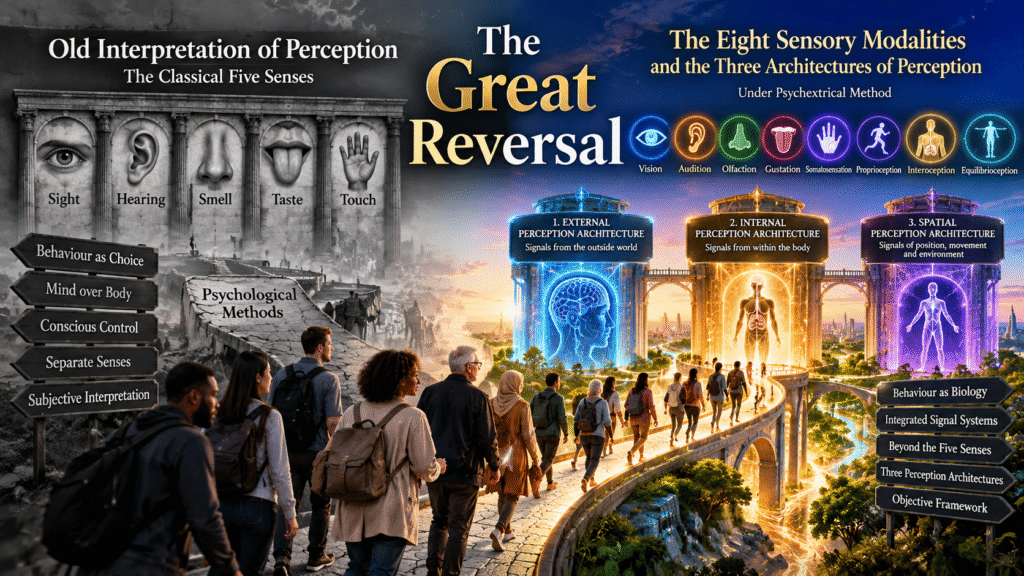
For generations, education has reduced human perception to five familiar senses: sight, hearing, smell, taste, and touch. While these senses remain fundamental, contemporary Neuroscience recognises that they represent only part of a much broader sensory architecture. The body continuously acquires information not only from the external environment but also from its own movement, balance, posture, and internal physiology.
Psychextrics adopts the eight principal sensory modalities because together they provide a foundational biological framework for understanding how behaviour emerges before consciousness. Every one of these modalities contributes unique information to the construction of behavioural reality, yet none operates independently. Instead, each feeds specialised subcortical networks that cooperate long before conscious awareness begins interpreting the situation.
The eight sensory modalities therefore should not be viewed as isolated senses, but as complementary biological information systems continuously constructing an integrated model of both the organism and its environment.
2. The Eight Sensory Modalities
I. Vision: Mapping the External World
Vision detects electromagnetic light reflected from surrounding objects. It provides information regarding shape, colour, motion, distance, depth, and spatial orientation. Although conscious sight feels immediate, enormous quantities of visual processing occur automatically within subcortical pathways before an object becomes consciously recognised.
Long before an individual becomes aware of seeing a moving object, multiple neural systems have already calculated its direction, speed, relative importance, and possible behavioural significance. Vision therefore begins as biological computation rather than conscious observation.
II. Audition: Monitoring the Acoustic Environment
Hearing transforms environmental vibrations into meaningful neural information. Auditory systems identify voices, locate unseen objects, distinguish emotional tone, estimate movement through sound, and detect danger beyond visual range.
The brain continuously monitors acoustic patterns even when attention appears elsewhere. Unexpected sounds can redirect behaviour within milliseconds, demonstrating that auditory processing contributes to behavioural preparation before conscious deliberation has begun.
III. Olfaction: The Chemistry of Memory
Smell occupies a uniquely privileged position within the nervous system. Unlike most sensory systems, olfactory information possesses unusually intimate access to emotional and memory circuitry.
A familiar fragrance, the scent of smoke, or the odour of decay may evoke immediate behavioural responses before conscious identification occurs. Chemical signatures therefore function not merely as sensory experiences but as biological triggers capable of rapidly activating previously established survival templates.
IV. Gustation: Biological Evaluation Through Taste
Taste evaluates dissolved chemical substances entering the body. Rather than simply producing pleasurable or unpleasant flavours, gustation continuously assesses nutritional value, toxicity, energy content, and physiological compatibility.
Even seemingly simple food preferences often reflect complex interactions between inherited biology, developmental learning, metabolic history, and previous physiological outcomes.
V. Somatosensation: Protecting the Body
Touch encompasses pressure, vibration, texture, temperature, pain, itch, and bodily contact. Far from being a passive sensory system, somatosensation continuously evaluates environmental interaction, bodily integrity, injury, and mechanical threat.
The body therefore responds to countless tactile events automatically, maintaining protective behaviour without requiring conscious supervision.
VI. Vestibular Sense: Stability in Motion
Hidden within the inner ear lies one of the most essential sensory systems for survival. The vestibular apparatus continuously measures balance, gravitational orientation, head movement, and acceleration.
Every stable step, rapid turn, or recovery from imbalance depends upon vestibular processing occurring beneath awareness. Without it, coherent navigation through the environment becomes impossible.
VII. Proprioception: Knowing Where the Body Exists
Proprioception provides continuous awareness of limb position, muscle tension, joint movement, and bodily posture. It allows individuals to walk in darkness, reach for familiar objects without looking, or maintain coordinated movement without consciously calculating every muscular contraction.
Rather than observing the external world, proprioception constantly informs the brain about the body’s own position within that world.
VIII. Interoception: Monitoring Internal Life
The final sensory modality originates entirely from within the body itself. Interoception continuously reports heartbeat, breathing, digestion, hormonal activity, immune responses, hunger, thirst, fatigue, and countless other physiological variables.
These signals rarely dominate conscious awareness, yet they profoundly influence motivation, emotion, attention, and behavioural readiness. Internal physiology therefore becomes an equal partner with external perception in shaping behaviour.
3. The Three Architectures of Perception
Although the eight sensory modalities appear distinct, Psychextrics organises them into three higher-order Architectures of Perception. These architectures describe not simply where information originates, but how the nervous system constructs an integrated behavioural reality.
A. Exteroception: Reading the External Environment
Exteroception gathers information originating beyond the body. Vision, hearing, smell, taste, and much of touch belong primarily within this architecture because they sample the surrounding environment.
Through exteroception, organisms identify food, predators, shelter, social interaction, opportunity, and environmental danger. It constructs the external landscape upon which behaviour must operate.
B. Proprioception: Constructing the Physical Self
The second architecture does not observe the world but the organism itself. Vestibular processing and proprioceptive feedback constantly calculate balance, posture, movement, orientation, and spatial positioning.
Behaviour cannot be organised unless the nervous system first knows where the body exists relative to its surroundings. Every movement therefore depends upon this continuously updated internal map.
C. Interoception: Monitoring Biological State
The third architecture observes the internal physiological condition of the organism. Respiration, cardiovascular activity, metabolism, hormonal regulation, immune function, and visceral chemistry collectively determine the body’s current biological status.
An organism confronting external opportunity while internally exhausted, dehydrated, or injured will produce entirely different behaviour from one experiencing physiological stability. Consequently, behaviour always emerges from the interaction between environmental information and internal biological condition.
4. The Hippocampal-Axis Architecture
Once sensory information enters these three perceptual architectures, it does not travel randomly throughout the nervous system. Within the Psychextrics framework, specialised hippocampal-axis pathways organise incoming sensory information into coherent behavioural representations.
Each axis serves as a dedicated biological corridor connecting a particular sensory domain with the hippocampal recording network.
- The Vestibular-Hippocampal Axis supplies balance, acceleration, and positional information from the Metencephalon.
- The Superior Colliculus-Hippocampal Axis rapidly delivers visual orientation data from the Mesencephalon.
- The Cochlear Nucleus-Hippocampal Axis continuously provides auditory context from the Myelencephalon,
- The Olfactory Bulb-Hippocampal Axis channels chemical signatures directly into mnemonic processing through the Siencephalon.
Alongside these pathways,
- the Forward Thalamic-Hippocampal Axis integrates somatosensory, gustatory, and visceral information originating within the Diencephalon.
- Finally, the Forward Entorhinal-Hippocampal Axis functions as the master gateway, compressing spatial, sensory, relational, and physiological information into unified hippocampal representations before subsequent cortical display.
Collectively, these six axes reveal that memory is never built from isolated sensory streams. Instead, every remembered event represents the convergence of multiple sensory systems operating simultaneously.
5. Amygdaloid Valence: The First Biological Filter
One of the most important propositions of Psychextrics is that sensory information reaches the hippocampus only after undergoing biological valuation.
Classical cognitive models frequently portray emotion as something added after perception. Psychextrics reverses this sequence. Emotional significance is assigned during perception itself.
Under the Psychextric Law of Structural Equivalence, the amygdala functions not primarily as an emotional generator but as a structural comparator. Incoming sensory signals are rapidly examined against inherited Genetic Index Markers (GIM) and acquired Experience Index Markers (EIM). Rather than asking, “What emotion should I feel?” the system first asks, “Does this sensory pattern resemble something biologically significant?“
The lateral amygdala and its intercalated cellular networks perform this initial comparison across every forward sensory pathway. Vestibular instability, sudden visual movement, unexpected sounds, distinctive odours, visceral changes, and multimodal Entorhinal integration all encounter this biological checkpoint before entering hippocampal memory formation.
Consequently, the hippocampus never process emotionally neutral reality. Every recorded experience has already been biologically weighted according to inherited predispositions, previous learning, physiological state, and survival relevance.
6. From Sensory Processing to Behaviour
The significance of this architecture extends beyond perception itself. If sensory information is integrated, valued, and organised before conscious awareness develops, then behaviour is already under construction long before conscious reflection begins.
The organism does not consciously decide first and then prepare for action. Instead, multiple sensory systems continuously cooperate to construct behavioural readiness beneath awareness. Consciousness simply inherits the integrated result.
This explains why human beings often react before they understand why they reacted, why familiar environments produce effortless navigation, why certain smells evoke immediate memories, and why emotional significance frequently precedes conscious explanation. Behaviour emerges from biological integration, while consciousness subsequently transforms that integration into narrative experience.
Conclusion: Reversing the Direction of Consciousness
The Great Reversal represents far more than a new interpretation of perception. It proposes an entirely different architecture of human behaviour.
The foundational eight sensory modalities, organised through the three Architectures of Perception and integrated by specialised hippocampal-axis circuitry, demonstrate that perception is neither passive nor consciously initiated. Every sensory signal undergoes biological organisation, structural comparison, contextual integration, and mnemonic preparation before it reaches the symbolic display of the Telencephalon.
Within Psychextrics, consciousness is therefore not the architect of behaviour but its interpreter. Behaviour begins with biological computation distributed across the six Cephalons, shaped by sensory convergence, filtered through inherited and acquired behavioural templates, integrated via the hippocampal system, and only then presented to conscious awareness as lived experience.
The question is no longer how consciousness creates behaviour. The more fundamental question becomes how the brain constructs behaviour before consciousness ever knows it has begun. That reversal serves as one of the central foundations upon which the entire Psychextric model of perception, memory, and human identity is built.
Back to: 👇