
VOLUME 4: SIENCEPHALON
MEMORY, TRAUMA, AND THE HUMAN SELF
THE MISSING ARCHITECTURE OF CONSCIOUSNESS IN PSYCHEXTRICS
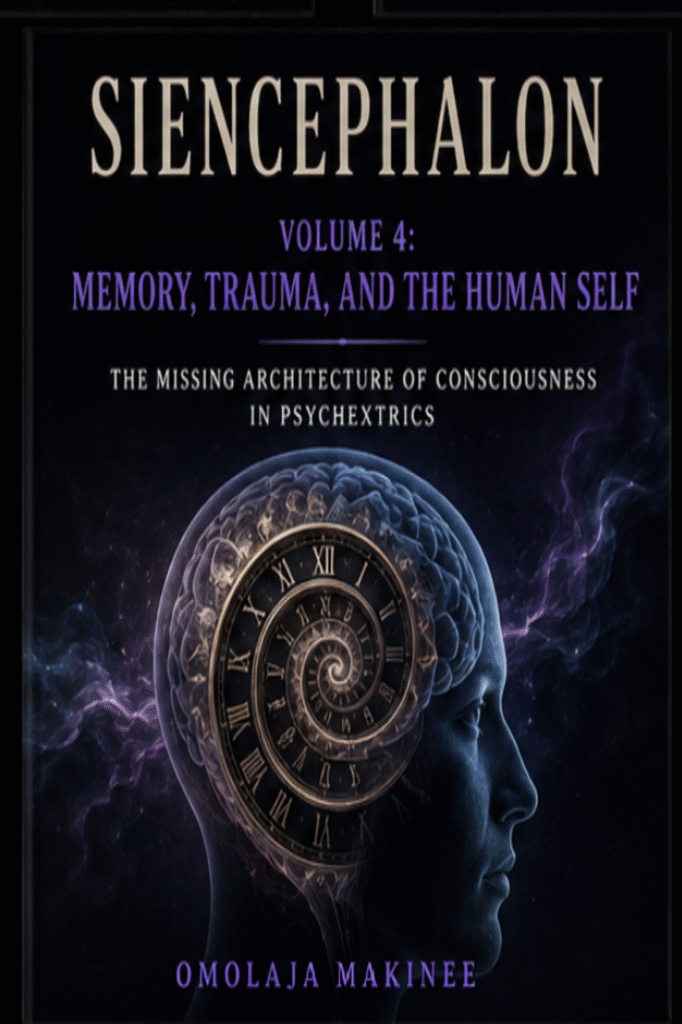
Where is memory? Where does trauma persist? What actually happens when the self disappears into sleep? And if consciousness is not the commander of behaviour, what exactly is the human self?
Memory, Trauma, and the Human Self enters one of the most unresolved territories in Behavioural science: the architecture through which biological signals become memory, memory becomes continuity, continuity becomes identity, and identity finally appears as the conscious experience of “I.”
In this fourth volume of The Siencephalon: The Missing Architecture of Consciousness in Psychextrics, Psychextrics advances beyond conventional categories of memory, trauma, sleep and consciousness to investigate the structural systems operating beneath behavioural display.
The volume introduces and develops major Psychextrical propositions, including:
- The Siencephalon as the Signal Integration Core responsible for indexing, stabilising and relaying behavioural continuity.
- The Entorhinal Relay Architecture, proposed as a bridge between past memory indices, spatial continuity and present behavioural projection.
- A structural reinterpretation of trauma as a continuity disturbance capable of reorganising present behavioural reality.
- The Four Cellular Pairings of Sleep, offering a new architecture for understanding synchronous and desynchronous sleep states beyond the conventional NREM–REM binary.
- The Tripartite Somatosensory Division of the Executive Self, challenging the idea of a singular conscious commander.
- The Thalamic Tug-of-War between Proactive-Core and Reactive-Matrix, revealing behavioural choice as a competition between structurally unequal systems.
- The Corticothalamic Bottleneck of Eye-Contact Overload, offering a Psychextrical architecture for understanding sensory conflict in autism.
- The Law of Behavioural Symphony, bringing the six-cephalon architecture into a single model of recursively stabilised behavioural continuity.
- The Executive as the Ninth Sensory Modality, proposing executive processing as a distinct sensory modality that integrates, prioritises and projects behavioural information alongside the established eight sensory modalities.
Across dreams, trauma, memory, sensory overload and executive conflict, one conclusion becomes increasingly difficult to ignore:
The self may not be a permanent entity hidden inside the brain.
What humans experience as identity may instead be the continuously rendered consequence of an immense biological negotiation occurring beneath symbolic awareness. The lower cephalons generate survival, stability and orientation. The Diencephalon weights meaning and behavioural priority. The Siencephalon integrates and indexes continuity. The Telencephalon receives the resulting architecture and displays it as a coherent reality.
The conscious narrator then looks at this projection and declares: “I am.”
But Volume Four asks a more disruptive question:
Who—or what—constructed the sentence before the narrator arrived to read it?
Memory, Trauma, and the Human Self is not an extension of conventional explanations. It is an architectural challenge to them.
It asks readers to reconsider where memory belongs, how trauma remains biologically active, why sleep can dissolve identity, how behaviour can occur before conscious narration, and whether the unified human self is anything more than the most convincing projection produced by the cephalic architecture.
The self does not possess a stable biological centre.
It is the temporary continuity produced when multiple biological systems achieve enough structural synchronisation to appear as one.
Welcome to the fourth volume of The Siencephalon.
The architecture beneath memory.
The structural persistence of trauma.
The machinery behind the self.
Publication Date : September 01, 2026
Read Online and Download for Free 👇
ARTICLES

Coming Soon