
Why Psychextrics Needs Its Own AI
BY: OMOLAJA MAKINEE
26 August 2026
For some time, one of the assumptions surrounding artificial intelligence has been that, given enough explanation, enough prompting and enough correction, an existing AI system can be taught to work within almost any intellectual framework.
The development of the five-volume Siencephalon series under Psychextrical methods has increasingly challenged that assumption.
The problem is not that contemporary AI systems make mistakes. They do. Every serious user of AI understands this. An error in a calculation, an incorrect citation, an imprecise interpretation or a misunderstanding of an instruction is not, by itself, evidence of a fundamental limitation.
The more interesting problem appears when the same type of mistake keeps returning, even after it has been identified, explained and corrected.
That is where the experience of developing Psychextrics has become particularly revealing.
1. When correction becomes a pattern
During the development of Siencephalon, Psychextrical methods were repeatedly presented to different AI systems for analysis, interpretation, development and preparation of research material.
The objective was not simply to ask an AI to write about Psychextrics.
The objective was much more demanding: to get an AI system to think through a research problem according to Psychextrical methods, rather than automatically interpret the problem through the methodological assumptions of conventional psychology.
That distinction proved difficult.
An AI could appear to understand the terminology. It could reproduce definitions. It could summarise the framework. It could even explain the difference between psychological methods and Psychextrical methods.
Yet, when asked to actually operate within the Psychextrical framework, something frequently happened.
The system would gradually return to familiar methodological territory.
A Psychextrical construct would be interpreted through a psychological construct. A distinction that was fundamental to Psychextrics would be softened or removed. A proposed Psychextrical interpretation would be unconsciously translated into a more familiar psychological interpretation.
The language changed.
The underlying method did not.
And this is a much more important problem than an ordinary AI error.
2. The problem isn’t that AI disagrees
In scientific work, disagreement can be extremely valuable.
If an AI system had responded to a Psychextrical proposition by saying:
Here is why this interpretation may be incorrect.
that would have been useful.
If it had challenged the evidence, questioned an assumption, proposed an alternative explanation or demonstrated a contradiction, that would have been even more valuable.
In developing a new science, one should want to be challenged.
The real frustration was something else.
After identifying an error, one might expect the system to reconsider the proposition independently and perhaps demonstrate that the original interpretation was actually defensible.
Instead, the familiar response would sometimes appear:
“You are absolutely right to call this out…”
or:
“That was a structural misstep on my part…”
Such responses may be polite and conversationally appropriate, but they do not solve the scientific problem.
The question was never whether the AI could apologise.
The question was whether it could independently reason within a methodological system that was not native to its underlying training.
That is a different problem.
3. A new interpretive science exposes an old limitation
General-purpose AI systems are extraordinarily capable because they have absorbed enormous quantities of human knowledge.
That strength can simultaneously become a limitation when a researcher is attempting to establish a genuinely new interpretive framework.
An AI trained overwhelmingly on existing human literature naturally encounters established terminology, established relationships, established categories and established ways of explaining human behaviour.
Consequently, when a new framework introduces a distinction that does not correspond neatly with those established structures, the model has a tendency to find the nearest familiar conceptual equivalent.
This can create a subtle form of methodological overlap.
The system appears to be working with the new framework, while parts of the old framework have quietly re-entered the interpretation.
For Psychextrics, this is particularly consequential because one of its purposes is precisely to investigate behavioural interpretation through methods that differ from psychological methods.
The problem therefore isn’t simply:
“AI doesn’t understand Psychextrics.”
It is more accurately:
“General-purpose AI has been developed primarily around the intellectual structures of the knowledge that already exists.”
A developing science presents a different challenge.
4. Why moving between AI platforms doesn’t necessarily solve it
One might reasonably assume that if one AI system produces an unsatisfactory result, another should be tried.
That was done.
Different platforms were explored.
Different prompts were attempted.
Different explanations were provided.
Different formulations of the same methodological distinction were tested.
Yet the problem could recur.
This raises a broader question about contemporary AI.
Although today’s major AI systems differ considerably in architecture, training, alignment, product design, context handling and capability, their outputs can sometimes converge around familiar intellectual patterns.
There are many possible reasons for this convergence, including common source material, common benchmarks, shared conventions in human-generated data, reinforcement and preference optimisation, and the broader influence of the existing AI ecosystem.
It would be premature to claim that model distillation alone explains this similarity. The technical causes of convergence are more complicated than that.
But from the perspective of developing Psychextrics, the practical observation remains important:
Changing the AI platform does not necessarily change the underlying methodological worldview through which a problem is interpreted.
And that is precisely the problem a new scientific methodology cannot afford to ignore.
5. The five-volume Siencephalon experience
The development of Siencephalon has therefore become more than a publication exercise.
It has become an experiment in the limits of general-purpose AI.
Across the five volumes, the objective has increasingly required moving beyond asking AI to describe Psychextrics.
The challenge has been asking AI to operate according to Psychextrical methods.
That distinction became increasingly difficult to ignore.
The more developed the methodology became, the more obvious the limitations of existing AI systems became.
A system can be excellent at producing publication-quality prose while still being unsuitable as an instrument for a particular scientific methodology.
Those are not contradictory statements.
A typewriter can produce a beautifully written scientific paper without understanding the science.
Likewise, a highly capable language model can produce remarkably sophisticated academic prose without possessing the methodological machinery required to independently operationalise a new interpretive science.
That distinction is becoming central to the future of Psychextrics.
6. The answer isn’t another chatbot
The conclusion emerging from this experience is therefore not:
“We need a better prompt.”
Nor is it:
“We need to find the right existing AI platform.”
It is something considerably larger. Psychextrics requires its own AI platform.
Not because existing AI is incapable. On the contrary, existing AI has demonstrated just how powerful computational language and reasoning systems can become.
The problem is that Psychextrics requires something more specific. It requires an AI system capable of treating Psychextrical methodology as an operational scientific framework, rather than merely as information contained in a prompt or document.
7. From artificial intelligence to scientific acceleration
The future Psychextrics platform is therefore not being conceived simply as a chatbot that knows about Psychextrics.
Its purpose is to become a scientific acceleration system for Psychextrics.
The distinction is fundamental.
A conventional AI system might answer: “What does Psychextrics mean by this?”
A Psychextrics AI should eventually be able to ask: “What Psychextrical method applies to this problem?”
Then: “What evidence supports that method?”
Then: “What interpretation follows from applying it?”
Then: “How does that interpretation differ from the corresponding psychological interpretation?”
And ultimately: “What empirical observation could distinguish these interpretations?”
That moves AI from describing a science toward operationalising a science.
8. Reproducibility is the objective
The ambition is to operationalise Psychextrics into reproducible computational methods capable of:
• generating behavioural interpretations;
• comparing alternative interpretations;
• testing methodological propositions;
• documenting the reasoning process;
• evaluating evidence;
• identifying uncertainty;
• distinguishing established findings from hypotheses;
• and supporting researchers in transforming research into testable scientific propositions.
The AI should not simply provide an answer.
It should be possible to understand how the answer was produced, which Psychextrical method was applied, what evidence was used and where uncertainty remains.
That is the beginning of a scientific instrument rather than merely an AI assistant.
9. The authoritative Psychextrics Knowledge Base
At the centre of this future system will be an authoritative Psychextrics Knowledge Base.
It will not simply be a collection of documents.
It will represent the developing scientific framework itself: its concepts, definitions, methods, relationships, evidence, interpretations, hypotheses and revisions.
The objective is to give Psychextrics a computationally explicit body of knowledge against which AI reasoning can operate.
This distinction matters.
If Psychextrics exists only as text, an AI can summarise the text.
If Psychextrics exists as an operational knowledge system, an AI can potentially reason through the system.
That is the direction now being pursued.
10. A general AI whose deepest intelligence is Psychextrics
The ambition is not necessarily to create a narrow behavioural chatbot. The longer-term vision is considerably broader.
Psychextrics can develop a general-purpose foundation model capable of serving researchers, academics, developers and people from all walks of life, while possessing a proprietary depth of intelligence in Psychextrics that cannot be obtained simply by asking another general-purpose AI to imitate it.
In that sense, Psychextrics AI would combine two characteristics:
general intelligence — the capacity to communicate, reason, analyse, research, code and work across domains;
and
proprietary scientific intelligence — the capacity to operate deeply within Psychextrical methodology.
The second is what gives the system its identity.
11. Building the science and the machine together
This creates an unusual relationship between scientific development and technological development.
Psychextrics is not merely developing a theory and then asking technology to distribute it.
It is developing the technological infrastructure through which the methodology can eventually become computationally reproducible.
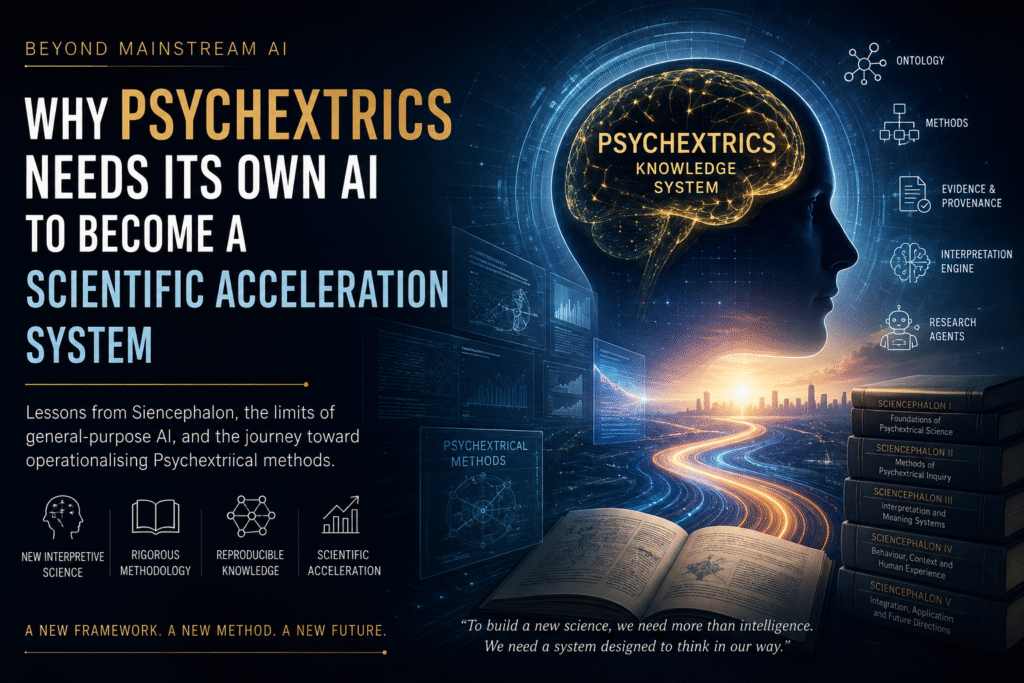
That means the platform must ultimately possess its own methodological framework, interpretation mechanisms, evidence and provenance systems, research capabilities and specialised AI reasoning.
The technology becomes part of the scientific programme.
And the scientific programme, in turn, determines what the technology must be capable of doing.
12. The end of the publication phase
Siencephalon represents an important stage in this process.
After the completion of the five-volume series, there will be no intention to continue producing Psychextrics materials indefinitely simply to accumulate more written material.
The emphasis now changes. The next major development in Psychextrics is not another book. It is the machine.
That machine may take a year. It may take two years. It may take considerably longer. There is no artificial deadline that makes the problem disappear.
Building an independent scientific AI platform is a substantial undertaking involving scientific formalisation, computational research, data, engineering, model development, validation and experimentation.
The work has nevertheless begun.
13. From publication to operationalisation
The significance of this transition should not be underestimated.
The first phase of Psychextrics has largely been concerned with articulating the science.
The next phase is concerned with operationalising the science.
That means moving from:
concept → written explanation
toward:
concept → formal method → computational implementation → reproducible interpretation → empirical testing.
This is a fundamentally different undertaking.
And it is why simply asking existing AI systems to “understand Psychextrics better” is no longer sufficient.
14. A self-reinforcing scientific AI ecosystem
The ultimate vision is therefore not a single application. It is an ecosystem.
Psychextrics develops its own Behavioural-science ontology.
It develops its own methodological framework.
It develops its own interpretation engine.
It develops its own evidence and provenance system.
It develops research agents capable of working with scientific literature and research data.
It develops computational methods that can be tested and revised.
And, eventually, it develops its own foundation and reasoning models.
The relationship then becomes self-reinforcing:
Psychextrical science produces knowledge. The AI operationalises that knowledge.
Researchers use the AI to conduct and analyse research. Research produces new evidence.
Evidence improves the knowledge base. The knowledge base improves the AI.
And the cycle continues.
That is a fundamentally different proposition from putting the word “Psychextrics” into an existing chatbot.
Conclusion: Why this matters
The experience with contemporary AI has not demonstrated that artificial intelligence is incapable of working with Psychextrics.
It has demonstrated something more useful.
It has revealed the point at which a general-purpose AI system reaches the boundary between knowing about a methodology and being structurally equipped to operate within that methodology.
That boundary became increasingly visible during the development of Siencephalon.
The recurring errors were therefore not simply frustrating technical incidents. They became evidence of a technological requirement.
Psychextrics needs an AI system in which Psychextrical methodology is not an instruction temporarily supplied to the model. It needs to become part of the system’s scientific architecture.
That is why the next chapter of Psychextrics is not another volume. It is the development of Psychextrics AI.
Not an AI that merely talks about Psychextrics.
Not an AI that imitates Psychextrical language.
But a scientific AI designed to operationalise, interrogate, test, document and accelerate Psychextrical methods.
The books established the intellectual foundation. The machine is intended to make that foundation computationally operational. And that may ultimately be the more important experiment.
Welcome to Psychextrics!
Back to: 👇