
Our Brain Knows More Than We Know: The Hidden Memories That Never Reach Consciousness
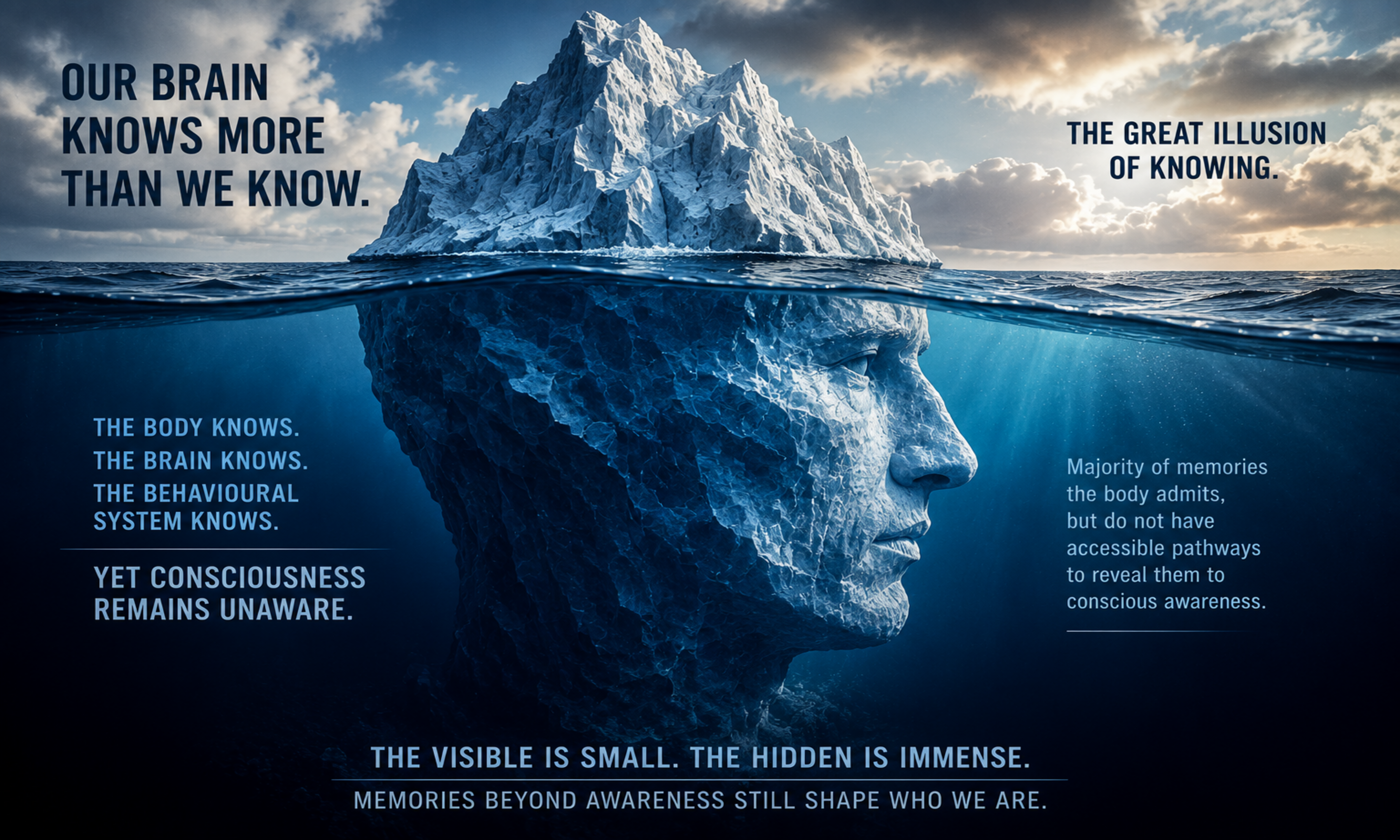
The Great Illusion of Knowing
BY: OMOLAJA MAKINEE
Human beings generally assume that whatever exists inside the mind can eventually become conscious.
If a memory is stored somewhere within the brain, we believe it can be recalled. If an experience leaves a trace, we assume that trace can be revisited. If the brain knows something, we assume that we know it too. The Psychextrics framework challenges this assumption at its foundation.
- The brain and consciousness are not identical.
- Knowledge and awareness are not identical.
- Storage and accessibility are not identical.
Even consciousness and awareness of consciousness are not the same thing.
The brain continuously records, indexes, modifies, and utilises information that never reaches conscious awareness. In many cases, the organism behaves according to information it cannot consciously describe.
- The body knows.
- The brain knows.
- The behavioural system knows.
Yet consciousness remains unaware.
This distinction emerges because the architecture of the brain is not organised around universal accessibility. Information does not automatically become conscious simply because it exists within the nervous system. Every piece of information must travel through specific relay pathways before it can appear on the telencephalic display-screen.
If no pathway exists, awareness never arrives.
- The data remains real.
- The experience remains recorded.
- The behavioural consequences remain active.
Yet the individual never consciously encounters it.
Under Psychextrics, this produces one of the most important principles in the study of behaviour:
The brain knows vastly more than consciousness can ever know.
1. The Difference Between a Gateway and a Relay Civilisation
To understand why hidden knowledge exists, it is first necessary to understand the distinction between the lower cephalic gateways and the Entorhinal Relay.
The lower gateways (Myelencephalon, Metencephalon, Mesencephalon) operate primarily as forward-moving transmission systems.
- They receive information.
- They process information.
- They forward information.
Their architecture is largely linear.
Examples include the Cochlear systems responsible for auditory input, Vestibular systems responsible for balance and orientation, and Collicular systems responsible for rapid environmental tracking.
These structures specialise in movement of information. They are gateways.
The Entorhinal Relay of the Siencephalon operates according to a fundamentally different design. It does not merely forward information.
- It receives.
- It indexes.
- It compares.
- It retrieves.
- It rebroadcasts.
- It stabilises.
It continuously revisits previously stored material and integrates it into present behavioural construction.
Unlike the lower gateways, the Entorhinal system is recursive.
- Its purpose is continuity.
- Its function is behavioural auditing.
Its architecture resembles less a gateway and more a civilisation of relays continuously exchanging information across time. The distinction is profound.
Gateways move information. The Entorhinal Relay negotiates information.
2. The Great Division of Labour Within the Brain
Within the 6-Cephalon architecture, behavioural processing is divided between two major domains.
- The first is the Somato-Valence Engine.
- The second is the Cognito-Recursive Axis.
The Somato-Valence Engine consists primarily of the lower cephalons and their associated valence systems. Its purpose is to generate behavioural reality.
- It produces urgency.
- It produces sensory saliency.
- It produces motor readiness.
- It produces emotional intensity.
It continuously calculates survival.
The Cognito-Recursive Axis performs a different function.
- It manages continuity.
- It manages historical integration.
- It manages behavioural auditing.
- It manages recursive rebroadcasting.
It constructs the continuity required for conscious identity and behavioural memory.
These systems cooperate continuously. Yet they do not possess equal access to one another. This unequal accessibility becomes one of the defining features of consciousness.
The brain records more than the conscious self can retrieve.
3. The Behavioural Auditor of the Brain
The Entorhinal Relay serves as the master auditor of behavioural continuity. Whenever a behavioural event requires integration into memory, the Entorhinal must gather information from across the cephalic hierarchy. It acts as a behavioural investigator. It reconstructs what happened.
- It packages meaning.
- It links emotion to memory.
- It creates continuity.
However, every investigation is limited by available evidence. The Entorhinal can only audit systems to which it possesses access.
- Where direct highways exist, recall becomes rich and detailed.
- Where highways are weak, recall becomes vague.
- Where highways do not exist, conscious awareness becomes inaccesible.
The limits of memory are therefore not determined by storage. They are determined by connectivity.
4. The Thalamic Highway: Why We Remember Words
One of the strongest connections maintained by the Entorhinal Relay exists with the Thalamic Core. This reciprocal relationship creates extraordinary access to narrative reconstruction.
When people recall emotional conversations from years ago, they are often able to reconstruct significant portions of what was said.
- Specific phrases remain accessible.
- Particular expressions survive.
- Distinct emotional language reappears.
This occurs because the Entorhinal can directly compare historical records against the Thalamus’s real-time narrative reconstruction system.
- The Thalamus rebuilds meaning.
- The Entorhinal supplies historical continuity.
Together they recreate linguistic history. The result is not a perfect recording. Yet it is sufficiently detailed to allow coherent narrative recall.
This direct highway is one reason verbal memory occupies such a prominent position within human consciousness.
5. The Hypothalamic Highway: Why Places Can Make Us Feel the Past
The Entorhinal also maintains powerful reciprocal access to the Hypothalamus. This connection provides one of the strongest emotional anchors in behavioural-memory.
The Hypothalamus stores the visceral signature of experience.
- Heart rate.
- Autonomic urgency.
- Physiological stress.
- Hormonal activation.
When the Entorhinal encounters a familiar location associated with a powerful historical event, it can rapidly reactivate these visceral patterns.
An individual driving past the site of a severe accident may suddenly experience racing heartbeat, tightened muscles, sweating palms, and intense vigilance despite being physically safe.
The conscious mind often interprets this as remembering. In reality, the body is partially reliving.
- The Entorhinal has retrieved the spatial coordinates.
- The Hypothalamus has supplied the autonomic intensity.
Together they reconstruct emotional continuity. The memory becomes physically alive.
6. The Subthalamic Blur: What We Cannot Precisely Recall
The situation changes dramatically when examining the Subthalamus.
Unlike the Thalamus and Hypothalamus, the Entorhinal possesses only indirect access to Subthalamic processing.
This limitation produces a remarkable phenomenon. People often remember what happened during highly emotional events while remaining unable to reconstruct precisely how their body moved.
A person involved in a physical confrontation may clearly remember the argument.
- They may remember the fear.
- They may remember the outcome.
Yet they cannot accurately recall the exact trajectory of every limb movement.
- The precise cadence of footsteps becomes unavailable.
- The exact sequencing of defensive reactions becomes inaccessible.
The event survives. The motor microstructure does not.
This is not because the information was never recorded. The information exists.
- The behavioural system utilised it.
- The body executed it.
- The brain processed it.
Yet the Entorhinal lacked sufficient direct access to preserve it within consciously retrievable continuity.
The memory becomes kinetically blurred.
7. The Epithalamic Blindspot
The most fascinating limitation emerges within the Epithalamic domain.
Within the Psychextrics model, the Entorhinal Relay possesses no direct access to the Epithalamic systems responsible for chronobiological regulation and long-term motivational calibration. This creates a profound form of behavioural blindness.
People rarely possess accurate awareness of their own biological chronology. Few individuals can precisely identify the moment a mood state began. Few can accurately determine the exact day emotional exhaustion started accumulating. Few can reconstruct the minute-by-minute progression of motivational decline across an entire week. Even sleep timing becomes surprisingly difficult to recall with precision.
- The organism experiences these processes.
- The brain records these processes.
- Behaviour is influenced by these processes.
Yet consciousness struggles to retrieve them.
The information exists beyond direct Entorhinal visibility. The result is chronobiological blindness.
The individual lives through the data without consciously owning the data.
8. The Difference Between Template Memory and Intensity Memory
This distinction becomes even clearer when comparing ordinary routines with emotionally intense experiences.
The Entorhinal excels at indexing predictable behavioural templates. Routine activities require relatively little emotional modulation.
- A factory worker performing identical tasks for six hours.
- A commuter driving the same route every morning.
- A patient resting in a waiting room.
These events generate highly structured templates. The Entorhinal packages them efficiently. Continuity becomes straightforward.
However, emotionally intense events require far more specialised information.
- A traumatic accident.
- A violent confrontation.
- A severe depressive episode.
- A moment of existential terror.
Here the behavioural system begins generating data streams that extend beyond the Entorhinal’s direct observational reach.
- The memory remains stored.
- The event remains recorded.
Yet parts of the event become inaccessible to conscious reconstruction. The individual recalls the experience without recalling every component of the experience.
9. Hidden Memories Beneath Consciousness
This leads to one of the most radical implications of the Psychextrics framework.
Not every memory exists for conscious recollection.
Some memories exist purely for behavioural regulation.
- The exact number of breaths taken between two moments of terror.
- The precise motor corrections executed during a panic response.
- The subtle chronobiological shift that preceded a depressive episode.
- The microscopic hormonal transitions occurring across a stressful week.
These events may be recorded deep within behavioural systems.
- They may continue influencing future behaviour.
- They may alter prediction.
- They may affect emotional responsiveness.
- They may contribute to future decision-making.
Yet they never become consciously visible. The brain stores them. The organism uses them. The self never sees them.
This creates a profound distinction between memory and awareness.
Conscious memory represents only a fraction of behavioural storage.
10. The Hierarchy of Knowing
The architecture ultimately reveals a hierarchy of awareness.
At the deepest level lie specialised behavioural systems that record information inaccessible to both the Entorhinal Relay and conscious awareness.
Above them sits the Entorhinal Relay, integrating continuity from the information it can access.
Above the Entorhinal sits the Thalamic Relay, which constructs conscious meaning from both immediate reality and historical continuity.
Finally, the Telencephalon displays the finished product.
- At each stage information is filtered.
- At each stage information is compressed.
- At each stage some details remain hidden.
The conscious self therefore receives only the final summary.
The display-screen never receives the complete archive. What appears in awareness is not the entirety of what the brain knows. It is merely the portion that successfully completed the relay journey.
Conclusion: The Hidden Ocean Beneath Consciousness
Human beings often assume that consciousness represents the summit of knowledge within the nervous system.
The Psychextrics model proposes the opposite.
Consciousness is not the totality of knowing. It is the visible tip of a vast behavioural iceberg.
Beneath conscious awareness lies an immense landscape of stored experiences, physiological metrics, behavioural calculations, emotional transitions, motor patterns, chronobiological records, and survival computations that continue shaping behaviour without ever becoming consciously visible.
The Entorhinal Relay serves as the great behavioural auditor, packaging continuity wherever connectivity permits. The Thalamic Relay serves as the narrator, transforming accessible information into conscious meaning. Yet both remain constrained by the architecture of their access.
Some memories are fully recallable. Some memories are partially reconstructable. Some memories remain permanently hidden within the deeper machinery of behavioural existence.
The result is a humbling conclusion.
We do not know everything our brain knows.
Much of what makes us who we are never reaches the screen of awareness. The brain remembers more than consciousness can remember. The organism knows more than the self can ever know.
And the deepest layers of behavioural reality continue their silent work far beyond the limits of conscious observation.
Back to: 👇