
The Anatomical Difference Between the Entorhinal Relay and the Thalamic Relay: How the Present and the Past Reach Different Cortical Destinations
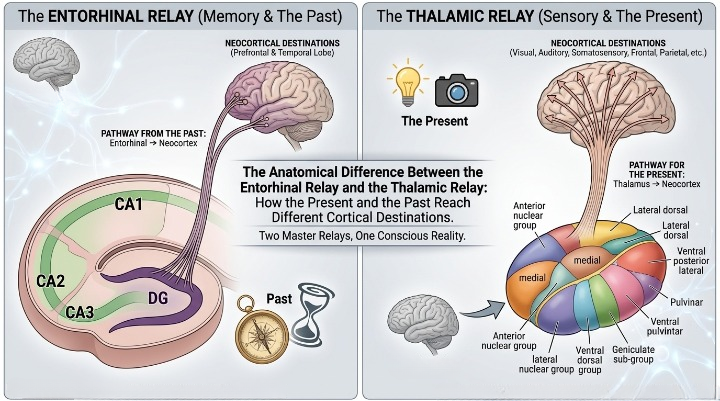
Two Master Relays, One Conscious Reality
BY: OMOLAJA MAKINEE
Within the architecture of Psychextrics, the two master relay systems do not communicate with the cortex in the same manner.
This distinction is often obscured because both the Thalamic Relay and the Entorhinal Relay ultimately influence conscious experience. From the perspective of the organism, both seem to participate in constructing reality.
- Both shape behaviour.
- Both contribute to awareness.
- Both influence decision-making.
Yet beneath this apparent similarity lies a profound anatomical divergence. The Thalamus and the Entorhinal Relay do not target the same cortical territories.
They do not deliver the same type of information. They do not operate on the same temporal scale. Nor do they participate equally in the construction of conscious reality.
The Thalamus is fundamentally a relay of present urgency. The Entorhinal Relay is fundamentally a relay of historical continuity. The Thalamus projects intensity. The Entorhinal projects indexed continuity.
The Thalamus asks: “What is happening right now?“
The Entorhinal asks: “What does the organism already know about this?“
The living experience of consciousness emerges where these two questions converge.
Understanding the anatomical differences between these relay systems therefore reveals how the brain continuously weaves the present moment into personal history.
1. Why Every Cephalon Requires a Relay Infrastructure
Every cephalic territory requires a mechanism capable of transferring information beyond simple intake and translation.
- Gateways transmit and receive.
- Relays integrate and distribute.
Without relay systems, information would remain trapped within local processing loops.
- The Myelencephalon transmits visceral vigilance.
- The Metencephalon transmits kinetic stability information.
- The Mesencephalon transmits orientational saliency vectors.
- The Diencephalon transmits contextual and emotional weighting.
Yet none of these systems can independently create conscious reality.
They require relay infrastructures capable of transmitting their outputs toward the behavioural display apparatus of the Telencephalon.
Within the Somato-Valence Engine, this responsibility falls primarily upon the Thalamus.
Within the Siencephalon, this responsibility falls primarily upon the Entorhinal.
Although both possess cortical access, the destinations of their projections differ dramatically.
2. The Fundamental Division of Labour
The relationship between these two systems follows a strict architectural principle.
- The Thalamus specialises in immediacy. The Entorhinal specialises in continuity.
- The Thalamus specialises in emotional intensity. The Entorhinal specialises in behavioural integration.
- The Thalamus specialises in sensory valuation. The Entorhinal specialises in behavioural indexing.
Consequently, they do not compete for the same cortical territories. Instead, they divide cortical labour strategically.
Primary sensory regions remain overwhelmingly thalamic. Behavioural continuity systems remain overwhelmingly entorhinal. Only specific paralimbic territories allow both systems to converge.
This separation prevents the organism from confusing raw sensory reality with historical prediction.
3. The Thalamic Relay: The Distributor of Present Reality
The Thalamus possesses direct access to nearly every major sensory and executive display system within the revised Telencephalon. Its architecture is designed to rapidly distribute incoming behavioural urgency. The primary sensory cortices therefore belong almost entirely to thalamic infrastructure.
- Visual information reaches the Primary Visual Cortex through the Lateral Geniculate Nucleus.
- Auditory information reaches the Primary Auditory Cortex through the Medial Geniculate Nucleus.
- Somatosensory information reaches the Rolandic cortex through the Ventral Posterolateral and Ventral Posteromedial nuclei.
- Motor planning systems receive thalamic input through ventrolateral pathways.
These projections terminate primarily within Layer IV of the six-layered display cortex.
This arrangement ensures that sensory fidelity remains uncompromised. The organism receives reality before interpretation. Urgency before memory. Stimulus before history.
The Thalamus therefore dominates the cortical territories responsible for displaying the immediate present.
4. Why the Entorhinal Relay Avoids Primary Sensory Cortex
The Entorhinal Relay serves an entirely different purpose. Its role is not to transmit sensory reality. Its role is to transmit indexed continuity. Consequently, it bypasses the primary sensory cortices almost completely.
- It possesses no meaningful monosynaptic projection into the Primary Visual Cortex.
- It possesses no direct pathway into the Primary Auditory Cortex.
- It possesses no direct access to the Primary Somatosensory Cortex.
- It possesses no direct influence over Primary Motor Cortex.
This exclusion is not accidental. It is protective.
If historical indexing were allowed to directly contaminate primary sensory fields, sensory accuracy would collapse. Raw perception would become inseparable from memory reconstruction. Reality would constantly be overwritten by prediction.
Psychextrics therefore proposes a strict anatomical firewall between sensory telemetry and behavioural continuity systems.
The Thalamus owns the sensory screens. The Entorhinal owns the continuity infrastructure.
5. Executive Isolation and the Protection of Symbolic Narration
The same principle extends into higher executive territories. Regions such as the Dorsolateral Prefrontal Cortex and Broca’s Area remain overwhelmingly thalamic in their direct relay dependencies.
The Mediodorsal nucleus projects extensively into the DLPFC. Pulvinar and ventral anterior systems support symbolic language networks. The Entorhinal Relay contributes only indirectly through multisynaptic hippocampal pathways.
This separation serves a critical purpose. Symbolic narration must remain flexible. Template memory must remain dynamic. Language generation must remain capable of responding to immediate contextual demands.
Direct entorhinal injection into these regions would risk locking symbolic systems into rigid historical templates. By maintaining separation, the organism preserves adaptive flexibility while still benefiting from deeper behavioural continuity operating elsewhere.
6. The Three Great Convergence Zones
Although the two relay systems remain largely segregated, complete separation would be equally problematic. The organism must eventually integrate present urgency with historical knowledge. For this reason, Psychextrics identifies three major convergence territories:
- The Orbitofrontal Cortex.
- The Anterior Cingulate Cortex.
- The Anterior Insular Cortex.
These regions occupy transitional paralimbic territory. They exist precisely at the border between sensory valuation, behavioural execution, and self-state construction.
Unlike primary sensory fields, these regions are specifically designed to receive both languages simultaneously.
The language of immediacy. And the language of continuity.
7. The Orbitofrontal Cortex: The Valuation–Blueprint Bridge
The Orbitofrontal Cortex represents the first major convergence point.
The Thalamus delivers the current value of an object.
- Its urgency.
- Its reward potential.
- Its threat potential.
- Its relevance.
Simultaneously, the Entorhinal Relay delivers historical behavioural packet associated with that object.
- Past successes.
- Past failures.
- Past consequences.
- Past behavioural solutions.
The Orbitofrontal Cortex functions as the intersection where these two streams become unified. Present value is compared against historical strategy.
The organism determines not only whether something matters now, but whether it has mattered before and how it was previously handled.
This convergence transforms simple valuation into behavioural selection.
8. The Anterior Cingulate Cortex: The Motor Execution Bridge
The Anterior Cingulate Cortex performs a second convergence function.
The Thalamus delivers current contextual urgency. The Entorhinal Relay delivers indexed behavioural sequences. The Anterior Cingulate Cortex merges these streams into executable behavioural output.
- Current threat.
- Past solutions.
- Current uncertainty.
- Historical strategies.
- Current conflict.
- Stored action plans.
The Anterior Cingulate Cortex therefore functions as a behavioural arbitration system. It translates continuity into action.
9. The Anterior Insular Cortex: The Integrated Self-State
The third convergence territory lies within the Anterior Insula.
The Insula must construct the organism’s momentary self-state. To accomplish this, neither relay is sufficient alone. The Thalamus supplies real-time bodily urgency. The Entorhinal Relay supplies historical bodily context. The Insula integrates both.
The result becomes the conscious sensation that: “This is how I feel.”
In Psychextrics, this feeling is not generated by emotion alone. Nor by memory alone. It emerges from the convergence of present visceral intensity and indexed behavioural continuity.
The self becomes assembled where these two streams meet.
10. Spatiotemporal Continuity: The Meeting of Past and Present
The convergence of the Thalamic and Entorhinal Relays creates what Psychextrics defines as Spatiotemporal Continuity.
The Thalamus supplies temporal immediacy. The Entorhinal Relay supplies historical depth. One provides the present. The other provides the past. The Telencephalon renders both simultaneously.
Conscious experience therefore becomes neither pure sensation nor pure memory. Instead, it becomes a unified behavioural reality in which the present moment appears seamlessly connected to personal history.
This synthesis creates the illusion that consciousness itself possesses continuity. In reality, continuity is being actively assembled by the convergence of these two relay systems.
11. When the Relays Separate
The most revealing evidence for this architecture emerges when the relays temporarily decouple.
During acute trauma, thalamic intensity may dominate.
- Urgency overwhelms continuity.
- Experience becomes fragmented.
- Timeless.
- Overwhelmingly immediate.
- Historical context disappears.
- The present consumes everything.
Conversely, during phenomena resembling déjà vu, continuity may temporarily dominate. Historical indexing arrives before proper sensory validation. The present moment is experienced as strangely familiar despite being objectively new.
In both cases, consciousness becomes fractured because the two relay streams are no longer synchronised. The organism experiences either too much present or too much past.
Normal consciousness requires both.
Conclusion: Where History Meets Urgency
The Thalamic Relay and the Entorhinal Relay perform the same broad function—both deliver behavioural reality toward the cortical display system—but they accomplish this through fundamentally different anatomical routes.
- The Thalamus projects intensity. The Entorhinal projects continuity.
- The Thalamus dominates sensory and executive display systems. The Entorhinal dominates behavioural indexing and historical stabilisation.
- The Thalamus delivers what is happening now. The Entorhinal delivers what has happened before.
Their separation preserves the accuracy of perception. Their convergence creates the continuity of identity.
Within the Orbitofrontal Cortex, Anterior Cingulate Cortex, and Anterior Insular Cortex, these two relay systems finally meet. There, the present is married to the past. Urgency is married to memory. Valence is married to continuity.
And from that union emerges the coherent behavioural reality that appears upon the telencephalic screen as the lived experience of being a conscious human being.
Back to: 👇