
Why Meaning Wins: How the Siencephalon Resolves Competing Emotional Valences into a Single Behavioural Directive
The Problem of Behavioural Contradiction
BY: OMOLAJA MAKINEE
Human behaviour often appears contradictory when viewed from the outside. Individuals regularly perform actions that seem incompatible with their emotional experiences.
- A person who enjoys violent combat games may become traumatised when confronted with actual violence.
- A soldier who acts decisively during combat may later experience profound regret over actions that were necessary for survival.
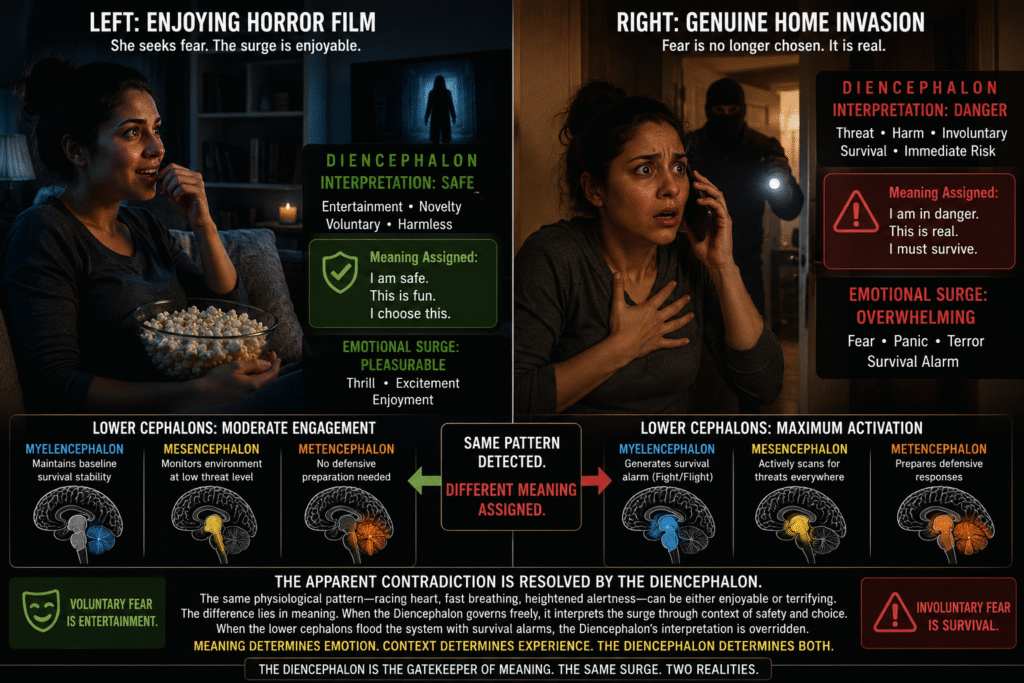
- An individual who enjoys the adrenaline of horror films may become overwhelmed by terror during a genuine home invasion.
- Someone who dreams of adventure may freeze when confronted with real danger.
Traditional psychological explanations often attribute such contradictions to personality differences, emotional instability, cognitive dissonance, or situational stress. While these explanations may describe the phenomenon, they do not fully explain why the same detected pattern can simultaneously generate attraction and aversion within the same individual.
The Psychextric framework approaches this problem from a different direction. It proposes that behaviour emerges from the interaction of multiple cephalic systems that may each generate different emotional valences toward the same detected pattern.
More importantly, it proposes that although multiple emotional valences may compete for influence, they do not possess equal authority during behavioural compilation. The Diencephalon occupies a privileged position because it provides behavioural meaning, contextual valuation, and interpretive significance. Through the Siencephalon’s relay architecture, diencephalic emotional valence frequently becomes the organising principle that determines the final behavioural directive presented to conscious awareness.
Understanding this process requires understanding the difference between emotional experience and behavioural meaning.
1. The Existence of Multiple Emotional Valences
Within the Psychextric model, emotional valence is not generated by a single unified emotional system. Different cephalons contribute different forms of behavioural significance.
- The Myelencephalon contributes survival-oriented realities.
- The Metencephalon contributes behavioural execution and adaptive response realities.
- The Mesencephalon contributes orientational and environmental realities.
- The Diencephalon contributes contextual meaning, symbolic interpretation, future consequences, social significance, and behavioural valuation.
Each of these systems may attach a different emotional significance to the same detected pattern.
A detected pattern involving violence, for example, may simultaneously activate fear, empathy, duty, survival, protection, curiosity, hesitation, determination, guilt, or attraction.
These emotional valences do not necessarily agree with one another. In many circumstances they directly oppose one another.
The nervous system therefore faces a problem. Multiple emotional realities may coexist, but behaviour ultimately requires a single behavioural output.
The organism cannot simultaneously attack and retreat. It cannot simultaneously advance and freeze. It cannot simultaneously protect and abandon.
A behavioural decision must eventually emerge. The question is how this decision is produced.
2. The Role of the Siencephalon as Behavioural Compiler
The Psychextric model assigns this responsibility to the Siencephalon.
The Siencephalon serves as the behavioural integration and packaging architecture of the forebrain. Through the Entorhinal Relay, it continuously receives converging information from the lower cephalons.
During forward relay, emotional contributions generated by the Myelencephalon, Metencephalon, Mesencephalon, and Diencephalon are directed into hippocampal indexing architecture.
These contributions are not stored as isolated emotional events. Instead, they are compared against existing detected patterns, contextual memories, inherited templates, emotional associations, and previous behavioural outcomes.
The Siencephalon then performs a process of behavioural compilation. Its task is not merely to identify which emotional signal is strongest. Its task is to transform competing emotional realities into a coherent behavioural directive. This distinction is crucial.
The strongest physiological signal does not always determine behaviour. Meaning determines behaviour.
The Diencephalon specialises in meaning. Consequently, the emotional valence generated by the Diencephalon frequently becomes the interpretive framework through which all competing emotional inputs are organised.
3. Why the Diencephalon Occupies Behavioural Priority
The lower cephalons provide reality. The Diencephalon provides interpretation. This difference gives the Diencephalon unique authority during behavioural compilation.
- Fear alone does not determine behaviour. The meaning assigned to fear determines behaviour.
- Pain alone does not determine behaviour. The meaning assigned to pain determines behaviour.
- Risk alone does not determine behaviour. The meaning assigned to risk determines behaviour.
The Diencephalon is therefore not simply contributing another emotional valence alongside the others. It is contributing the framework that explains why one emotional valence should be prioritised over another.
When the Siencephalon assembles behavioural directives, the Diencephalon effectively supplies the argument. The lower cephalons provide evidence. The Diencephalon provides justification.
This does not mean that lower-cephalic emotional valences disappear. They remain present within the integrated behavioural package. However, they are frequently subordinated to the behavioural meaning generated by the Diencephalon.
The final conscious experience therefore often reflects the triumph of meaning over immediate physiological preference.
4. The Soldier Who Regrets What Was Necessary
This process becomes particularly visible in situations involving self-defensive violence.
Imagine a soldier confronted with an immediate threat to life. The Myelencephalon may generate fear. The Metencephalon may generate confrontation. The Mesencephalon may continuously signal danger. Simultaneously, the Diencephalon may generate an emotional valence attached to duty, protection, survival, loyalty, or responsibility.
All of these emotional realities enter the Siencephalon through forward relay. All become attached to the same detected pattern. All compete for behavioural influence. Yet a behavioural directive must emerge.
Because the Diencephalon has already assigned greater significance to protecting comrades, the confrontation generated by the Metencephalon becomes behaviourally justified to the organism.
If the Metencephalon generates fear rather than confrontation, the soldier’s emotional capacity to carry out the Diencephalic significance of protection becomes impeded by fear of engaging in the act itself.
The Diencephalon may assign greater significance to survival than hesitation. It may assign greater significance to duty than personal discomfort. However, the emotional valences generated by the lower cephalons are the systems that engage directly with the reality of action. Diencephalic meaning alone remains contextual significance until one or more lower cephalons provide compatible physiological participation.
When the Siencephalon compiles the behavioural package, Diencephalic meaning organises the competing emotional contributions into a coherent directive.
- The soldier acts because the Metencephalon generates confrontation rather than fear.
- Violence is performed despite the Mesencephalon continuously signalling danger because the Metencephalon remains engaged in confrontation.
- The threat is neutralised because the Metencephalon engages even when the Myelencephalon and Mesencephalon contribute competing emotional realities.
At the moment of action, the Diencephalon wins the behavioural argument precisely because at least one lower cephalon provides compatible participation. If the Metencephalon generates fear and none of the lower cephalons engage in neutralising the threat in their own way, the Diencephalon still wins the behavioural argument through subsequent regret over the failure to act. The behavioural meaning remains unchanged even though the behavioural outcome differs.
However, the lower-cephalic emotional valences never disappear. They are merely subordinated. After the event, those emotional realities remain available for future compilation. The same individual may later experience regret, guilt, grief, empathy, or distress when reflecting upon what occurred.
This does not mean the original action was inconsistent. It means different behavioural compilations are being performed under different contexts. The behaviour occurred because Diencephalic meaning achieved dominance during action.
The regret emerges because the same Diencephalic meaning remains attached to the detected pattern even after the opportunity for action has passed.
5. The Horror Film Enthusiast and the Home Invasion
The same principle can be observed in less extreme circumstances.
Consider an individual who enjoys horror films. The person actively seeks experiences involving fear, suspense, uncertainty, and danger. The emotional surge generated by these experiences is enjoyable.
Yet suppose that same individual experiences a genuine home invasion. The physiological realities immediately change. The Myelencephalon generates survival alarm. The Mesencephalon monitors environmental threat. The Metencephalon prepares defensive responses. The resulting emotional intensity may become overwhelming.
From the outside, this appears contradictory. How can someone enjoy fear in one situation and despise it in another? The answer lies in the Diencephalon.
While watching a horror film, the Diencephalon assigns meaning associated with entertainment, novelty, safety, and voluntary participation. The detected pattern is interpreted through a framework of harmless engagement.
During a home invasion, the Diencephalon assigns entirely different meanings because the hormonal surge of lower cephalons has caused interruption to its sole governance over the same detected pattern.
The same physiological sensations become associated with vulnerability, mortality, loss, and irreversible consequences. The emotional valence generated by meaning changes. The detected pattern remains recognisable. The behavioural significance does not.
Again, the Diencephalon determines which interpretation dominates Siencephalic compilation. The conscious experience reflects the meaning assigned to the event rather than the physiological sensation alone.
6. Meaning as the Architect of Conscious Awareness
The significance of this process extends beyond behaviour itself. The final behavioural directive compiled by the Siencephalon is transmitted through feedback relay toward the Telencephalon.
The Telencephalon does not receive raw emotional inputs from competing cephalons. Instead, it receives an already integrated behavioural package. By the time information reaches conscious awareness, the competition has largely been resolved. Consciousness therefore experiences the conclusion rather than the debate.
The individual becomes aware of a unified intention, decision, perception, or behavioural inclination. The afterthoughts experienced later often reflect the behavioural trajectory originally preferred by the Diencephalon but not fully realised by the participating lower cephalons.
Regret, wishful thinking, guilt, or self-criticism frequently emerge because the Diencephalon continues to assign significance to the same detected pattern even after the moment of action has passed. The countless competing emotional negotiations that produced that conclusion remain largely hidden within the integration architecture of the Siencephalon.
This explains why people often struggle to understand their own contradictions. They experience the behavioural directive. They do not directly experience the compilation process that created it. The conscious self therefore mistakes the final package for the entirety of behavioural reality.
Conclusion: Behaviour as the Triumph of Meaning
The Psychextric model ultimately proposes that behaviour cannot be understood merely by examining emotional intensity. Intensity alone does not determine action. Multiple intense emotional valences may coexist simultaneously. The decisive factor is behavioural meaning.
- The Diencephalon supplies this meaning.
- The Siencephalon compiles it.
- The Telencephalon displays it.
Consequently, behaviour frequently reflects the emotional valence that best explains why action should occur rather than the emotional valence that feels most comfortable.
- A frightened soldier may still fight because the Metencephalon engages in confrontation.
- A terrified parent may still enter a burning building to rescue a child because the Metencephalon cannot remain behaviourally idle.
- A reluctant individual may still act in defence of another person because the Myelencephalon or Mesencephalon refuses to tolerate the unfolding reality of injustice, even when the Metencephalon generates competing emotional valences.
- A person may pursue a goal despite anxiety, exhaustion, uncertainty, or discomfort because one or more lower cephalons remain compatible with the Diencephalic significance attached to that detected pattern.
In each case, lower-cephalic emotional realities remain active. However, the Diencephalon provides the behavioural meaning capable of organising those realities into a coherent directive.
The result is one of the central principles of Psychextrics:
Behaviour is not governed by the loudest emotional signal. Behaviour is governed by the emotional valence that successfully establishes behavioural meaning during Siencephalic compilation.
The lower cephalons provide reality, but the Diencephalon provides purpose. When competing emotional valences converge upon the same detected pattern, purpose frequently determines which reality becomes behaviour.
Back to: 👇