
Why the Siencephalon Hosts the Piriform Cortex for the Telencephalon
BY: OMOLAJA MAKINEE
One of the most difficult architectural questions produced by the 6-Cephalon Model emerges immediately after the separation of the Siencephalon from the Telencephalon.
If the revised Telencephalon is the exclusive behavioural display interface of the organism, where does smell belong?
At first glance, the answer appears obvious. Conscious smell is consciously experienced. Anything consciously experienced should belong to the display system. The problem is that olfaction stubbornly refuses to obey the rules followed by every other sensory modality.
Vision follows the rules. Hearing follows the rules. Touch follows the rules. Olfaction does not.
The piriform cortex stands as one of the strangest structures in the entire brain because it behaves like a display surface while simultaneously possessing anatomical characteristics that completely exclude it from the revised Telencephalon.
The result is a structural paradox that forces Behavioural science to confront one of its deepest assumptions regarding consciousness itself.
1. The Display Problem of Smell
Once the Siencephalon is extracted from the traditional Telencephalon, the revised Telencephalon becomes a remarkably clean anatomical territory.
- It houses sensory display systems.
- It houses symbolic rendering systems.
- It houses reflective awareness.
- It houses language-based narration.
- It houses associative display networks.
In short, it becomes a six-layered behavioural theatre.
Every sensory reality reaching consciousness appears there. Every symbolic thought appears there. Every reflective experience appears there.
Yet smell presents an immediate complication. Unlike vision, hearing, and touch, olfactory perception does not arrive through the standard thalamic architecture that dominates neocortical display.
Instead, smell travels through the olfactory-bulb and projects directly into its own separate cortical territories associated with the rhinencephalon.
Among these territories sits the piriform cortex. The piriform cortex clearly contributes to conscious smell perception. Yet it lacks the very architectural features that define the revised Telencephalon.
2. The Six-Layer Rule
Within the Psychextric model, the Telencephalon is not simply a geographical territory. It is an operational territory.
Its defining feature is the six-layered display architecture. The entire display civilisation operates through six-layered neocortical organisation.
- Visual cortex.
- Auditory cortex.
- Somatosensory cortex.
- Language cortex.
- Association cortex.
All participate in the six-layered display format.
This architecture is not arbitrary. It evolved specifically to support symbolic representation. It enables cross-modal integration. It supports abstract cognition. It supports language. It supports reflective awareness. Most importantly, it allows sensory information to be organised into structured spatial and symbolic coordinates.
The six-layered display system excels at geometry.
- Vision can be mapped.
- Sound frequencies can be mapped.
- Body surfaces can be mapped.
- Language symbols can be mapped.
The display-cortex thrives when reality can be converted into orderly coordinates.
The chemical world of smell cannot.
3. Why Chemical Reality Breaks the Display System
Odours possess none of the organisational properties that make vision or hearing suitable for neocortical display.
- There is no olfactory equivalent of visual space.
- There is no olfactory equivalent of auditory frequency.
- There is no olfactory equivalent of tactile geometry.
Odours exist as enormously complex chemical combinations.
A single scent may contain hundreds of molecular signatures interacting simultaneously. Their behavioural meaning emerges from combinatorial relationships rather than simple spatial coordinates. This creates a problem.
The six-layered display system evolved for ordered mapping. Olfaction presents disorderly chemistry. The cortical solution was not to redesign the entire neocortex. The cortical solution was to preserve an older architecture.
4. The Survival of the Paleocortex
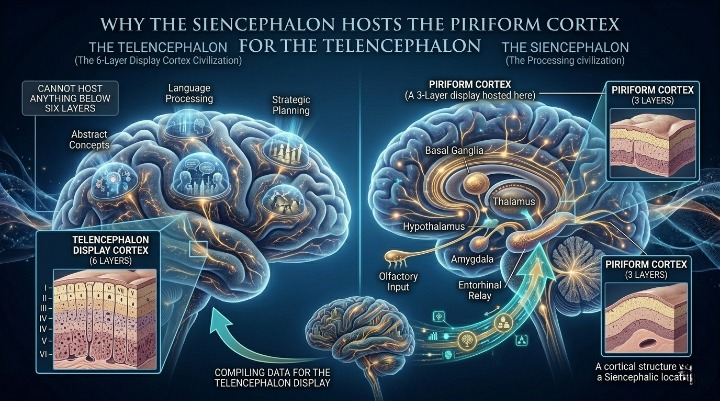
Unlike the six-layered neocortex, the piriform cortex possesses a three-layered allocortical organisation. It lacks the classical granular Layer IV that characterises thalamic input zones throughout the neocortex.
It does not require the standard thalamic gateway. It does not depend upon the same relay infrastructure that supports visual or auditory display. Instead, it receives olfactory information through direct routes originating from the olfactory-bulb.
This arrangement is not an architectural defect. It is an engineering necessity. The chemical world of smell requires a different display technology. The piriform cortex emerge because the primary six-layered display system is fundamentally unsuited to perform that job.
5. The Refuge Problem
At this point the architectural dilemma becomes unavoidable.
If the piriform cortex performs conscious display functions, it cannot belong entirely to the hidden processing machinery of the Siencephalon. Yet if it possesses only three layers and not six, it cannot belong to the revised Telencephalon either.
The Telencephalon cannot host cortical territories with fewer than six layers because the six-layer structure defines the operational identity of the primary display civilisation itself.
This forces an unexpected conclusion. The Siencephalon must provide refuge.
The Siencephalon becomes the only cephalic territory capable of hosting an allocortical display surface without violating the architectural integrity of the Telencephalon. The piriform cortex therefore becomes cortical in function but siencephalic in location.
It is consciously experienced. Yet it remains physically embedded within the integration machinery of the brain.
6. The Siencephalon as the Generous Host
This solution reveals something profound about the nature of the Siencephalon.
The Siencephalon is not merely a storage facility. It is not merely an integration centre. It is the only cephalic territory broad enough to accommodate every form of behavioural information regardless of format.
The lower cephalons each possess specialised gateways. The Diencephalon possesses valuation gateways. The Telencephalon possesses display surfaces. The Siencephalon alone serves all of them simultaneously.
It already houses the Entorhinal gateway. It already houses memory indexing systems. It already houses emotional tagging systems. It already houses relay infrastructures. Now it also becomes the host territory for the piriform display system.
Not because the piriform cortex belongs to the Telencephalon. But because the Telencephalon lacks the architectural machinery required to support it.
The Siencephalon becomes the larger civilisation that accommodates what the neocortical display mantle cannot.
7. Why This Strengthens the Display Theory
Critics might assume that placing a conscious display structure inside the Siencephalon weakens the distinction between integration and display.
The opposite is true. It strengthens it.
The piriform cortex exists precisely because the standard display architecture fails for chemical reality. It is the exception that proves the rule.
If the Telencephalon were truly the universal generator of consciousness, the piriform cortex would eventually have been absorbed into the six-layered display mantle. It was not.
Instead, evolution preserved a separate display mechanism embedded directly within the olfactory-integration complex. The brain effectively admits that not all conscious displays require the same hardware.
What matters is not location. What matters is function.
- The piriform cortex displays.
- The Entorhinal integrates.
- The Amygdala weights.
- The Hippocampus indexes.
Their proximity does not erase their specialised roles.
Conclusion: The Final Lesson of the Piriform Cortex
The piriform cortex ultimately teaches a larger lesson about the architecture of consciousness.
The Telencephalon does not project consciousness. It receives consciousness.
- It possesses no independent gateway.
- It possesses no originating relay.
- It possesses no primary behavioural engine.
Its role is reception and display.
The piriform cortex survives outside this civilisation because smell requires a different display technology than the six-layered neocortex can provide. The Siencephalon therefore acts as both host and protector.
It provides an anatomical refuge for a form of conscious display that cannot exist within the revised Telencephalic framework. In doing so, it exposes the true hierarchy of the cephalic civilisation.
The lower cephalons generate behavioural streams. The Diencephalon values those streams. The Siencephalon integrates, records, relays, and when necessary even hosts specialised display surfaces. Only after this immense infrastructure completes its work does the Telencephalon illuminate the final symbolic projection.
The piriform cortex is therefore not a violation of the 6-Cephalon Model. It is one of its strongest pieces of supporting evidence.
It demonstrates that the brain was willing to preserve an entire allocortical display system rather than force chemical reality into a display architecture that was never designed to handle it.
And in doing so, it confirms the central Psychextric proposition:
The Telencephalon is not the source of consciousness. It is the final theatre in which consciousness is shown.
Back to: 👇