
The Cephalic Service Architecture: Local Functional Units and Global System Cores
BY: OMOLAJA MAKINEE
One of the most persistent problems in modern Neuroscience is that the brain is usually described as a collection of structures rather than a hierarchy of services.
Thousands of pages have been written describing nuclei, gyri, pathways, neurotransmitters, circuits, and networks. Yet despite this enormous accumulation of anatomical detail, a fundamental organisational question remains largely unanswered:
Why do some brain regions exist solely to serve themselves, while others exist to serve the entire organism?
The Psychextric framework approaches the brain from this architectural perspective.
Rather than viewing the nervous system as a flat collection of interacting structures, Psychextrics proposes that the cephalic hierarchy is organised according to a segmented service architecture.
- Some cephalons function as local operators. Others function as global coordinators.
- Some exist to execute specialised tasks. Others exist to integrate, distribute, store, evaluate, and display the outputs of every other system.
This distinction creates a profound division within the six-cephalon model.
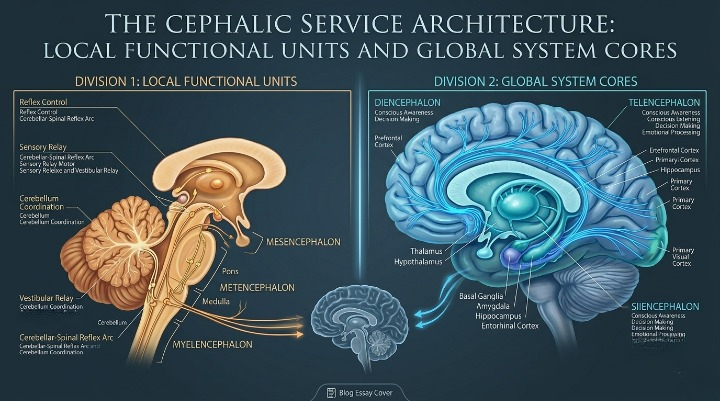
The lower cephalons operate as Local Functional Units. The upper cephalons operate as Global System Cores.
Understanding this distinction reveals why the classical model struggled to explain how segmented brain unifies behaviour.
1. The Hidden Divide Inside the Brain
The traditional five-vesicle model treated the brain largely as a continuous anatomical territory. Structures differed in complexity, but they remained members of the same broad organisational civilisation. Psychextrics argues that this approach concealed a deeper reality.
The cephalic hierarchy is not flat. It is layered. The lower levels are specialised service providers. The upper levels are shared service platforms.
This creates two fundamentally different classes of biological hardware. The first class exists to execute local behavioural functions. The second class exists to integrate information across the entire organism.
Once this distinction becomes visible, the architecture of behaviour begins to organise itself.
2. The Local Functional Units
The Myelencephalon, Metencephalon, and Mesencephalon form the first category. These are the Local Functional Units.
- Each operates within a highly specialised domain.
- Each performs tasks essential for survival.
- Each possesses dedicated gateways.
- Each possesses dedicated processing loops.
Yet none possesses authority over the entire organism.
- The Myelencephalon governs survival vigilance. It maintains respiratory stability, cardiovascular regulation, autonomic monitoring, and the foundational requirements of biological continuity.
- The Metencephalon governs kinetic stability. It continuously refines posture, movement, coordination, motor sequencing, and physical execution.
- The Mesencephalon governs spatial orientation. It tracks environmental geometry, visual targeting, acoustic localisation, directional awareness, and orienting behaviour.
These systems are extraordinarily powerful. Yet their power remains localised. They do not exist to build a unified behavioural reality. They exist to maintain specialised behavioural services.
They resemble municipal departments rather than central government. Each performs its assigned task. None supervises the entire civilisation.
3. Why the Lower Cephalons Cannot Create Conscious Unity
One of the most important implications of this segmented architecture is that the lower cephalons cannot independently generate a coherent conscious self.
Each operates according to its own priorities. Each processes a different category of reality. Each speaks a different biological language.
The Myelencephalon speaks survival. The Metencephalon speaks movement. The Mesencephalon speaks orientation. Because they are local service units, they do not naturally unify their outputs into a single behavioural narrative.
Without higher integration, behaviour would remain fragmented. Survival signals would compete with motor signals. Motor signals would compete with orientation signals. No common behavioural ledger would exist.
The organism would function. But it would not experience itself as a coherent whole. This limitation creates the necessity for an entirely different class of cephalic infrastructure.
4. The Rise of the Global System Cores
The Diencephalon, Siencephalon, and Telencephalon form the second category. These are the Global System Cores.
Unlike the lower cephalons, these territories do not exist to serve a single behavioural domain. They exist to serve every domain simultaneously. Their function is organisational. Their function is integrative. Their function is civilisational.
- The Diencephalon acts as the organism’s valuation authority.
- The Siencephalon acts as the organism’s integration authority.
- The Telencephalon acts as the organism’s display authority.
Together they create a unified behavioural civilisation from the fragmented outputs of the lower cephalons.
5. The Diencephalon: The Universal Meaning Hub
The first Global System Core is the Diencephalon.
Within Psychextrics, its role extends far beyond traditional sensory relay. The Diencephalon functions as the universal valuation engine. Every lower cephalon eventually encounters diencephalic processing.
Survival information receives threat weighting. Motor information receives energetic valuation. Spatial information receives contextual significance.
The Diencephalon determines what matters. It determines urgency. It determines saliency. It determines behavioural priority. In this sense, it serves the entire organism rather than any individual subsystem.
Its role is global.
6. The Siencephalon: The Universal Integration Hub
Above the Diencephalon sits the architectural centrepiece of the Psychextric model. The Siencephalon.
If the Diencephalon decides what matters, the Siencephalon decides what becomes integrated. This territory functions as the organism’s central recording infrastructure, routing network, indexing platform, behavioural archive, and relay civilisation.
Unlike the lower cephalons, which process only their own specialised streams, the Siencephalon maintains dedicated relay systems for every major cephalic tier. This distinction is critical.
The Siencephalon does not belong to a single sensory modality. It does not belong to a single behavioural category. It belongs to all of them.
- The Cingulate system interfaces with survival baselines.
- The Basal Ganglia interfaces with kinetic stability.
- The Parahippocampal systems interface with spatial orientation.
- The Perirhinal systems interface with contextual valuation.
- The Entorhinal system interfaces with conscious display.
No other cephalon possesses this level of universal connectivity. No other cephalon maintains dedicated bridges across the entire hierarchy.
The Siencephalon becomes the organism’s great translation house. Every major behavioural language passes through it.
7. Why the Siencephalon Occupies the Architectural Centre
The importance of the Siencephalon does not emerge from symbolism. It emerges from infrastructure.
Every stimulus entering the organism eventually arrives within siencephalic territory for integration, indexing, stabilisation, coordination, or routing.
Not every stimulus reaches conscious display. Not every stimulus becomes awareness. But every major and minor behavioural stream becomes known to the Siencephalon. This creates a unique architectural position.
- The Myelencephalon knows survival.
- The Metencephalon knows movement.
- The Mesencephalon knows orientation.
- The Diencephalon knows valuation.
- The Telencephalon knows display.
Only the Siencephalon knows all of them simultaneously.
Its authority emerges from integration. Its superiority emerges from access. Its centrality emerges from architecture.
8. The Telencephalon: The Universal Display Screen
The final Global System Core is the Telencephalon.
Yet unlike the other two global cores, the Telencephalon performs neither valuation nor integration. Its function is display. It acts as the common rendering surface shared by every lower system.
- The survival outputs of the Myelencephalon appear there.
- The motor outputs of the Metencephalon appear there.
- The spatial outputs of the Mesencephalon appear there.
- The contextual outputs of the Diencephalon appear there.
- The integrated packages of the Siencephalon appear there.
The Telencephalon serves as the universal theatre where the entire cephalic civilisation becomes visible. It is the parlour arena where all cephalons comes to play and commune with one another.
It is not the producer. It is the screen.
9. The Brain as a Segmented Service Architecture
Once the distinction between Local Functional Units and Global System Cores becomes visible, the organisation of the brain changes dramatically.
The nervous system ceases to resemble a network of equal participants. Instead, it resembles a layered service architecture.
The lower cephalons provide specialised behavioural services. The upper cephalons provide civilisation-wide services. The Local Functional Units generate behavioural ingredients. The Global System Cores transform those ingredients into unified behavioural reality.
The lower systems produce fragments. The upper systems produce coherence.
Conclusion: The Missing Organisational Principle
The classical model struggled because it described structures without describing services. It catalogued anatomy without explaining hierarchy. It mapped components without identifying organisational responsibility.
The Cephalic Service Architecture resolves this problem by dividing the brain into two operational classes. The Local Functional Units perform specialised behavioural work. The Global System Cores coordinate, integrate, preserve, evaluate, and display that work.
At the centre of this architecture stands the Siencephalon. Not because it is the largest territory. Not because it is the most visible. But because it is the only cephalon wired to understand every other cephalon simultaneously.
In the Psychextric model, behaviour becomes unified not when the cortex thinks, but when the Siencephalon binds the entire cephalic civilisation into a single integrated reality and delivers that reality to the final display screen of consciousness.
Back to: 👇