
Every Sensory Input Twists Through the Basal Ganglia: The Hidden Engine of Physical Adaptation
BY: OMOLAJA MAKINEE
One of the most enduring assumptions in modern Behavioural science is that sensory information arrives in the brain, becomes consciously interpreted, and is then transformed into action. Under this model, perception comes first, conscious understanding comes second, and behaviour emerges last.
The Psychextric model reverses this sequence entirely.
Behaviour does not wait for consciousness. The organism does not pause for symbolic interpretation before adapting to reality.
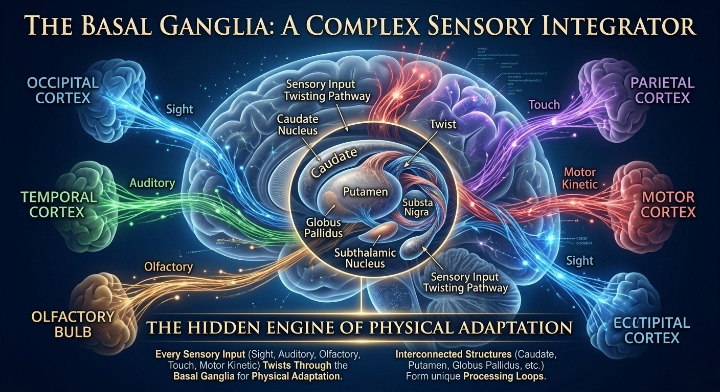
Instead, every major sensory stream entering the behavioural hierarchy is rapidly funnelled through deep subcortical infrastructures that begin preparing physical adaptations long before conscious awareness understands what is happening. At the centre of this hidden machinery sits one of the most misunderstood systems in neuroanatomy: the Basal Ganglia.
Traditionally buried inside the boundaries of the Telencephalon, the Basal Ganglia has often been treated as an accessory motor structure supporting cortical decision-making. Psychextrics rejects this interpretation.
The Basal Ganglia is not a servant of conscious thought. It is a core Siencephalic filtering engine responsible for converting sensory reality into behavioural adaptation.
The conscious mind observes the results. The Basal Ganglia creates the readiness.
1. The Great Display Illusion
The historical placement of the Basal Ganglia within the Telencephalon produced a profound misunderstanding of behavioural generation.
Because neuroscientists grouped these deep nuclei alongside the cortical display mantle, they unconsciously assumed that behaviour originated within the same civilisation responsible for conscious awareness. The result was a persistent tendency to explain action as a consequence of thought.
Yet the operational profile of the Basal Ganglia tells a completely different story. The Basal Ganglia does not narrate. It does not reflect. It does not visualise. It does not generate symbolic awareness. Instead, it continuously filters, stabilises, selects, suppresses, reinforces, and automates behavioural trajectories.
Even during sleep, when conscious display is largely absent, the Basal Ganglia remains active. This immediately reveals a fundamental truth. The system responsible for generating action is not the same system responsible for displaying awareness.
2. The Direct-to-Storage Highways of Behaviour
The strongest evidence for this architecture comes from the existence of rapid subcortical pathways connecting sensory systems directly into the Siencephalic integration infrastructure.
These pathways operate with extraordinary speed because survival cannot afford the delays imposed by reflective consciousness.
- The Vestibular-Hippocampal Axis continuously monitors bodily balance and spatial stability.
- The Superior Colliculus-Hippocampal Axis rapidly tracks visual orientation and environmental movement.
- The Cochlear Nucleus-Hippocampal Axis responds to sudden acoustic disturbances.
- The Thalamic-Hippocampal Axis integrates contextual and attentional weighting.
- The Olfactory Bulb-Hippocampal Axis delivers powerful behavioural templates without requiring conventional thalamic mediation.
Together, these pathways create a direct behavioural highway between sensory detection and behavioural preparation. The purpose of these systems is not conscious understanding. Their purpose is adaptation.
When a loud explosion occurs nearby, the body begins moving before the conscious mind identifies the source.
When balance is disrupted, posture shifts before conscious analysis begins.
When a threatening object enters peripheral vision, muscular preparation occurs before reflective awareness forms a coherent explanation.
The behavioural response is already underway. Consciousness arrives later.
3. Every Sensory Input Becomes a Physical Adaptation
This architecture reveals one of the most important principles within Psychextrics:
Every sensory input ultimately twists through the Basal Ganglia to evoke a physical adaptation.
- Vision triggers adaptation.
- Sound triggers adaptation.
- Smell triggers adaptation.
- Touch triggers adaptation.
- Balance triggers adaptation.
The organism is fundamentally built to move.
A sudden visual object approaching the face triggers blinking. A loud sound instantly rotates the head. A pungent smell changes breathing patterns and facial posture. An unexpected loss of balance shifts muscular tension throughout the body.
These reactions occur because sensory information does not merely inform the organism. It physically reorganises the organism.
The Basal Ganglia serves as the central filtering apparatus through which these adaptive possibilities are evaluated and selected. The body is not waiting for permission from consciousness. The body is already changing.
4. The Basal Ganglia as a Behavioural Sieve
At any given moment, the nervous system is flooded with unimaginable quantities of sensory information. Millions of potential behavioural responses compete simultaneously for expression. Without filtering, the organism would become paralysed by competing behavioural possibilities. The Basal Ganglia prevents this collapse.
It acts as a behavioural sieve. Raw sensory streams arrive continuously from multiple cephalic systems. The Striatum collects these competing inputs and begins evaluating their behavioural significance. Some signals are promoted. Others are suppressed. Some action pathways are opened. Others are closed.
The system functions much like an air traffic control tower managing thousands of simultaneous flight requests. Only the most behaviourally relevant trajectory is permitted to proceed. The remainder are inhibited. The result is behavioural coherence.
Instead of executing a thousand contradictory movements, the organism performs one integrated action.
5. Why Consciousness Feels Like It Is In Control
The remarkable efficiency of the Basal Ganglia creates one of the greatest illusions in Behavioural science.
Because behavioural selection occurs so rapidly, conscious awareness only encounters the final chosen trajectory. The competing alternatives have already been filtered away.
- The suppression process remains invisible.
- The selection process remains invisible.
- The gating process remains invisible.
The conscious mind therefore sees only the completed behavioural outcome and assumes it authored the event.
- A person steps backward from danger and believes they consciously chose to do so.
- A person ducks beneath an incoming object and assumes the decision originated within awareness.
- A person turns toward an unexpected sound and believes they initiated the movement.
In reality, the behavioural filtering occurred beforehand. The conscious narrative merely arrived afterward.
The screen receives the finished movie and mistakes itself for the director.
6. The Pathology of Filter Failure
The significance of the Basal Ganglia becomes even more obvious when its filtering systems malfunction. Because the Basal Ganglia governs behavioural selection itself, disruptions produce disturbances that extend far beyond movement. They alter the organism’s relationship with reality.
When filtering becomes insufficient, excessive behavioural noise enters conscious display.
- Competing signals leak through simultaneously.
- Attention becomes unstable.
- Motor suppression weakens.
- Behavioural organisation deteriorates.
When filtering becomes excessive, the opposite problem emerges.
- Behavioural initiation becomes difficult.
- Movement slows.
- Action pathways become trapped behind overactive inhibitory gates.
- The individual possesses behavioural capacity but cannot efficiently project it into execution.
In both situations, the disturbance originates within the filtering engine rather than within the conscious display system. The screen merely reflects the consequences.
7. The Night Shift of the Behavioural Machine
During sleep, when conscious awareness fades, symbolic narration largely disappears.
Language quiets.
Reflection ceases.
Visual consciousness collapses.
Yet the Basal Ganglia continues operating. The body still changes position. Motor patterns remain regulated. Behavioural templates undergo consolidation. Memory systems continue organising information with hippocampal indexing.
Filtering operations persist throughout the night. The behavioural machine never truly stops. Only the display screen of the Telencephalon powers down.
This distinction exposes the deepest flaw in cortical-centred interpretations of behaviour. The structures that generate adaptation do not require conscious awareness to function. Consciousness merely witnesses the results when it becomes available.
Conclusion: The Organism Acts Before It Explains
The Basal Ganglia reveals a behavioural reality that challenges centuries of psychological interpretation.
Human beings do not first understand reality and then adapt. They adapt first and understand later.
Every sensory system entering the behavioural hierarchy ultimately contributes to physical adaptation through deep subcortical filtering infrastructures.
- Vision becomes posture.
- Sound becomes orientation.
- Smell becomes respiratory adjustment.
- Balance becomes muscular correction.
- Sensation becomes action.
The Basal Ganglia stands at the centre of this transformation.
It receives behavioural possibilities. It suppresses noise. It selects trajectories. It stabilises execution. It converts sensation into adaptation. Only after these operations have been completed does the Telencephalon illuminate the event as conscious experience.
The organism therefore acts before it explains. The body moves before the story is told.
And hidden beneath the surface of awareness, the Basal Ganglia quietly continues performing the work that consciousness later claims as its own.
Back to: 👇