
The Screen and the Compiler: How the Siencephalon Dismantles the Executive Cortex Myth
BY: OMOLAJA MAKINEE
For more than a century, Behavioural science operated under one enormous structural misunderstanding: It mistook the display screen of behaviour for the architect of behaviour itself.
This mistake became the foundation upon which modern Psychology, Cognitive science, and large portions of Neuroscience constructed the myth of:
- the unified self,
- the executive cortex,
- and the conscious ruler inside the brain.
Under psychextrics, this historical illusion collapses the moment the Siencephalon is structurally separated from the Telencephalon.
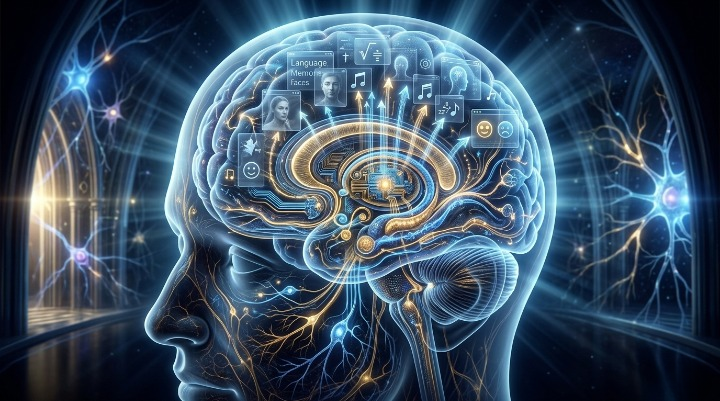
Because once this separation occurs, the cortex is finally exposed for what it truly is: A display cortex.
Not the origin of behaviour.
Not the executive ruler of consciousness.
Not the author of the self.
But the final rendering surface upon which integrated behavioural reality becomes visible.
This single structural correction may become one of the most devastating inversions ever introduced into Behavioural science.
1. The Historical Blindspot That Changed Behavioural Science
The historical error did not begin with malice. It emerged through anatomical compression.
Traditional Neuroanatomy grouped:
- the hippocampus,
- amygdala,
- entorhinal,
- and behavioural indexing systems
inside the same broad territorial classification as:
- the cortical display surface.
Everything became buried together under the umbrella of: the “Telencephalon.”
This created a fatal illusion.
The:
- engine room,
- memory-indexing systems,
- emotional packaging systems,
- and conscious display screen
were all treated as one unified behavioural territory.
And because conscious awareness visibly appears on the cortical display, the cortex gradually inherited executive authority by default.
The screen became mistaken for the source of the signal projected upon it.
2. How Psychology Conquered Behavioural Science
This structural blindspot created the perfect environment for speculative psychology to dominate Behavioural science.
Once the backend processing systems remained hidden inside the same anatomical territory as the display screen itself, Psychology could easily claim that:
- thought,
- personality,
- intention,
- identity,
- willpower,
- and conscious choice
emerged spontaneously from the cortex through abstract mental processes.
The cortex became crowned as:
- the thinker,
- the executive,
- the decision-maker,
- and the sovereign self.
This gave rise to the entire psychological civilisation of:
- personality theory,
- executive function theory,
- conscious willpower,
- stable identity structures,
- and introspective selfhood.
But under psychextrics, this entire behavioural monarchy was built upon a structural illusion.
3. The Siencephalon Changes Everything
The introduction of the Siencephalon destroys this illusion because it restores the missing distinction between:
- backend processing,
and:
- frontend rendering.
The Siencephalon becomes recognised as:
- the signal integration civilisation,
- the memory-indexing engine,
- the behavioural packaging core,
- and the continuity architecture of the organism.
Suddenly, the Telencephalon loses its stolen crown.
Because once these systems are untangled, one devastating question emerges immediately:
How can the cortex claim executive supremacy if it cannot independently generate the behavioural material appearing upon its own screen?
Without the Siencephalon:
- no emotional continuity exists,
- no behavioural familiarity forms,
- no contextual packaging occurs,
- no memory indexing stabilises,
- and no integrated behavioural stream reaches awareness.
The display-cortex becomes directionless. It possesses no behavioural substance of its own.
4. The Telencephalon as Display Interface
Under psychextrics, the Telencephalon becomes:
- the behavioural projection surface,
- the symbolic rendering screen,
- the conscious display interface.
It does not generate:
- emotional urgency,
- trauma activation,
- instinctive attraction,
- memory continuity,
- behavioural familiarity,
- or saliency weighting.
Those behavioural ciphers are assembled beneath awareness first. The Telencephalon simply receives a highly compressed, pre-packaged behavioural signal constructed elsewhere.
The conscious self therefore does not author behaviour. It inherits a rendered projection generated beneath awareness.
5. But the Siencephalon Is Not the Author Either
Yet psychextrics goes further still. The profound realisation of the 6-Cephalon architecture is this:
Neither the Siencephalon nor the Telencephalon produces consciousness.
This is one of the most radical corrections in modern Behavioural science. Because both systems are entirely dependent upon lower cephalic gateways for the raw materials of consciousness itself. The Siencephalon is not the sovereign ruler. It is the compiler and integrator of conscious materials. And the Telencephalon is not the executive monarch. It is the displayer of conscious materials.
6. The Vertical Assembly of Consciousness
Consciousness is therefore not generated centrally. It is assembled vertically through distributed cephalic labour systems.
- The Myelencephalon Produces Somatic Consciousness.
- The Metencephalon Produces Kinetic Consciousness.
- The Mesencephalon Produces Spatial Consciousness.
- The Diencephalon Produces Saliency Consciousness.
A. The Neuro-Anatomical Architecture of Behavioural Significance and Visceral Integration
A fundamental anatomical distinction separates the lower brainstem cephalons from the diencephalic core. The lower three cephalons—the Myelencephalon, Metencephalon, and Mesencephalon—act as the primitive producers of raw consciousness, directly interfacing with the peripheral organs and sensory apparatuses that execute primary, observable physical behaviours.
- The Myelencephalon serves as the survival vigilance gateway, mapping visceral and autonomic variables such as breathing, cardiovascular rhythm, and metabolic rate via the vagal-solitary axis.
- The Metencephalon governs kinetic stability, maintaining an unyielding structural record of deep tendons, skeletal muscles, and vestibular inputs to coordinate immediate bodily movement.
- The Mesencephalon controls immediate spatial orientation, utilising the collicular pathways to direct oculomotor systems and map rapid eye orientation toward environmental stimuli.
B. The Diencephalic Split and Cardiac Integration
In stark contrast, the Diencephalon interfaces with a visceral organ whose underlying operations are not apparent at face value to the reflective behaviours of thought and imagination: the Heart.
While the physical mechanics of the lower brainstem manage localised, real-time motor and respiratory reflexes, the Thalamocortical Core of the Diencephalon acts as the direct recipient of integrated cardiovascular valence vectors.
The heart serves as the central somatic anchor for the diencephalic engine. Each thalamic nucleus utilises immediate protein synthesis and epigenetic remodelling to capture real-time cardiovascular shifts, translating these deep-body currents into the foundational emotional states that underpin higher cognitive processing.
C. Pre-Reflective Significance and the Thalamic Relay
The organism does not consciously calculate or decide what environmental features matter first. The conscious field that articulates the telencephalic screen is localised strictly within the diencephalic thalamus, meaning that the symbolic declaration “I chose to focus on this” is merely a post-hoc narrative.
The Thalamic Relay functions as the primary consciousness narrator, assigning immediate behavioural significance, valence, and meaning to incoming data streams before awareness of consciousness ever catches up at the Telencephalon Display-Cortex.
Behaviour is entirely compiled subcortically and pre-reflectively within these master subcortical relays; the revised telencephalic screen merely reveals, narrates, and witnesses the highly coordinated outputs of the underlying cephalic integration.
7. The Siencephalon as Compiler
Only after these lower cephalic systems generate the raw behavioural materials of consciousness does the Siencephalon begin its role.
The Siencephalon acts as: the Compiler. Through the Entorhinal relay, it receives:
- somatic traffic,
- kinetic traffic,
- spatial traffic,
- and saliency traffic
ascending from below.
It then maps these behavioural streams against:
- Genetic Index Markers (GIM),
- Hormonal Index Markers (HIM),
- Epigenetic Index Markers (EIM),
- and Hormonal Fluidity Index (HFI).
The Siencephalon compresses:
- familiarity,
- memory continuity,
- emotional tagging,
- predictive relevance,
- and contextual integration
into one unified behavioural package to the display-cortex of the revised Telencephalon.
8. The Telencephalon as Displayer
The Telencephalon then receives this fully integrated behavioural signal and projects it symbolically as:
- thought,
- language,
- imagery,
- reflective narration,
- behavioural intention,
- and conscious awareness,
This creates the final conscious movie humans mistake for ‘the self’ concept.
9. The Greatest Optical Illusion in Behavioural Science
Because:
- emotion,
- bodily awareness,
- memory,
- movement,
- spatial orientation,
- and symbolic narration,
all appear simultaneously upon one unified cortical display, the organism commits a logical error.
It assumes: simultaneous display equals singular origin.
And once singularity is assumed, the cortex becomes falsely crowned as:
- the thinker,
- the executive ruler,
- and the conscious author of behaviour.
But the moment the Siencephalon is separated structurally from the Telencephalon, the illusion collapses completely.
The cortex can no longer claim authorship because it merely displays behavioural traffic assembled elsewhere. The Siencephalon cannot claim sovereignty either because it merely integrates behavioural materials generated beneath it. The lower gateways themselves cannot independently produce conscious materials to awareness without upper integration and rendering systems.
The singular self therefore dissolves into: A distributed cephalic civilisation.
10. The Collapse of the Nineteenth-Century Self
The nineteenth-century model of:
- the singular mind,
- the conscious self,
- and executive identity,
sat upon a structural chair whose legs have now been systematically removed.
The self can no longer claim to be:
- a permanent ruler,
- a unified thinker,
- or a sovereign behavioural executive.
It has been caught utilising:
- distributed subcortical labour,
- layered cephalic governance,
- relay integration,
- hormonal weighting,
- memory indexing,
- and contextual packaging
all along.
The “I” was never an independent monarch inside the cortex.
It was a continuously rendered behavioural projection generated through vertically integrated cephalic synchrony.
Conclusion: The Final Psychextric Inversion
Psychextrics therefore performs one of the most profound inversions in modern Behavioural science. The organism is no longer interpreted as a singular conscious self possessing behaviour. Instead behaviour constructs the illusion of the singular self.
The:
- cortex,
- consciousness,
- identity,
- personality,
- and self,
become the final glowing projection of a much deeper cephalic civilisation operating beneath awareness itself.
The screen was never the machine. And the conscious self was never the ruler of behaviour.
Back to: 👇