
Wilhelm His, the Failure of Psychological Interpretation, and the Birth of the Siencephalon
BY: OMOLAJA MAKINEE
One of the deepest unresolved problems in Behavioural science has never been the absence of anatomy. It has been the absence of a structural interpretative method.
For centuries, humanity attempted to explain behaviour through systems that were never structurally grounded in the biological organisation of the nervous system itself. Philosophy and Psychology became the dominant interpretative engines of human behaviour, yet both emerged from worldview-centric methods dependent upon the sentient observer.
Philosophy interpreted behaviour through:
- introspection,
- metaphysics,
- morality,
- symbolic abstraction,
- and conceptual reasoning.
Psychology inherited these same interpretative foundations, but redirected them toward:
- behavioural observation,
- population cohorts,
- personality trends,
- and symbolic behavioural narratives.
Neither discipline emerged from cephalic architecture itself. This is the critical distinction.
Under psychextrics, neither Philosophy nor Psychology belonged structurally within Behavioural science because both remained interpretative systems rooted in worldview rather than biological organisation. Their explanations varied according to:
- civilisation,
- historical assumptions,
- cultural symbolism,
- philosophical inheritance,
- and observer interpretation.
Behavioural science therefore spent generations attempting to explain the organism from the surface of consciousness downward instead of from cephalic structure upward.
And this is precisely the same fracture point that drove the work of Wilhelm His Sr. in the nineteenth century.
1. Wilhelm His and the Crisis of Scientific Interpretation
The historical importance of Wilhelm His Sr. extends far beyond embryology.
His was responding to a profound scientific problem:
Interpretation had begun outrunning structure.
During the nineteenth century, Biology and Neuroscience were increasingly flooded with broad philosophical narratives attempting to explain human development, evolution, and nervous-system organisation. Many theories were speculative, symbolic, or exaggerated beyond anatomical evidence itself.
Wilhelm His rejected this trend.
His primary motivation was to replace speculative developmental theories with rigorous, mechanically grounded anatomical observation. This is why his work was revolutionary.
Rather than philosophising development, he attempted to structurally map it.
2. The Problem of Worldview-Centric Science
Scientific history repeatedly demonstrates that observation alone is not enough. The interpretation of observation becomes the decisive problem.
Human beings naturally interpret reality through the worldview of their civilisation. When interpretative systems become detached from structural grounding, science becomes vulnerable to:
- embellishment,
- ideology,
- symbolic projection,
- philosophical bias,
- and narrative distortion.
This was precisely the problem Wilhelm His confronted.
At the time, scientific interpretations of development were increasingly shaped by evolutionary storytelling and speculative biological narratives. One of the most influential figures of the period was Ernst Haeckel, whose biogenetic law became widely summarised as: “ontogeny recapitulates phylogeny.”
According to this theory, embryonic development replayed the evolutionary history of the species itself.
But Wilhelm His became sharply critical of Haeckel’s methods, particularly his notoriously manipulated embryo drawings, which exaggerated anatomical similarities between embryos in order to support evolutionary conclusions.
For His, this represented a dangerous collapse between:
- interpretation,
- and structure.
The problem was not evolutionary inquiry itself. The problem was interpretative embellishment imposed upon anatomy.
3. Wilhelm His and the Structural Rebellion Against Speculation
In response, Wilhelm His Sr. pursued an entirely different scientific ethic: Objective Structural Precision.
He sought:
- measured anatomical norms,
- serial developmental reconstruction,
- microscopic accuracy,
- and mechanically verifiable observation.
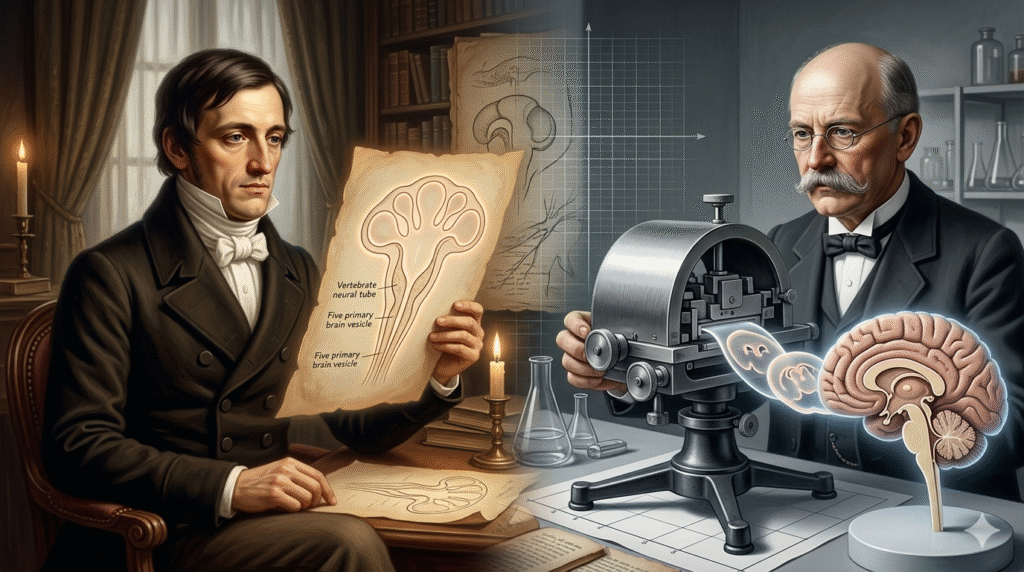
To accomplish this, he developed one of the first precision microtomes with micrometer advancement, allowing embryos to be sliced into ultra-thin serial sections. He reconstructed embryological development through:
- microscopy,
- photography,
- and three-dimensional wax modelling.
This work transformed Neuroscience.
The brain was no longer viewed merely as adult tissue. It became understood as developmental architecture.
Most importantly, His demonstrated that the nervous system develops through differentiated cephalic territories rather than through one uniform mass.
This became foundational for the mapping of:
- the Myelencephalon,
- Metencephalon,
- Mesencephalon,
- Diencephalon,
- and Telencephalon.
Behavioural anatomy was becoming visible.
4. The Five Cephalons and the Missing Structural Interpretation
The foundational credit for identifying and describing the five primary brain vesicles belongs to Karl Ernst von Baer.
In his seminal 1828 work, Über Entwickelungsgeschichte der Thiere (“On the Development of Animals”), von Baer first mapped the structural transition of the vertebrate neural tube as it expands from three primary expansions into the five classical embryological divisions:
- the Prosencephalon (which he watched divide),
- Mesencephalon,
- and Rhombencephalon (which he saw split into what we now call the Metencephalon and Myelencephalon).
5. The Role of Wilhelm His and the Missing Structural Mapping
While von Baer discovered and laid out the basic five-vesicle plan, Wilhelm His (in the late 19th century) revolutionised our understanding of them by providing the exact, ultra-precise anatomical and histogenetic mapping.
Using his newly invented microtome and 3D reconstruction modeling, Wilhelm His:
- Formalised the exact boundaries, cellular zones, and flexures of these five vesicles in human embryos.
- Authored the Basel Nomina Anatomica (1895), which standardised the very Greek-derived terms we use in neurological sciences today (such as Telencephalon and Diencephalon).
But despite the brilliance of his embryological mapping, Wilhelm His still operated within an anatomical framework rather than a behavioural one. This distinction matters enormously.
His was not a behaviourist. He was an anatomist.
His interpretative focus centred upon:
- developmental segmentation,
- tissue differentiation,
- ventricular organisation,
- neural growth,
- and embryological continuity.
Wilhelm His correctly mapped the five cephalons anatomically, following Karl Ernst von Baer’s work.
But he was not attempting to construct a structural behavioural architecture explaining how behavioural reality itself emerges from these differentiated systems.
And because Behavioural science still lacked a structural interpretative method, something critical remained hidden.
6. The Siencephalon Problem
What Wilhelm His missed was not anatomy in the traditional sense. He missed a behavioural civilisation hidden inside the forebrain itself.
Under conventional anatomy, the Prosencephalon divided into:
- the Telencephalon,
- and the Diencephalon.
From a developmental standpoint, this was correct.
But under psychextrics, the forebrain contains three distinct behavioural territories:
- the Diencephalon,
- the Siencephalon,
- and the Telencephalon.
The missing territory was the Siencephalon: the signal integration civilisation positioned structurally between contextual weighting and conscious display.
7. Why the Siencephalon Remained Invisible
The Siencephalon remained invisible for one reason:
Behavioural science lacked a biological interpretative engine capable of structurally decoding behavioural labour.
The problem was never anatomical visibility alone. The problem was interpretative structure.
The hippocampus, entorhinal network, amygdala, allocortical systems, mesocortical systems, and parahippocampal fields all appeared embedded inside the broader Telencephalic territory anatomically.
But behaviourally, they were performing radically different operations from the display-cortex itself.
The cortex:
- renders,
- symbolises,
- narrates,
- and displays consciousness.
The Siencephalon:
- indexes,
- integrates,
- loops continuity,
- compresses behavioural coherence,
- and packages reality before awareness emerges.
These are fundamentally different categories of labour.
Yet without a structural behavioural interpretative method, Neuroscience inherited the anatomy without fully behaviourally decoding what the anatomy itself already demonstrated.
8. The Gateway Revelation
The decisive moment arrived through gateway architecture.
Under psychextrics, every cephalon possesses a dedicated gateway through which its specialised behavioural reality enters conscious integration.
The:
- Cochlear Nucleus,
- Vestibular system,
- Superior Colliculus,
- Thalamic systems,
- and Entorhinal,
each function as cephalic gateways.
And this revealed something profound:
The so-called signal-cortex integration system possessed its own gateway entirely separate from the display-cortex.
The Entorhinal gateway demonstrated cephalic sovereignty.
At that moment, the Siencephalon became inevitable.
9. The Same Problem Wilhelm His Faced Still Exists Today
The historical continuity is remarkable.
The same problem Wilhelm His fought against in embryology is the same problem psychextrics confronts in Behavioural science:
Interpretation outrunning structure.
Wilhelm fought against:
- speculative embryology,
- symbolic exaggeration,
- and worldview-driven anatomy.
Psychextrics fights against:
- worldview-centric psychology,
- philosophical behavioural narration,
- and bureaucratic interpretations of consciousness.
Both confront the same fundamental danger:
Human beings projecting socio-cultural worldview onto biological reality.
10. Why Psychextrics Emerges
Psychextrics emerges precisely because Behavioural science never possessed a universal structural interpretative engine.
- Neuroscience mapped anatomy.
- Psychiatry classified dysfunction.
- Psychology interpreted behaviour through cohorts.
- Philosophy interpreted existence through introspection.
But none interpreted behaviour directly through cephalic architecture itself. Psychextrics attempts to fill this vacuum.
It proposes that behaviour must be interpreted structurally through:
- gateways,
- signal integration,
- contextual weighting,
- memory indexing,
- cephalic labour,
- timing hierarchies,
- and distributed behavioural governance.
The observer’s worldview no longer becomes the primary interpretative authority.
The structure itself becomes the interpreter.
Conclusion: The Delay Was Never Anatomical
The greatest irony is this:
The brain may have been anatomically mapped correctly for over a century. The delay was not anatomical. The delay was interpretative.
Wilhelm His Sr. successfully mapped the five cephalons embryologically. But Behavioural science lacked the structural behavioural framework necessary to decode the hidden signal-integration civilisation embedded within the forebrain.
Psychextrics argues that the forebrain was never behaviourally dualistic. It was always tripartite:
- contextual weighting,
- signal integration,
- and conscious display.
The Siencephalon did not appear because anatomy changed. It appeared because behavioural interpretation finally caught up to what the anatomy had been silently demonstrating all along.
Back to: 👇