
Why We Look Up to Remember: The Triadic Pattern of Perception in Echoic Sighting
BY: OMOLAJA MAKINEE
The reflective character of Echoic Sighting emerges most clearly within associative cortical systems, where perception interacts with memory and conceptual thought. It is within this integration that a deceptively simple question reveals a profound truth:
What is Echoic Sighting?
Before answering, one foundational principle must be established. Every perceptual output from the self is not newly created—it is retrieved. When we speak, we are speaking history. When we think, we are thinking from what has already been encoded. Every word, every idea, every interpretation is drawn from an internal archive of prior experience. Human expression is, at its core, a historical retrieval mechanism.
With this in mind, Echoic Sighting can be defined with clarity: it is the act of recall—the process by which stored perceptual experience is re-sighted, and sometimes in re-contextualised form, into present awareness. It is not merely remembering; it is re-seeing internally. And this process, far from being abstract, is physically observable in the everyday behaviour of human beings.
1. The Triadic Pattern of Human Behaviour
Across cultures, contexts, and individuals, a consistent behavioural pattern emerges in relation to perception and recall:
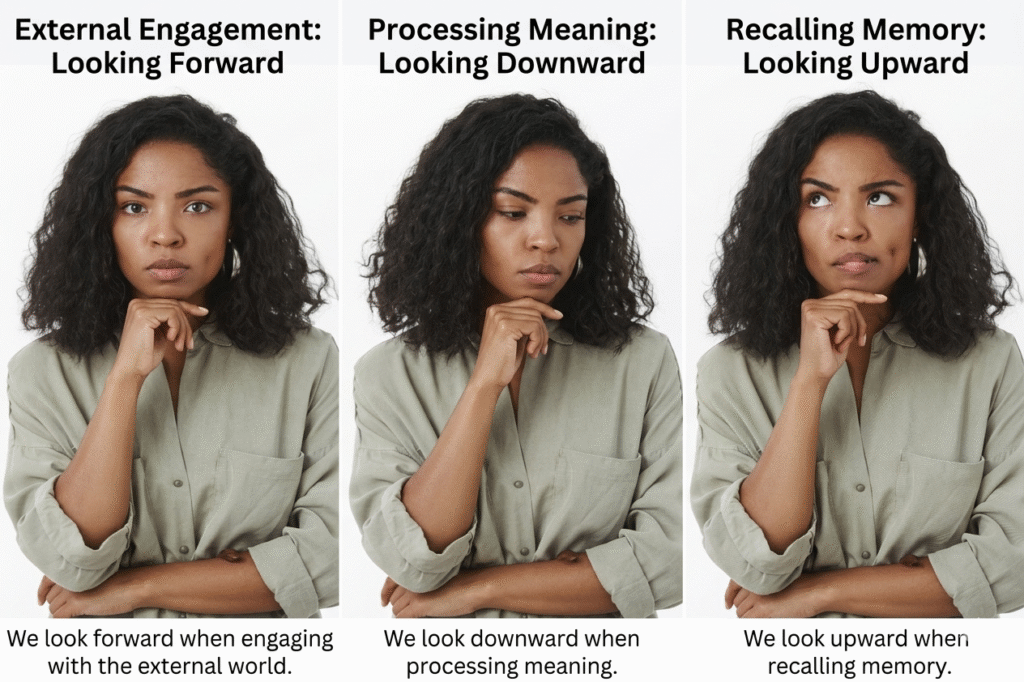
- We look forward when engaging with the external world,
- We look downward when processing meaning,
- We look upward—or close our eyes—when recalling memory.
This is not coincidence. It is the outward expression of a deeper neurological organisation—a triadic pattern of perception that aligns with the three major domains of Psychextric sighting: Environmental Interface, Signal Detection, and Meaning Construction.
2. Looking Forward: The Engagement of Reality
When we look directly at an object, we are operating within the Environmental Interface. This is the primary domain of Aperture and Orientation Sighting, including the environmental aspects of Precision and Luminance Sighting within Signal Detection—the systems responsible for capturing and structuring the visual world.
Here, perception is anchored in the present moment. The eyes align with incoming light, the visual cortex is actively processing its display of stimuli, and the brain prioritises data acquisition. The forward gaze represents a state of openness to external reality—a direct engagement with what is.
In this mode, the mind is not yet concerned with interpretation or memory. It is gathering raw material.
3. Looking Downward: The Processing of Meaning
When individuals cast their gaze downward—often during moments of thought, hesitation, or evaluation—they are engaging primarily within the domain of Precision and Luminance Sighting in Signal Detection, governed under the supervisory control of Reflective Sighting.
This is the domain of the thalamus, the brain’s central relay system. Here, incoming sensory data is filtered, prioritised, and organised. The downward gaze reflects an inward shift—a movement away from external input toward internal processing.
In this state, the mind asks:
- What does this mean?
- What is relevant?
- How should this be understood?
The downward posture reduces environmental distraction and facilitates focus on internal computation. It is the transitional phase of perception, where raw sensory input is transformed into structured meaning.
4. Looking Upward: The Recall of Experience
Perhaps the most intriguing of the three is the upward gaze. When individuals attempt to remember something—whether a conversation, a face, or a past event—they often look upward into space or close their eyes entirely. This is the activation of Echoic Sighting.
In this state, the brain shifts from processing the present to retrieving the past. The hippocampus, located within the medial temporal lobe, engages with associative cortical networks to reactivate stored memory traces. By looking upward or closing the eyes, the brain reduces competition from incoming visual stimuli, allowing internal imagery and memory reconstruction to take precedence.
The result is a re-experiencing:
- Images are reconstructed,
- Conversations are replayed,
- Emotions are reactivated or reassigned.
This is not passive recall—it is active re-sighting. The past is not simply remembered; it is projected back into present awareness.
5. The Anatomical Logic Behind the Pattern
This triadic behavioural pattern is deeply rooted in the brain’s anatomical structure. Tilting the head slightly upward or to the side while talking is a universal human body language trait.
The hippocampus, as the seat of Echoic Sighting, is interconnected with both the thalamus and hypothalamus, forming a network that links memory, perception, and emotional state. When upward gaze disengages the visual cortex from external input, cortical resources become more available for hippocampal retrieval processes. This facilitates smoother activation of stored perceptual sequences.
The thalamus, governing Reflective Sighting, sits centrally within the brain, ideally positioned to filter and route sensory information. Downward gaze corresponds with this inward routing, as attention shifts from external acquisition to internal organisation.
The visual cortex and ocular systems, engaged during forward gaze, remain aligned with the environment, optimising real-time perception.
Thus, the body itself becomes an interface through which neural processes are expressed:
- Forward gaze aligns with sensory intake,
- Downward gaze aligns with the cognitive reflective processing,
- Upward gaze aligns with intense memory retrieval.
6. A Unified System of Perception
The triadic pattern—forward, downward, upward—reveals that perception is not a single act, but a cycle:
- We engage with the world,
- We process what we encounter,
- We recall and integrate it into our internal archive.
This cycle repeats continuously, forming the foundation of thought, behaviour, and identity.
Directional Control and Emotional Supervision
This triadic pattern is not merely behavioural—it is governed by a precise hierarchy of emotional supervision across the perceptual system.
When we look forward, the system is under the authority of Aperture Sighting. At this stage, perception is in its state of initial encounter. The visual field is open, and emotional valence is activated at its origin point. The forward gaze reflects engagement with external reality, where the emotional field is not yet interpreted, but primed. Here, the organism is oriented toward possibility—toward what may emerge from the environment. The emotional valence is therefore raw, undifferentiated, and under Aperture’s supervisory control.
When we look downward, control shifts to Reflective Sighting. This is the phase of meaning construction. The organism withdraws slightly from the external field, directing attention inward to interpret what has been perceived. The downward gaze reflects cognitive grounding—an anchoring of perception into structured understanding. The emotional field becomes organised, categorised, and expressed as meaning. This is reflection in its direct, grounded form.
When we look upward, the system enters the domain of Echoic Sighting, but crucially, not as an independent controller of emotion. Echoic Sighting remains a neutral archive—it does not generate or assign emotional valence. Instead, what occurs is a delegated reflection. Reflective Sighting extends its supervisory authority into the echoic domain, initiating recall. The upward gaze is therefore not a function of Echoic Sighting itself, but of Reflective Sighting operating through Echoic memory.
This creates an important inversion:
- Downward gaze shows Reflective Sighting in direct operation.
- Upward gaze shows Reflective Sighting operating through Echoic Sighting.
The upward motion represents a reversal of immediate reflection. Instead of grounding perception into present meaning, the system reaches into stored perceptual history, re-sighting past experience into the present moment.
It is through this upward/downward gaze that Reflective Sighting either reactivates variants of existing emotional valence within context of experience or reassigned a different one to re-contextualised meaning during recall. This is how human come up with a different way of looking at the same thing or understanding the same event, after reflection.
Thus, while Aperture Sighting governs the emotional initiation of forward engagement, Reflective Sighting governs both downward interpretation and upward recall.
Echoic Sighting, in this structure, serves as the stabilising archive—a silent reservoir that holds perceptual content without altering its emotional charge. It is only when Reflective Sighting re-engages this archive that emotion is reintroduced, reshaped, and projected back into conscious awareness.
The triadic pattern therefore reveals a deeper truth:
Human gaze direction is not random—it is a visible expression of which perceptual authority is currently in control of emotional valence.
- Forward: Emotion initiated.
- Downward: Emotion interpreted.
- Upward: Emotion re-sighted.
In this way, the simple act of where we look becomes a diagnostic window into the architecture of perception itself.
Conclusion: The Body as a Map of the Mind
What appears as a simple behavioural habit—looking up to remember, down to think, forward to see—is, in reality, a map of the mind in motion. Within this framework, Echoic Sighting takes on a deeper significance. It is not merely the storage of memory—it is the reanimation of experience.
When we recall, we do not access a static file. We reconstruct. We reassemble fragments of stored perception into a coherent internal scene. This process is shaped by both Reflective structure and Resonant emotion, but it is Echoic Sighting that enables the return of the past into the present.
Echoic Sighting completes the loop. It ensures that perception does not vanish with time, but is retained, revisited, and repurposed. It transforms fleeting moments into enduring components of the self. This is why human communication is inherently historical. Even when speaking spontaneously, we draw upon previously encoded material. The present is always informed by the past.
It reveals that human perception is not confined to the eyes, nor to the present moment. It is distributed across systems of sensing, processing, and remembering—each with its own anatomical and functional signature.
Echoic Sighting stands at the apex of this system, reminding us that to perceive is not only to see, but to retain, reconstruct, and relive. And in that process, the experience of the past is never truly gone. It is simply waiting—ready to be seen again.
Back to: 👇