
Integrated Perceptual Reflection: The Three Spectral Valences of Echoic Sighting
BY: OMOLAJA MAKINEE
Reflective Sighting allows the visual system to function not only as a detector of external stimuli but also as a generator of internal meaning. Nowhere is this more evident than in the everyday human experience of memory—particularly in the moments immediately following a conversation, argument, encounter, visual scene, or even a dream.
In such moments, a familiar pattern emerges. Individuals often struggle to recall the precise words that were spoken, yet can vividly recount how the experience felt. The emotional tone remains intact—sometimes even intensified—while the literal structure begins to fragment. When attempts are made to reconstruct the missing details, the mind does not remain neutral. Instead, it actively fills in the gaps. What emerges is not silence, but embellishment—a narrative reconstruction shaped by emotional coherence rather than factual precision.
Within Psychextrics, this phenomenon is not treated as a flaw. It is the natural outcome of the interaction between Reflective, Resonant, and Echoic Sighting. Yet, this outcome is not uniform across individuals. There exist high-functioning spectral variations within the thalamic system—particularly in filtering, prioritisation, and signal routing—that can significantly alter how memory is encoded, retained, and recalled.
At the centre of this variation lies what Psychextrics defines as Integrated Perceptual Reflection—a mechanism governed by three core spectral valences within Echoic Sighting. These valences determine whether memory is preserved as literal structure, retained with high efficiency, or transformed into symbolic narrative.
1. Reflective-Dominant Valence: The Architecture of Literal Truth
In the first configuration, Reflective Sighting operates at a higher spectral range than both Echoic and Resonant systems. Here, memory encoding is guided primarily by structural fidelity.
- Words are retained as they were spoken.
- Sequences are preserved in order.
- Visual details remain anchored in their original configuration.
There is minimal interference from emotional reinterpretation. Resonant Sighting, while still present, does not exert enough influence to reshape the stored content. As a result, memory in this state aligns closely with literal truth—what actually happened.
However, this precision comes with a trade-off. If Echoic Sighting operates at a lower than expected spectral range, the rate of recall may be constrained. The individual may possess accurate memory, but retrieval may be slower, less fluid, or less expansive. The memory exists with clarity, but not always with immediacy or volume.
This valence represents the preservation of structure over expression—a system prioritising accuracy, even if at the expense of recall efficiency or emotional richness.
2. Echoic-Dominant Valence: The Engine of Retention and Recall
In the second configuration, Echoic Sighting itself operates at the highest spectral range, surpassing both Reflective and Resonant systems. This produces a fundamentally different outcome.
Here, the defining characteristic is capacity. Memory is:
- Rapidly encoded,
- Efficiently retained,
- And readily retrievable.
The individual demonstrates a high rate of recall across a wide range of stored information. Content—whether structural or emotional—is accessible with relative ease.
Yet, this efficiency introduces its own limitation. If Reflective and Resonant systems operate within narrower spectral ranges below average, the depth of interpretation will be reduced. Structural detail may not always be refined to high precision, and emotional meaning may not be richly elaborated. The system prioritises retention over refinement.
In this valence, the individual remembers more, and remembers it faster, but not necessarily with the same degree of structural accuracy or emotional depth seen in other configurations.
This is the engine of memory throughput—a system optimised for storage and retrieval rather than transformation.
3. Resonant-Dominant Valence: The Realm of Symbolic Truth
In the third configuration, Resonant Sighting operates above both Reflective and Echoic systems. This produces perhaps the most recognisable and widespread pattern in human behaviour.
Memory, in this state, is encoded primarily through emotional and symbolic frameworks. The individual retains:
- The feeling of the event,
- The perceived meaning of the interaction,
- The narrative significance of the experience.
However, the literal structure—exact words, precise sequences, detailed visual arrangements—is deprioritised.
Over time, recall becomes increasingly narrative-driven. The memory evolves, shaped by emotional resonance rather than factual consistency. What is remembered is not the event as it occurred, but the event as it has been emotionally lived and relived.
This is the domain of symbolic truth. Retention within Echoic memory becomes selective, favouring emotionally salient elements. Recall remains vivid, but its fidelity to literal structure diminishes. The individual may confidently recount events in rich, expressive detail, yet these details may diverge from the original occurrence.
This valence represents the transformation of experience into story—where meaning takes precedence over structure.
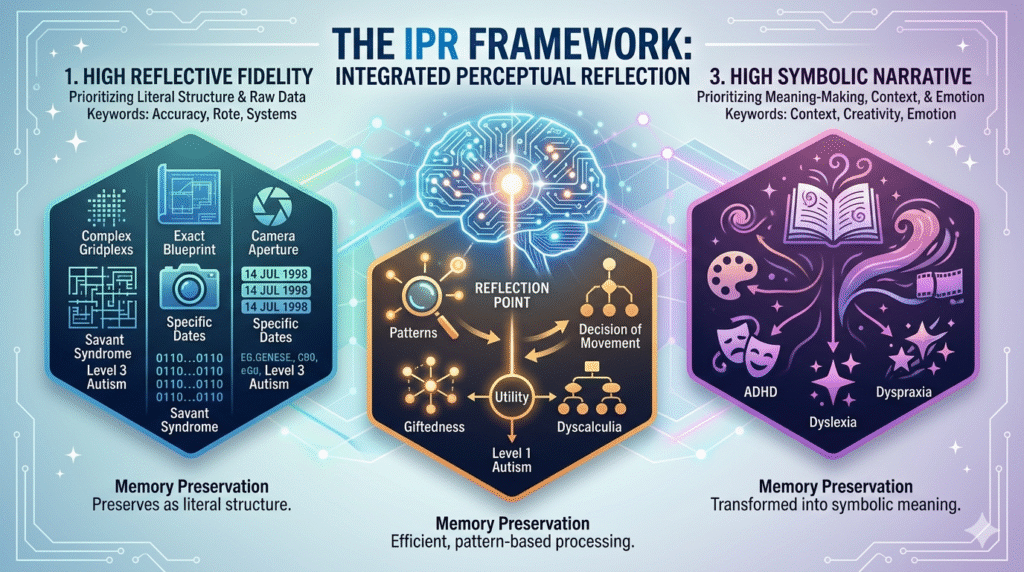
4. “Integrated Perceptual Reflection” (IPR) framework
Applying the three valences to the way different minds process data, here is how these profiles generally align:
A. High Reflective Fidelity: Reflective-Dominant Valence
Priority: Literal structure and raw data over emotional narrative or summarised retention.
These minds often prioritise “Bottom-Up” processing—gathering every detail before forming a whole picture.
- Autism (Level 2 & 3 / “Low-functioning”): Often characterised by intense focus on literal sensory input and “systemising” without the filter of social or emotional narrative.
- Hyperlexia: The ability to read words at an advanced level without necessarily grasping the “big picture” or emotional subtext initially.
- Savant Syndrome: Extreme memory for literal structures (music, dates, maps) with near-perfect fidelity.
- Non-Verbal Learning Disorder (NVLD): High reliance on literal, verbal information and rote memory, often struggling with the “symbolic” or abstract nature of visual-spatial data.
B. Efficient Memory Retention: Echoic-Dominant Valence
Priority: Information utility and speed over literal fidelity or emotional depth.
These minds are “pattern hunters.” They strip away the “noise” of literal detail to find the “signal” that allows for quick application.
- Autism (Level 1 / “High-functioning”): Often involves high-efficiency processing of systems and logic, discarding “social fluff” to retain functional data.
- Dyscalculia: While it involves a struggle with numbers, it often forces the brain to develop highly efficient heuristic strategies to navigate quantitative logic.
- Giftedness (Twice-Exceptional/2e): Rapid acquisition of knowledge where the “core concept” is retained with extreme efficiency, often at the expense of showing the literal “work” or steps taken.
- Dysgraphia: Often involves a “bottleneck” where the mind processes information efficiently but struggles with the literal, physical fidelity of output (writing).
C. High Emotional/Symbolic Narrative: Resonant-Dominant Valence
Priority: Meaning-making and symbolic connections over literal data or raw volume.
These minds tend to be “Top-Down” processors, where the “vibe,” the story, or the creative link is the anchor for memory.
- ADHD (Attention Deficit Hyperactivity Disorder): Memory is often “interest-based.” Data is retained if it is tied to an emotional spark or a novel connection; literal details often fall away if they lack narrative “juice.”
- Dyslexia: Often associated with “Big Picture” thinking. Dyslexics frequently struggle with literal phonemes (fidelity) but excel at seeing symbolic relationships and complex narratives.
- Auditory Processing Disorder (APD): Because literal sound fidelity is compromised, the brain often over-relies on emotional cues and context (symbolism) to “fill in the blanks” of what was said.
- Dyspraxia (DCD): Often involves a high reliance on narrative sequencing to remember physical movements or tasks, as the literal “muscle memory” fidelity is less reliable.
Summary Table: The IPR Framework
| VALENCE | PRIMARY DRIVER | REPRESENTATIVE NEURODIVERGENCE |
| High Reflective Fidelity | Literal Structure | Savantism, Level 3 Autism, Hyperlexia |
| Efficient Retention | Pattern Logic | Level 1 Autism, Giftedness, Dyscalculia |
| Symbolic Narrative | Emotional Context | ADHD, Dyslexia, Dyspraxia |
5. Memory as a Spectral System, Not a Fixed Function
Together, these three valences define the core architecture of Integrated Perceptual Reflection. They reveal that memory is not governed by a single, uniform process, but by dynamic spectral dominance across interacting systems.
At any given moment, what is remembered—and how it is remembered—is determined by:
- The balance between Reflective, Echoic, and Resonant Sighting,
- The spectral range at which each system is operating,
- And the interaction between inherited and environmental influences.
This has profound implications. Human beings do not think in isolation from memory. Every word spoken, every thought formed, every decision made is grounded in recall of past experience—whether consciously accessed or subconsciously activated. Even when speaking in the present or projecting into the future, the mind draws upon previously encoded material.
It is precisely at this point of recall that Echoic Sighting exerts its influence.
6. The Role of Inheritance and Environment
Memory retention is not static across the lifespan. It is shaped by the interaction between:
- Genetic architecture (GIM),
- Epigenetic modulation (EIM),
- And spectral variation within the sighting systems.
An individual may, for instance, exhibit limited memory retention during adolescence, only to develop significantly enhanced recall capacity in later life, or vice versa. Such changes are not random. They reflect the unfolding of inherited spectral variation interacting with environmental conditions such as diet, experience, and neurological development.
What may appear disorganised or inconsistent externally is, in reality, the expression of a complex but lawful system.
Conclusion: The Archive of Consciousness
Echoic Sighting stands as the final and defining layer of perception—the corporate archive of consciousness. It is where experience is not only stored, but continuously reactivated, reshaped, and integrated into the evolving narrative of the self.
Through the three spectral valences of Echoic Sighting:
- Some individuals preserve reality with structural precision,
- Others retain vast amounts of information with ease,
- And many transform experience into emotionally rich narratives.
None of these modes are inherently superior. Each represents a different way in which the human mind engages with reality.
What Psychextrics ultimately reveals is this:
We do not simply remember. We remember through a system of spectral interpretation.
And in that system, memory is not a passive record of the past—it is an active, evolving construction that defines how we understand the present and imagine the future.
Back to: 👇