
Resonant Sighting: The Spectral Governance of Emotional Valence
BY: OMOLAJA MAKINEE
If Aperture Sighting is the ignition point of emotional awareness, then Resonant Sighting is its orchestration.
Aperture Sighting activates emotional valence—it determines whether a stimulus is felt as positive, negative, threatening, inviting, neutral, or ambiguous. Yet, this activation in itself is undifferentiated. It is a charged field without structure, a raw emotional atmosphere awaiting form.
Resonant Sighting enters at this precise juncture.
- It does not create awareness.
- It does not initiate perception.
Instead, it applies spectral variation to the emotional valence that Aperture Sighting has already activated. In doing so, Resonant Sighting becomes the governing guide of all other sighting nodes.
1. The Role of Resonant Sighting: Emotional Differentiation
Where Aperture Sighting says “this matters emotionally,” Resonant Sighting determines “how it matters across action.”
Resonant Sighting breaks emotional valence into spectral variations—gradients of response that can be distributed across behaviour. These variations are not random; they are structured, inherited, and contextually modulated through the HIM–HFI network.
Thus, every action taken since aperture by the perceptual system is not merely cognitive—it is emotionally tuned.
- Orientation Sighting does not just detect environment—it detects it through a selected emotional spectrum.
- Precision Sighting does not just refine detail—it refines according to emotional weighting.
- Luminance Sighting does not just interpret clarity—it assigns emotional intensity to visibility.
- Reflective Sighting does not just express—it expresses within a specific emotional tone.
Resonant Sighting is therefore the unseen conductor, assigning emotional frequencies to each perceptual act.
2. Independence from Surface Sighting
Like all deeper sighting nodes, Resonant Sighting has no direct relationship with Surface Sighting. Surface Sighting operates at the level of visible output—the observable behaviour, the externalised act, the expressed form. It is the endpoint, not the origin—a classic case of seeing without sighting.
Only Aperture Sighting interfaces with Surface Sighting, because it is the gateway through which stimuli acquire emotional relevance in the first place.
Resonant Sighting, by contrast, operates beneath this layer. It does not engage with what is seen—it governs how what is seen is internally felt and distributed.
This distinction is critical:
- Surface Sighting opens the perceptual field.
- Aperture Sighting activates the emotional charge.
- Resonant Sighting shapes the emotional spectrum that guides all internal operations.
3. The Sequential Activation Model
The process unfolds as a precise chain:
- Aperture Sighting activates emotional valence: A stimulus is marked as emotionally relevant.
- Resonant Sighting is simultaneously activated: The emotional field becomes spectrally available.
- Orientation Sighting engages: It retrieves an emotional spectral variation from Resonant Sighting to complement environmental detection.
- Precision Sighting follows: It selects a spectral variation from Resonant Sighting to refine detail according to emotional bias.
- Luminance Sighting engages: It draws a spectral emotional intensity from Resonant Sighting to clarity own visibility.
- Echoic Sighting retains in memory: It stabilise stimuli in their raw form, allowing visual patterns to be retained long enough for reflective meaning to crystallise.
- Reflective Sighting completes the loop: It retrieves emotional spectral from Resonant Sighting to re-sight the experience into conscious awareness in the cortex and reconstructs it back into the internal archive of Echoic memory.
Each node does not generate its own emotional valence independently from Resonant Sighting. Each node draws from the same initial activated emotional reservoir from Resonant Sighting held at aperture, selecting a variation that aligns with its function.
What must now be clarified within this sequence is the temporal authority of emotional activation across the perceptual cycle. We correctly establishes that emotional valence is activated at the level of Aperture Sighting, making the Resonant field available to all downstream perceptual nodes. However, this is not a one-time event confined to the moment of first visual capture. It is a recurring mechanism.
After the first perceptual cycle is completed and the experience is retained within Echoic Sighting, every subsequent act of recall reactivates the perceptual chain. At this point, Reflective Sighting assumes a secondary role of activation, drawing once again from the Resonant system—not merely selecting from an existing pool, but re-engaging different emotional valence itself in alignment with the reconstructed meaning.
- Aperture Sighting is the origin point of emotional activation during initial perception.
- Reflective Sighting is the re-activation point of emotional valence during recall and reinterpretation.
All other perceptual spectrums—Orientation, Precision, and Luminance—do not generate or reactivate emotional valence independently. They operate strictly by selecting spectral variations from the currently active emotional field, at initial perception, reflection, and at recall cycle.
Echoic Sighting remains neutral in this process. It does not activate or select emotion; it only retains and stabilises perceptual content for future re-sighting. This establishes a dual-gate system of emotional authority:
- Initial Activation Gate — Aperture.
- Reconstructive Activation Gate — Reflective.
Between these two gates, all perceptual processing is constrained to operate within the boundaries of an already activated emotional reservoir. The implication is profound. Perception is not only emotionally initiated—it is emotionally re-authored at every recall.
Each time an experience is brought back into conscious awareness, Reflective Sighting does not merely retrieve it; it reassigns emotional weight, either preserving the original valence or substituting it with a new one based on current internal conditions. This is why memory is not static. It evolves.
Thus, the continuity of behaviour over time is not governed solely by what was first seen, but by how often—and how differently—it is re-sighted. In this architecture, emotion is not a passive layer added to perception. It is the recurring force that shapes perception across time.
4. Sequential Activation of Emotional Valence in Resonant Sighting
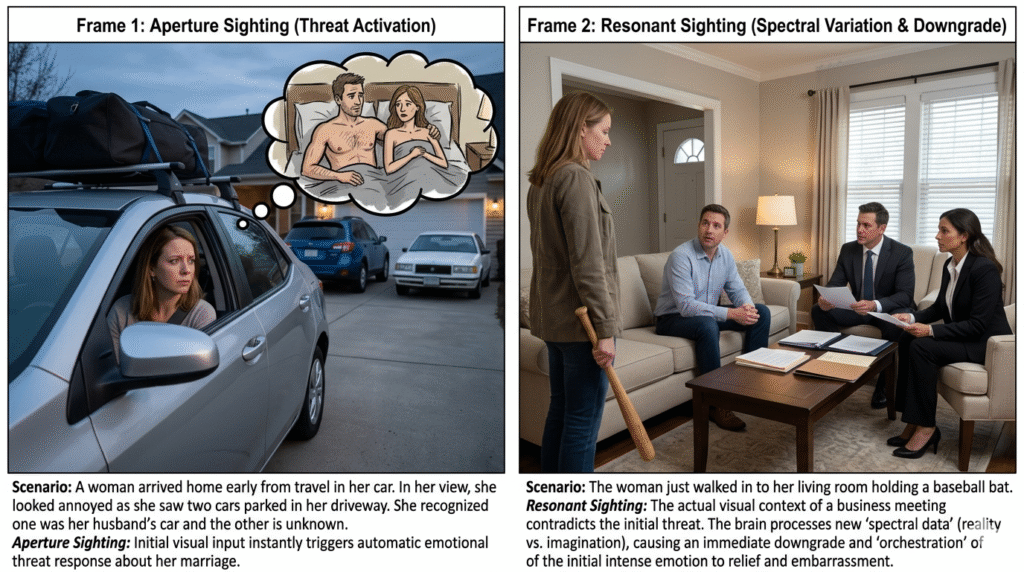
The scenario in the cover image of this article unfolds as a tightly coordinated perceptual–emotional chain, demonstrating how a single activated emotional reservoir is distributed, refined, and ultimately recalibrated across the sighting spectrums:
A. Aperture Sighting (Threat Activation)
The moment the unknown car is registered in the driveway, Aperture Sighting opens the perceptual gate and simultaneously activates an initial emotional valence. This valence is not neutral—it is immediately coded as threat, specifically to marital stability. This is not yet reasoning; it is biological marking. The system has decided: this matters.
B. Resonant Sighting (Emotional Field Availability)
With Aperture activated, Resonant Sighting becomes globally available as a spectral emotional reservoir. It does not yet decide the outcome, but it provides the full range of possible emotional variations (fight, flight, confrontation, suspicion, fear). This reservoir will now be drawn upon by each downstream perceptual node.
C. Orientation Sighting (Emotion-Guided Mapping)
Orientation Sighting engages and retrieves a specific spectral variation from the resonant field—one aligned with confrontation. The environment is rapidly mapped:
- Entry points,
- Spatial layout,
- Movement direction.
The selection of the baseball bat is not incidental; it is the behavioural expression of the chosen spectral variation. Space is no longer neutral—it is mapped for action.
D. Precision Sighting (Emotion-Biased Detail Extraction)
Precision Sighting now refines the scene under the influence of the same emotional reservoir. Detail is not extracted objectively—it is filtered through bias:
- Focus is narrowed,
- Attention is sharpened toward confirming threat,
- Movement becomes deliberate and directed (toward the building).
This is the stage of enquiry, but it is emotionally steered enquiry.
E. Luminance Sighting (Clarity Under Emotional Intensity)
Luminance Sighting amplifies visibility and contrast, heightening clarity under the existing emotional charge. However, this is also the first point where visual reality can disrupt emotional assumption. Upon entering the living room, the luminance-adjusted scene reveals:
- A professional setting,
- Two individuals in business attire,
- Documents spread across a table.
The clarity of light now contradicts the initial emotional narrative.
F. Reflective Sighting (Valence Recalibration or Persistence)
Reflective Sighting completes the loop. It is the only node capable of reassigning emotional valence. In this instance, it overrides the initial threat encoding and substitutes it with:
- Embarrassment,
- Relief,
- Apologetic shame.
However, this recalibration is spectrally dependent.
- In high-functioning Reflective Sighting, the emotional reassignment is rapid and adaptive.
- In lower spectral ranges, Reflective Sighting may fail to disengage from the original aperture-triggered valence. The individual may continue sustaining the emotional charge of threat despite contradictory evidence. This may manifest in grumbling whilst walking away from the scene, blaming the husband for failure to inform her in advance, shouting or holding some type of grudge for emotion sake.
In such cases, behaviour loops on the initial emotional imprint until time and repeated recall cycles allow eventual recalibration through reflection.
Core Principle:
No perceptual node generates emotion independently. Each stage—Orientation, Precision, and Luminance—draws from the same emotional reservoir activated at Aperture, selecting variations that align with its functional role.
Reflective Sighting alone holds the authority to recode the emotional meaning of the entire event—either adapting to reality or remaining trapped within the inertia of the initial emotional activation.
5. “What You Give Is What You Get”: The Law of Emotional Reciprocity
This entire mechanism can be understood through a simple but profound principle:
“What you give is what you get.”
The emotional valence activated at the level of Aperture Sighting determines for other sighting nodes the spectrum available within Resonant Sighting. And this spectrum, once distributed, shapes every perceptual and behavioural output.
Thus:
- A threat-based valence produces defensive spectral variations.
- A curiosity-based valence produces exploratory variations.
- A hostile valence produces aggressive interpretations.
- A calm valence produces measured, stable responses.
The system does not distort arbitrarily—it amplifies what is initiated.
6. The Triple F Framework: Fight, Flight, Freeze
This principle becomes most visible in the Triple F response system: Fight, Flight, Freeze. These are not merely survival instincts. Within the framework of Resonant Sighting, they are spectral outputs of emotional valence distributed across perceptual nodes.
Consider the scenario in the cover image of this article within Orientation Sighting—the woman:
- The Aperture Sighting activates a threat-based emotional valence.
- Resonant Sighting makes available a spectrum of responses: fight, flight, freeze.
From this spectrum:
- The hypothalamus, operating through Resonant Sighting, may apply a flight variation—driving away from the premises, avoidance, irrational conclusion.
- The subthalamus, interacting with action pathways, may simultaneously express a fight variation—internal tension, defensive posture, readiness for divorce.
This is not contradiction—it is spectral layering.
Different nodes draw different variations from the same emotional field, producing complex behavioural outcomes.
7. Spectral Assignment Across All Sighting Nodes
The same principle extends across all sighting domains:
- Orientation Sighting: Detects environment through emotionally tuned awareness (e.g., scanning for threat versus opportunity).
- Precision Sighting: Focuses detail based on emotional priority (e.g., hyper-focusing on risk versus certainty).
- Luminance Sighting: Enhances or dulls clarity based on emotional intensity (e.g., vivid perception under fear).
- Reflective Sighting: Expresses initial outcomes in alignment with emotional tone (e.g., confident speech versus hesitant speech).
Each of these is not acting independently. Each is guided by the spectral variations assigned by Resonant Sighting.
8. Resonant Sighting as the Hidden Regulator of Behaviour
Resonant Sighting is therefore the silent regulator of behavioural consistency. It ensures that:
- Perception aligns with emotion,
- Action aligns with perception,
- Expression aligns with internal state.
Without it, the system would fragment:
- One might perceive calmly but react aggressively,
- Or detect threat but respond passively,
- Or understand clearly but express incoherently.
Resonant Sighting prevents such dissonance by distributing a unified emotional spectrum across all operations.
Conclusion: The Emotional Spectrum Behind All Action
Resonant Sighting reveals that behaviour is not merely the product of perception—it is the product of emotionally tuned perception.
- Aperture Sighting lights the flame.
- Resonant Sighting shapes its colour, intensity, and direction.
Every action taken by the perceptual system—whether in orientation, precision, luminance, or reflection—is guided by this underlying emotional spectrum.
Thus, to understand behaviour is not to observe action alone, but to trace it back to its source: the emotional valence activated at inception, and the spectral variations applied through Resonant Sighting.
In this way, the system becomes self-consistent, self-reinforcing, and profoundly revealing: What is felt at the beginning becomes what is expressed at the end.
Back to: 👇