
Psychextrics and the Cephalic Brain: Why the Diencephalon Leads—but Never Acts Alone
BY: OMOLAJA MAKINEE
In the evolving science of Psychextrics, behaviour is no longer treated as the product of isolated brain regions, nor is it attributed to the cortex as a command centre. Instead, behaviour is understood as the outcome of a cephalic collaboration—a coordinated, layered process involving the full architecture of the brain, from its most primitive survival systems to its highest-order display interface.
At the centre of this framework stands the diencephalon, often described within Psychextrics as the core of behavioural construction. However, this centrality must not be mistaken for exclusivity. The diencephalon leads, but it does not act alone. To misunderstand this is to collapse Psychextrics back into the very reductionism it seeks to move beyond.
Here I establishes the unified view: the five cephalons operate as an integrated behavioural system, and while the diencephalon serves as the seat of interpretation, it is inseparable from the cephalic network that feeds, stabilises, and ultimately displays behaviour.
1. From Brain Regions to Cephalic Systems
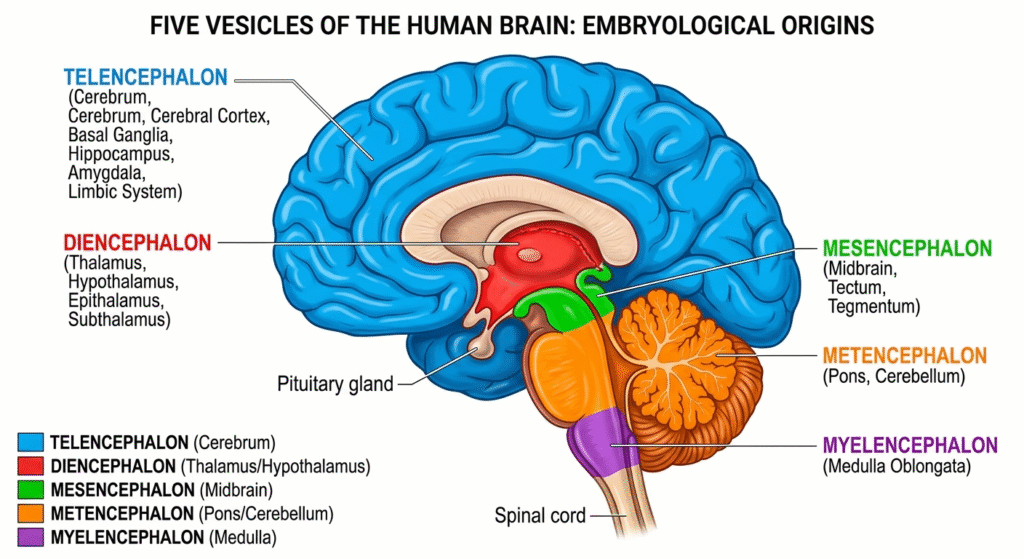
Human brain development begins with embryonic vesicles that mature into five major divisions:
- Telencephalon (cerebrum and cortex, etc).
- Diencephalon (thalamus and hypothalamus, etc).
- Mesencephalon (midbrain, etc).
- Metencephalon (pons and cerebellum, etc).
- Myelencephalon (medulla oblongata, etc).
Traditional neuroscience often studies these as anatomical regions. Psychextrics, however, reinterprets them as functional stages in behavioural construction. Each cephalon contributes a necessary layer, and none can independently produce behaviour in its complete form.
2. The Diencephalon: Central, But Not Singular
The diencephalon occupies a unique position within Psychextrics because it is the point of convergence where three essential dimensions meet:
- Meaning (via thalamic integration of GIM–EIM).
- Emotion (via hypothalamic HIM–HFI dynamics).
- Decision (emerging from their synthesis).
It is here that raw sensory input becomes interpreted reality, and where interpretation transforms into behavioural directive. In this sense, the diencephalon is rightly described as the interpretative core.
Yet, interpretation is not creation in isolation. The diencephalon does not:
- Select all incoming stimuli (mesencephalon contribution).
- Stabilise behavioural patterns (metencephalon contribution).
- Guarantee survival viability (myelencephalon contribution).
- Display or enact behaviour (telencephalon contribution).
Thus, while the diencephalon constructs the meaning of behaviour, the possibility, structure, and expression of that behaviour are distributed across the entire cephalon.
3. The Five Cephalons as a Behavioural Assembly System
To understand Psychextrics fully, the brain must be seen not as a map of regions, but as a sequence of functional filters.
A. Myelencephalon — The Survival Gate
At the foundation lies the myelencephalon, responsible for autonomic regulation. In Psychextrics, it determines whether a behaviour is biologically permissible. No matter how meaningful or emotionally charged a behavioural directive may be, it cannot manifest if it violates survival thresholds.
It answers the first question of behaviour:
Can this behaviour exist within the limits of life?
B. Metencephalon — The Pattern Stabiliser
Above survival lies structure. The metencephalon refines behaviour into coherent, coordinated patterns. It transforms raw behavioural impulses into stable, repeatable expressions—what we often recognise as habits, skills, or behavioural identity.
It answers:
Can this behaviour be expressed smoothly and consistently?
C. Mesencephalon — The Orientation Engine
Before interpretation, there must be selection. The mesencephalon determines what stimuli enter the system and which are ignored. It directs attention, prioritises urgency, and establishes the entry point of reality into the psychextrical process.
It answers:
What is important enough to be processed?
D. Diencephalon — The Interpretative Core
Only after survival, stabilisation, and orientation does the diencephalon perform its defining role: integration.
Here:
- The thalamus aligns incoming signals with genetic and experiential templates (GIM–EIM)
- The hypothalamus assigns emotional weight and hormonal tone (HIM–HFI)
The result is a unified construct:
A meaning–emotion–decision bundle.
It answers:
What does this mean, and how should it matter?
E. Telencephalon — The Display Interface
Finally, behaviour is rendered. The telencephalon, particularly the cortex, does not originate decisions; it displays them. It is the conscious surface upon which the outcomes of cephalic integration appear as thoughts, perceptions, and actions.
It answers:
How is this behaviour experienced and expressed?
4. The Psychextrics Brain Decoding Scanner: Whole-Brain Input, Diencephalic Interpretation
Within this framework emerges the conceptual Psychextrics Brain Decoding Scanner—a model designed to read and interpret behaviour from neural activity.
Crucially, this system:
- Collects data from the entire cephalon.
- But interprets behaviour through the diencephalon.
This is not a contradiction. It is a methodological necessity.
Because:
- The mesencephalon tells us what entered the system.
- The metencephalon tells us how it was stabilised.
- The myelencephalon tells us what was permitted.
- The telencephalon shows us what was displayed.
But only the diencephalon reveals:
What the behaviour means.
Thus, the scanner’s architecture reflects the doctrine of Psychextrics itself:
Data is distributed. Interpretation is centralised.
5. Why Centrality Must Not Become Exclusivity
A common error that must be avoided in emerging theories is to elevate a central structure into an exclusive one. Psychextrics explicitly rejects this.
To say the diencephalon is central is not to say:
- It is sufficient on its own.
- It overrides all other regions.
- It operates independently.
Rather, it is to recognise that:
All behavioural roads pass through it—but none originate or terminate there alone.
The diencephalon is a convergence point, not a solitary engine.
6. Behaviour as Cephalic Collaboration
The ultimate claim of Psychextrics is both simple and profound:
No single brain region produces behaviour. Behaviour is the outcome of cephalic collaboration.
From the medulla’s silent regulation of life, to the cerebellum’s refinement of motion, to the midbrain’s selection of reality, to the diencephalon’s construction of meaning, and finally to the cortex’s display of experience—each layer contributes indispensably.
Remove one, and behaviour is not altered—it is fundamentally transformed.
Conclusion: A New Orientation for Brain Science
Psychextrics offers a reorientation of neuroscience:
- Away from localisation.
- Toward integration.
- Away from cortical supremacy.
- Toward cephalic collaboration.
- Away from fragmented interpretation.
- Toward unified behavioural construction.
In this model, the diencephalon stands as the interpretative heart of behaviour—but like any heart, it depends on the system it serves.
- It leads.
- It integrates.
- It defines meaning.
But it does not—and cannot—act alone.
And it is in this balance between centrality and interdependence that Psychextrics finds its most complete and powerful expression.
Back to: 👇