
Lawderly and Molaw: Arbitration and Force in a Populocratic Order
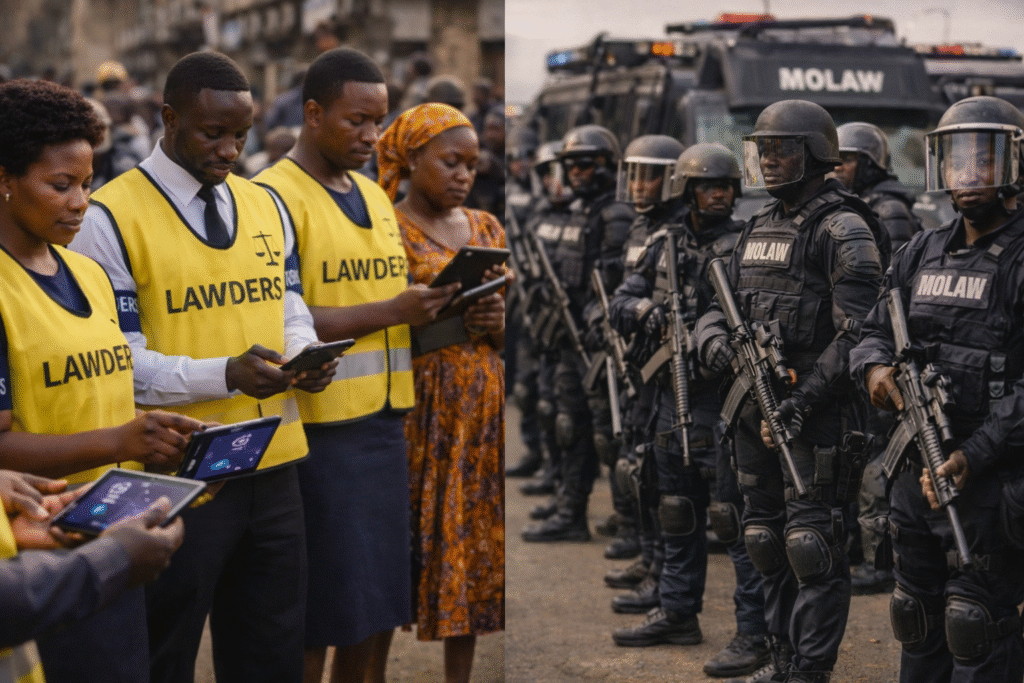
BY: OMOLAJA MAKINEE
A just society is not one that abolishes force entirely, but one that places force in its correct position.
Modern policing collapses arbitration, enforcement, and violence into a single visible institution. This fusion is precisely what renders policing adversarial, feared, and structurally incompatible with populocratic governance.
In response, ethnopublic society introduces a bifurcated but integrated system: Lawderly and Molaw—two distinct institutions, each bound by strict operational limits, moral hierarchy, and functional separation.
Lawderly governs law. Molaw contains violence. Understanding their relationship is essential to understanding how order is maintained without terror, and how justice remains socially owned without descending into chaos.
1. Lawderly: Law in Motion, Not Force in Uniform
Lawders are “walking arbitrators“, not enforcers.
They do not patrol, pursue, or compel. They circulate through communities as accessible legal stewards, equipped not with weapons, but with legal authority, moral legitimacy, and a working tablet-device that serves as a mobile justice terminal.
A Lawder may encounter:
- A public argument escalating toward violence.
- A domestic dispute stumbled upon by chance.
- A disagreement between traders, neighbours, or partners.
In such cases, the Lawder does not intervene by default. Consent is the first threshold.
Consent-Based Arbitration
The Lawder requests permission from the parties to intervene. If consent is granted, arbitration proceeds. If not, the Lawder withdraws—unless imminent tension or imminent violence is detected, in which case escalation protocols apply.
Once arbitration begins, the Lawder:
- Hears both parties impartially.
- Applies relevant sections of law.
- Facilitates resolution or issues binding arbitration.
- Generates an arbitration reference.
This reference is digitally recorded in both parties’ justice records, including:
- The nature of the dispute.
- Applicable legal provisions.
- The conclusion reached.
- Any corrective or preventive measures.
These records are cumulative and revisit-able, enabling future Lawders to identify recurring patterns without criminalisation.
Justice becomes continuous, contextual, and preventative.
2. Law Without Enforcement: Why Lawderly Does Not Use Force
Lawderly does not enforce because enforcement corrupts legitimacy. The moment arbitration is backed by threat, law ceases to be moral and becomes coercive. Lawderly is designed to resolve disputes before they harden into criminal acts.
This is why Lawders:
- Do not wear intimidating uniforms.
- Do not carry weapons.
- Do not detain or restrain.
- Do not pursue suspects.
Their authority is procedural, not physical.
3. The Necessity of Molaw: When Arbitration Is Not Enough
A mature legal system must acknowledge reality: not all violence is preventable through dialogue. To address extreme scenarios—armed violence, imminent harm, organised criminal activity—a supporting arm exists. This arm is Molaw.
Crucially, Molaw is not policing by another name. Unlike policing, Molaw is not the primary operational body of law administration in an ethnopublic society. Its function is exceptional, conditional, and subordinate—activated only when Lawderly’s non-violent, arbitrative capacity is exhausted or rendered ineffective by imminent harm.
According to behavioural studies, violence is rarely spontaneous, but rather a progression.
- Tension: Agitation, restlessness, and increased volume.
- Aggression: Threats, verbal abuse, and erratic movement.
- Violence: Physical acts, such as striking or throwing things.
Recognising the difference is crucial for intervention; tension can often be de-escalated through lawderly communication, whereas imminent violence requires immediate Molaw protection.
4. Molaw Defined: Controlled Force Within Law
The term Molaw is derived from:
- Mobile – rapidly deployable.
- Law – operating strictly within legal mandate.
Molaw denotes:
A closed, mobile system of law-enforcement capacity, activated only under exceptional conditions, operating under State authority but instructed through Lawderly frameworks.
Molaw is a closed system of force.
- It is not visible in daily public life.
- It does not patrol communities.
- It does not interact casually with civilians.
- It does not arbitrate disputes.
Molaw exists only for violence containment.
5. Visibility and Psychological Order
Unlike police, Molaw is not omnipresent. Its invisibility is deliberate. Public safety is not maintained by reminding citizens that violence is near, but by creating conditions where violence rarely arises.
Molaw appears only when:
- Violence is active or imminent.
- Lawderly intervention is insufficient.
- Immediate containment is required.
When Molaw withdraws, Lawderly resumes jurisdiction.
6. The Chain of Authority
The operational hierarchy is precise:
- Lawderly governs everyday law and dispute resolution.
- Molaw supports Lawderly when violence obstructs arbitration.
- Molaw acts only upon Lawderly instruction or State emergency mandate.
- Molaw reports upward to the State, not to public opinion.
- Molaw never overrides Lawderly decisions.
This ensures force remains subordinate to law, not fused with it.
7. Accountability Without Public Terror
Molaw is not answerable directly to the public, precisely to prevent mob pressure, politicisation, or performative enforcement. Its accountability is institutional, not emotional.
Lawderly, by contrast, remains fully embedded within society, accountable through transparency, records, and communal legitimacy.
Together, they form a system where:
- Law is visible.
- Force is restrained.
- Order is legitimate.
8. Why This Is Not Policing
Policing collapses three functions into one body:
- Arbitration.
- Enforcement.
- Violence.
This fusion produces fear, abuse, and moral decay.
From a psychextrical-method, this collapse is not merely institutional; it is neurological. Human beings do not approach conflict from a neutral baseline. Behaviour is always the surface expression of deeper thalamic prioritisation, shaped by the interaction between GIM/EIM (genetic–epigenetic meaning architecture) operating within HIM/HFI (hormonal emotional resonance and fluidity).
The neurotype thalamic nuclei continuously rank stimuli according to what the brain finds salient, rewarding, or necessary to act upon. For some individuals, conflict stimuli preferentially activate enforcement-oriented nuclei—those that translate disorder into urgency for containment, dominance, or force. For others, the same stimuli preferentially activate arbitration-oriented nuclei—those that translate disorder into narrative, negotiation, and meaning-resolution.
In individuals with a higher innate preference for violence or enforcement, the thalamus resolves uncertainty through action rather than dialogue. Their GIM sets a narrow tolerance for ambiguity, their EIM reinforces experiential success of force-based outcomes, and their HIM/HFI amplifies emotional readiness for confrontation. Violence is not always conscious cruelty; it is often experienced internally as clarity, decisiveness, or problem-solving. Such individuals will naturally find arbitration slow, tedious, and psychologically unrewarding. To them, extended dialogue feels like stagnation.
Conversely, individuals whose thalamic prioritisation favours arbitration experience conflict as a problem of misalignment rather than threat. Their neurotype nuclei bias toward interpretive circuits—memory comparison, emotional attunement, and symbolic reconciliation. Their hormonal resonance rewards discussion, mediation, and narrative closure. Enforcement feels excessive; violence feels disruptive to meaning. These individuals are drawn instinctively to dialogue, social reasoning, and moral calibration. They are, in psychextrical terms, natural philosophers—people whose brains enjoy inhabiting complexity and social drama rather than terminating it through force.
Crucially, professional training does not override this architecture. Training can refine behaviour, but it cannot invert thalamic priority. When a single institution forces arbitration, enforcement, and violence into one role, it guarantees internal conflict: arbitration-minded individuals are pressured into violence they neurologically resist, while enforcement-minded individuals are handed discretionary power over dialogue they neurologically devalue. The result is predictable—excessive force, performative mediation, moral incoherence, and public fear.
The Lawderly–Molaw separation resolves this at the level of brain reality rather than moral aspiration. Lawderly becomes a domain for arbitration-dominant psychologies—those whose GIM/EIM–HIM/HFI alignment finds meaning in talk, negotiation, and civic reasoning. For violence-oriented individuals, Lawderly is boring, unrewarding, and unattractive, acting as a natural psychological filter.
Molaw, by contrast, is tightly restricted to individuals whose brains are already oriented toward enforcement and controlled violence, and whose role is activated only when arbitration has failed and containment is necessary.
This is not a moral judgement; it is a neurological allocation. Ethnosocialism, informed by psychextrics, recognises that justice fails when roles contradict brain potency. Governance stabilises when social functions align with the innate priorities of the human nervous system.
By separating arbitration from violence, society stops pretending that everyone can—or should—resolve conflict the same way. Instead, it allows each psychological variant to serve where it is most coherent, least corruptible, and most humane. Ethnopublic governance separates them:
| FUNCTION | INSTITUTION |
|---|---|
| Arbitration | Lawderly |
| Violence Containment | Molaw |
| Moral Legitimacy | Society |
By separating these roles, power is decentralised, abuse is structurally constrained, and justice remains human.
Conclusion: Law First, Force Last
The operational relationship between Lawderly and Molaw represents a civilisational recalibration. Law is restored to its rightful place as a moral process, not an armed command. Force is retained, but sealed—visible only when absolutely necessary and never allowed to define social order.
In this system:
- Law walks among the people.
- Violence is quarantined.
- Justice is recorded, remembered, and owned.
Lawderly governs society. Molaw protects it from collapse.
This is not the reform of policing. It is the end of policing as a paradigm—and the birth of lawful order without fear.
Back to: 👇