
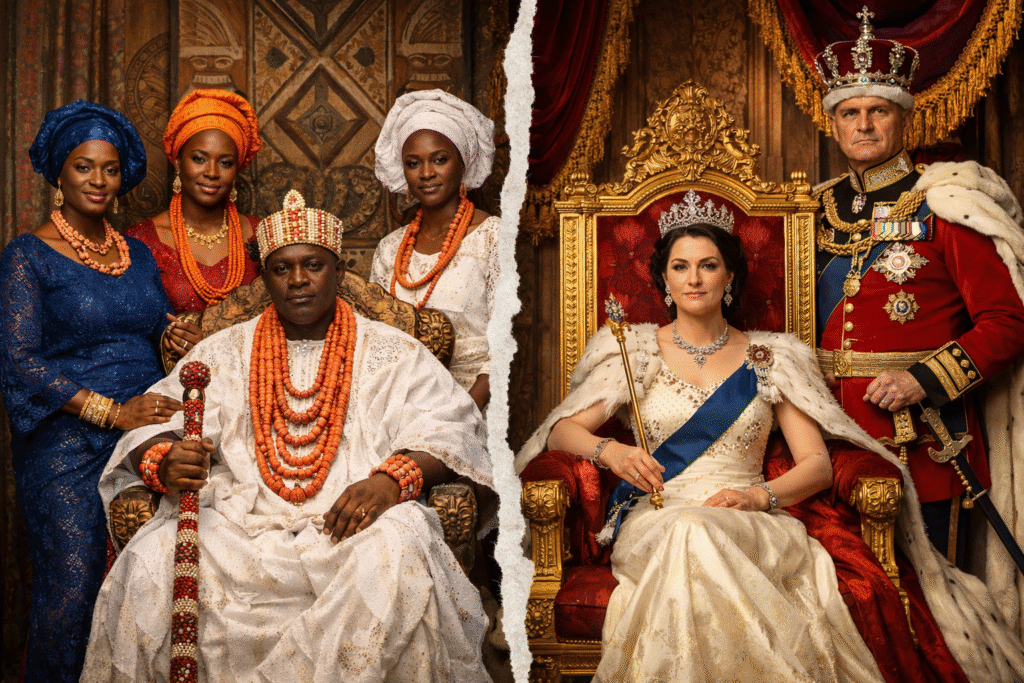
Two Monarchies, Two Logics: Why Western Monarchy and African Monarchy Are Not the Same
BY: OMOLAJA MAKINEE
Introduction: A False Equivalence
The word monarchy has long been treated as a universal category—as though kingship is a single institution that merely wears different cultural clothing. This assumption is not only inaccurate; it is intellectually destructive. It collapses fundamentally different civilisational logics into a single term and, in doing so, erases Africa’s indigenous governance philosophy.
Western monarchy and African monarchy are not variations of the same system. They are opposites in structure, logic, moral authority, and social organisation. One is hierarchical and bureaucratic; the other was historically horizontal and commicratic. One concentrates power vertically; the other distributed authority across communal institutions. To describe both with the same conceptual language is to commit a category error.
Here I draws an irrevocable distinction between the two and argues that Africa must henceforth restore conceptual clarity in its terminologies, education systems, and political thought.
1. Western Monarchy: Hierarchy, Command, and Bureaucratic Sovereignty
Western monarchy emerged from feudal Europe, a civilisation organised around vertical command, land ownership, and military coercion. Power flows downward in a clear chain of authority: God to King to Nobility to Clergy to Peasantry. This hierarchy is rigid, centralised, and enforced through law, bureaucracy, and violence.
Core Characteristics of Western Monarchy
- Vertical Authority Structure: The monarch is sovereign over the people, not among them. Authority is uni-directional and non-reciprocal. Subjects do not co-govern; they obey.
- Bureaucratic Governance: Western monarchy relies on courts, ministries, tax collectors, standing armies, and legal institutions that operate impersonally. Governance is procedural, not relational.
- Land Ownership and Class Stratification: The king owns land in principle; nobles own it in practice. Land ownership becomes the basis of wealth, power, and inheritance. This produces entrenched class hierarchies.
- Monogamy with Illegitimacy: Western kings are formally monogamous. Only one wife—the queen—has legitimacy. Yet kings historically maintained multiple mistresses whose children held no recognised political or moral standing. Power is moralised publicly while privately violated.
- Law Above Community: Law exists as an abstract authority above society. Justice is administered impersonally, often detached from communal ethics or lived reality.
Western monarchy is therefore command monarchy—a system designed to rule territory, extract surplus, and preserve dynastic power through bureaucracy and coercion.
2. African Monarchy: Pharaonic, Horizontal, and Commicratic
African monarchy did not emerge from feudal conquest. It emerged from communal life, spiritual cosmology, and reciprocal obligation. Authority was not imposed vertically but emerged horizontally from collective recognition.
At its origin, African monarchy was not monarchy in the Western sense at all—it was gerontocratic and custodial.
The Gerontocratic Foundation
Early African societies were governed by elders—custodians of memory, morality, and continuity. Authority rested on:
- Wisdom, not force.
- Stewardship, not ownership.
- Trust, not coercion.
The monarch was first among equals, not a ruler above society. He functioned as a symbolic centre, an absolute sovereign in the judicial sense, and not an absolute sovereign in the executive function.
While the judiciary provides the legal architecture that guides executive action, society often mistakenly conflates this role with supreme governance, viewing the African monarch’s sovereign authority over conduct as a mandate to rule over their ethno-governed community itself.
Colonial administrators sees the African monarch directing the executive order of the chiefs, they perceive it as the monarch (Judiciary) “dictatorship over” the chiefs (Executive). In reality, the monarch is simply ensuring the chiefs remains within the “symbolic centre” of the customary law.
3. Embedded Communal Checks: The Commicratic Order
Traditional African monarchy functioned within a web of institutions, not above them:
- Councils of Elders checked royal decisions.
- Spiritual authorities restrained moral excess.
- Lineage heads governed land allocation.
- Women’s institutions held economic and ritual power.
- Age grades and guilds exercised social regulation.
This was commicracy—governance through collective organs, not bureaucratic chains. Power circulated; it did not accumulate. The monarch governed with the people, not over them.
4. Polygamy as Governing Architecture: Pharaonic Logic
One of the clearest civilisational distinctions lies in marital structure.
African (Pharaonic) Monarchy
- Rulers were polygamous by design, not indulgence.
- The first wife was queen—co-sovereign, holding State authority alongside the king.
- Other wives held graded legitimacy, often representing:
- Clans.
- Regions.
- Governing alliances.
- Spiritual offices.
Marriage was governance. The palace was a governing federation.
Western Monarchy
- Kings were formally monogamous.
- Mistresses existed outside legitimacy.
- Illegitimate offspring were excluded from power.
- Sexual power was private indulgence, not public structure.
Thus, African monarchy institutionalised plurality, while Western monarchy moralised singularity and practiced hypocrisy.
5. The Corruption of African Monarchy: From Custodianship to Domination
Over time—especially under external pressure, trade monopolies, and colonial interference—African gerontocratic systems degraded.
- Community leaders became socially elevated rulers.
- Custodianship became ownership.
- Stewardship became domination.
- Communal land became royal property.
With ownership came the ability to impose rules against collective will. African monarchy began to resemble Western hierarchy—not by design, but by distortion.
6. Postcolonial Monarchy: Authority Without Balance
Modern African monarchies preserved or revived within postcolonial States are no longer embedded in their original commicratic systems.
- Councils are ceremonial.
- Elders are symbolic.
- Spiritual checks are marginalised.
- The State, not the people, defines legitimacy.
What remains is authority without equilibrium—titles without communal grounding. This is not African monarchy as civilisation once conceived it. It is a stratified caricature, preserved under colonial constitutional frameworks.
7. Why Terminology Matters: The Urgent Need for Conceptual Separation
Calling both systems “monarchy” without distinction is intellectually dishonest.
Western monarchy is hierarchical sovereignty. African monarchy is communal custodianship. One commands. The other coordinates. One rules territory. The other stabilises society. Africa must therefore restore conceptual accuracy in:
- Education curricula.
- Social science.
- Legal theory.
- Cultural discourse.
African monarchy must be taught as pharaonic–ethnopublic governance, not as a variant of European feudalism.
Conclusion: Reclaiming African Govoxical Intelligence
Africa’s tragedy was not the loss of monarchy—it was the loss of understanding what its monarchy truly was. Western systems taught Africans to see monarchy through foreign eyes, stripping it of its communal logic and spiritual restraint. The result was confusion, imitation, and institutional decay.
To move forward, Africa must first think clearly again. African monarchy was never about domination. It was about balance. It was never about command. It was about coordination. Until we restore this distinction—in language, knowledge, and governance—Africa will continue to misdiagnose its past and misdesign its future.
Reclaiming African monarchy is not about returning to crowns. It is about restoring commicracy, custodianship, and collective sovereignty—the true genius of African civilisation.
Back to: 👇