
Ancient Africa Was One: The Case for Reuniting the Continent Through Ethnopublic Governance
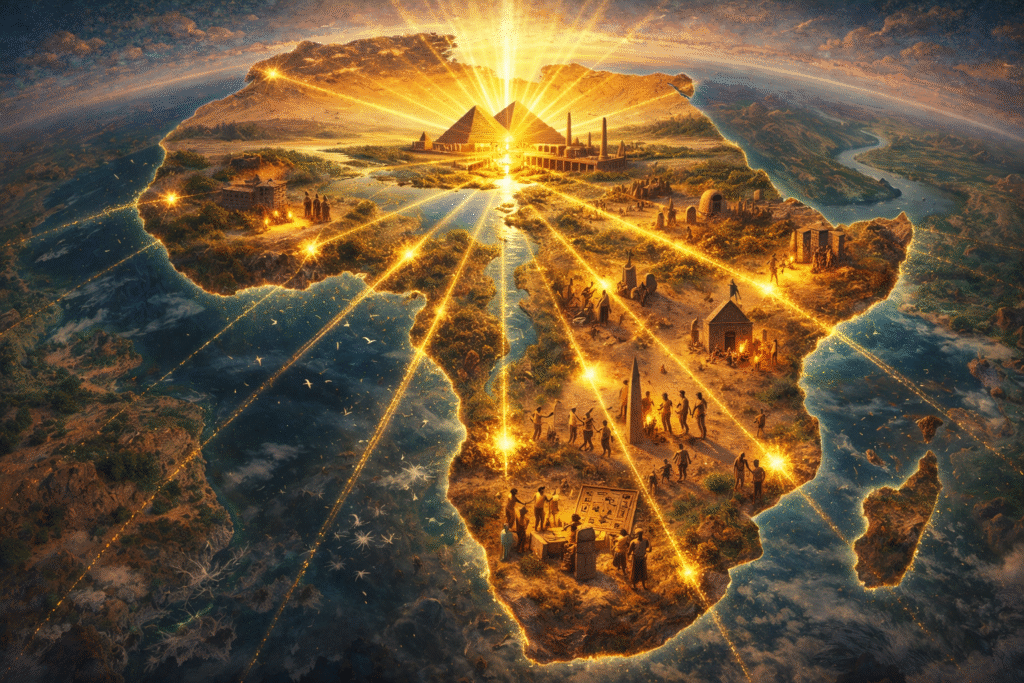
BY: OMOLAJA MAKINEE
For centuries, Western scholarship has insisted on a fictional Africa—an Africa carved into isolated “tribes”, disparate kingdoms, disconnected cultures, and unrelated spiritual systems. But this narrative collapses under even modest historical scrutiny.
When we interrogate Africa from within Africa’s own civilisational logic, a different picture emerges: a continent bound by shared cosmologies, pantheistic religious traditions, cooperative economic customs, and a governing culture rooted in communal governance—an Africa inherently united.
The truth is simple: Ancient Africa was never a collection of scattered tribes. It was a continent of interdependent ethno-governed territories, spiritually aligned govities, and civilisations built on reciprocity, solidarity, and collective moral order. Arab and European interferences merely interrupted this trajectory—they did not define it. And today, Africa stands at a historical moment where revival is not only possible, it is necessary.
This is the promise of Ethnopublicanism. This is the return to African ethnosocialism. This is the future our ancestors expected us to reclaim.
1. Africa’s Civilisations Were Interconnected Long Before Foreign Contact
Before the first Arab caravans crossed the Sahara and long before Europeans stumbled onto our shores, Africa’s civilisations were already entwined through trade networks, migration patterns, spiritual exchange, and diplomatic alliances.
A. From Kemet to the Niger Basin
Kemet—ancient Egypt—was not a northern outlier but the intellectual fountainhead of African civilisation. Its governing logic, its theology, and its social ethics rippled across the continent. The same cosmological principles that guided the Kemetian understanding of balance (Ma’at) informed the justice systems of the Yoruba, the philosophical codes of the Akan, and the moral governance practices of the Nubians, Axumites, and Great Lakes kingdoms.
The Nile connected Africa.
B. A Continent of Shared Pantheistic Traditions
Africa’s spiritual systems—far from being contradictory—speak a common theological language. The names differ; the deities do not.
- Osiris of Kemet is the same archetype as Orisa Nla/Obatala of Yoruba and the Akan Onyame’s order-givers.
- Isis reappears as Yemoja, Asase Yaa, and mother-creator deities across West and Central Africa.
- Horus, the divine avenger, echoes through Ogun, Sango, and the Akan’s heroic spirits.
- Amun, the invisible creative Source, becomes Olodumare, Mzimu, and Nyame.
These are not parallels by accident. They are expressions of a single theological blueprint manifested through diverse but unified tongues. Africa did not invent “gods”; Africa harmonised archetypes across regions because it shared a single cultural parenthood.
C. Cooperative Economic and Social Structures
The economic foundations of ancient Africa were profoundly altruistic and communal:
- Cooperative agriculture (e.g., esusu, njangi, stokvels).
- Shared labour systems (e.g., Kemetian corvée labour, Yoruba owo-ise, Bantu communal farming).
- Collective wealth redistribution through chiefs, councils, and community elders.
- A moral economy driven not by monetary gain but by reciprocity, prestige, and societal harmony.
This was socialism before socialism had a name. This was governance before constitutions were written. This was African public life before outsiders disrupted it.
2. Arab and European Interference: A Break, Not the Beginning
Foreign influence did not teach Africa civilisation—it fractured it.
A. Arab Incursions and Cultural Displacement
Arab involvement introduced new religions, new hierarchies, and new economic relations. Islam, though spiritually rich, often layered itself over Indigenous systems in ways that alienated African cosmology and created hybrid States with conflicting loyalties. The trans-Saharan slave trades and governing alliances bent ancient African governance toward foreign power centres.
B. European Colonisation and the Violent Redrawing of Africa
Europeans did not contribute to African unity—they destroyed it.
- Artificial borders sliced through ethnic homelands.
- Cooperative economic systems were replaced with extractive capitalism.
- Ethnic groups were split, reclassified, or politicised as “tribes”.
- Indigenous governance models were abolished or subordinated.
- A foreign, adversarial, winner-takes-all form of republican politics was imposed.
The Africa of today—with its coups, ethnic rivalries, and systemic instability—is a post-colonial invention, not an African one.
3. Why Africa Must Return to Ethnopublic Governance
The Ethnopublican model of this Manifesto is not a utopian dream. It is a historical return, a civilisational restoration, and a governing correction.
A. Ethnopublics Restore Natural Ethnic Territories
Instead of artificial colonial borders, Ethnopublic governance recognises the historic ethno-territories that pre-dated colonisation. These territories can federate into a continental Ethnopublic union—one Homeland, many communities.
This mirrors ancient Africa, where each ethnic civilisation governed itself while contributing to a broader continental identity.
B. Citizen-Directed Governance Prevents Tyranny
In an Ethnopublic State, coups cannot occur. Why?
Because no military, no elite, no party can claim government legitimacy above the citizenry-electorate. Governance is not a privilege granted to rulers—it is a day-to-day mandate exercised by the people themselves. The citizenry can recall, demote, or re-elect leadership at any time.
This eliminates the vacuum that typically invites military intervention in republican societies.
C. Ethnosocialism Revives Africa’s Cooperative Economic Ethos
Ethnosocialism:
- replaces exploitative capitalism with shared economic governance;
- restores communal ownership of production;
- blends State-guided planning with citizen-driven directives;
- re-establishes altruistic economic relations grounded in African traditions.
It is not Marxism. It is not Western socialism. It is African communalism modernised—a direct descendant of Indigenous economic systems.
4. The Mandate of the Ancestors: Africa Must Rise Again
Let it be known: Africa’s unification under Ethnopublicanism is not merely a govoxical project—it is a civilisational duty.
We are the descendants of Kemet, of Kush, of Ife, of Oyo, of Axum, of Nok, of Mali, of Burkina Faso, of Ghana, of Songhai, of Benin, of Great Zimbabwe.
They expected of us what they themselves built:
- unity through shared spirituality, not division through foreign dogma;
- cooperative economies, not exploitative markets;
- citizen-directed governance, not imposed rule;
- continental identity, not colonial boundaries;
- solidarity, not fragmentation.
The Arab and European disruptions broke our trajectory, but they did not erase our blueprint. The blueprint remains. The memory remains. The destiny remains.
CONCLUSION: Africa Can Unite Again. Africa should unite again. Africa must unite again
This is not nostalgia. This is the next stage of African civilisation. This is the return of the Ethnopublics. This is the revival of African-socialism in its truest, most authentic form.
And this—this Ethnopublican ideal—is the future Africa is owed.
Back to: 👇