
The Foreign Faiths That Divide the Black Land: How Africa’s Children Kill Each Other Over Imported Gods
BY: OMOLAJA MAKINEE
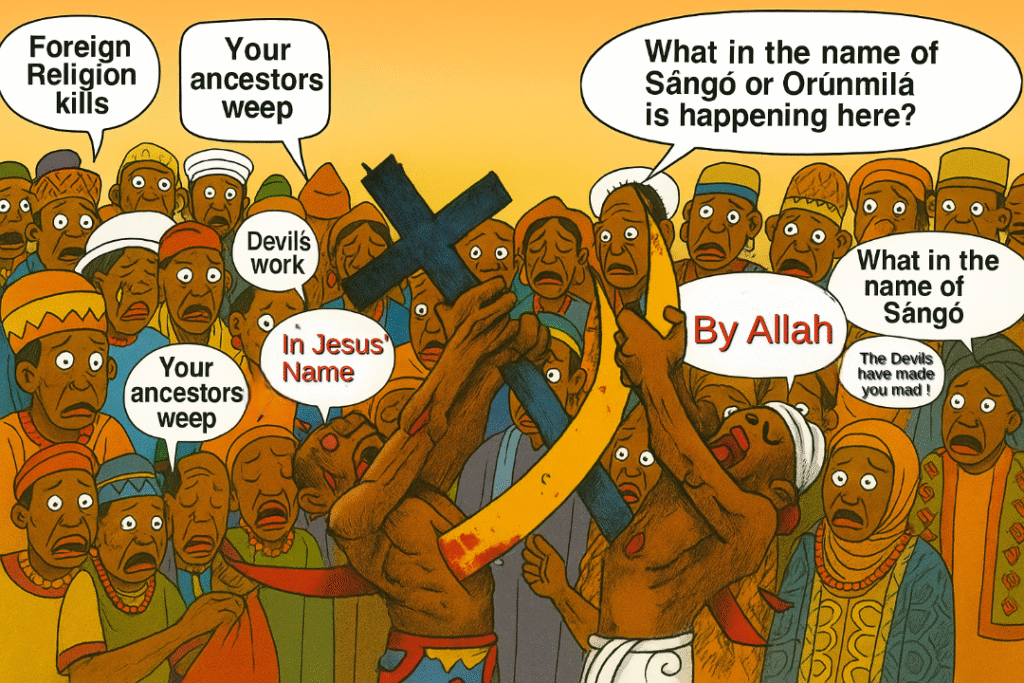
Across the sunburnt plains of the Black Land, two brothers kneel in the dust — one clutching a cross, the other wielding a crescent. They call upon foreign gods in tongues not of their ancestors. Their foreheads glisten with sweat, their hands soaked with each other’s blood. Behind them, a gathering of elders stands aghast — their faces twisted with grief, their voices rising in lamentation: “Your ancestors weep! Foreign religion kills! The devils have made you mad!”
This image captures more than a moment; it captures centuries of tragedy. It tells the story of a continent once united under one spiritual order — Ma’at, the principle of balance, harmony, and truth — now broken into fragments by imported faiths that preached peace but delivered discord.
1. The Invasion of the Mind
The greatest conquest of Africa was not the capture of her lands but the colonisation of her spirit. Before the ships and the guns, came the missionaries and the imams — emissaries of empires who brought scriptures bound in foreign languages and stories that erased the divine presence in African blood.
They told our forebears that their gods were demons. That their sacred groves were places of sin. That the river spirits that sustained their harvests were false idols. They demanded we bow to alien heavens and forsake the Earth that birthed us. In time, the coloniser’s religion became a badge of status; the more one renounced his ancestral ways, the closer he was to being “civilised.”
But this civilisation came at a terrible cost — the destruction of self-knowledge.
2. Brothers at War Over Borrowed Beliefs
Today, entire regions of Africa bleed because one group says “In Jesus’ name” and another says “By Allah.” Both pray to a foreign sky, both defend imported doctrines that neither originated nor belong to the soil beneath their feet. Churches and mosques now stand where shrines once echoed with drums of communal prayer; and the spiritual heart of Africa beats faintly, smothered beneath the noise of sectarian rivalries.
In Northern Nigeria, in Mali, in Sudan, in the Congo, in Ethiopia — brothers slaughter brothers, forgetting that before Mecca or Jerusalem, there was Nok, Ifẹ̀, Axum, and Kemet. The tragedy is not merely that they fight; it is that they believe they do so in the name of righteousness, blind to the irony that their wars are fought over ideologies their ancestors never knew.
3. The Forgotten Religion of Ma’at
Long before the Bible and the Qur’an were ever translated into our tongues, Africa had already conceived of divine order. From Kemet’s priests to the Yoruba’s diviners, from the Zulu isangoma to the Akan okomfo, our people understood the cosmos as a living balance — that truth (Ma’at) was the path to righteousness, and righteousness the key to harmony.
Ma’at was not a religion of conquest but of equilibrium. It did not demand that one tribe convert another, nor did it sanctify war. Instead, it taught that the heart must weigh lighter than the feather of truth. That one’s deeds, not one’s creed, determine worth before the ancestors.
When Africa lived by Ma’at, there was unity. When Africa abandoned Ma’at, division took root.
4. Religious Occupation of the Black Land
To this day, Africa remains the most spiritually colonised continent on Earth. No other civilisation so completely replaced its gods with those of others. The Arabisation of the north and the Christianisation of the south have created a spiritual frontier across the continent, turning neighbours into enemies and believers into bigots.
Our marketplaces, schools, and even parliaments now echo with the rhetoric of imported religious wars. Our children are named after prophets of foreign lands but cannot name the deities of their own ancestors. The temples of Orunmila, of Nyame, of Olokun, of Ausar, lie abandoned while we build monuments to Mecca and Rome.
This is not spirituality — it is occupation of the soul.
5. The Path to Spiritual Decolonisation
If Africa is to rise again, she must reclaim her spiritual independence. This does not mean erasing the foreign, but rather rebalancing the soul of the continent. Christianity and Islam must no longer be treated as superior to ancestral faiths; rather, they must take their place as imported systems that coexist with, not dominate, indigenous belief.
Africans must once again teach their children the names of their own gods, the ethics of their own cosmologies, and the prayers of their own tongues. The shrines and sacred groves must be restored — not as relics of superstition but as centres of philosophy, science, and spiritual equilibrium.
6. The Cry of the Ancestors
In the image of the two men fighting, we see ourselves — the children of the Black Land, warring under banners we did not weave. The elders in the background represent our ancestors, watching as we repeat the mistakes of those who forgot who they were. Their cry is the conscience of Africa itself:
“What in the name of Ṣàngó or Òrúnmìlà is happening here?” “Foreign religion kills!” “Your ancestors weep!”
Their message is clear — our liberation begins when we stop dying for foreign gods and start living for our ancestral truth.
Conclusion: Toward A Reunited Spirit
To heal Africa is not only to rebuild her economies or borders but to reunite her soul. It is to restore Ma’at as the moral geometry of civilisation. It is to teach our people that divinity is not imported but inherited — that the gods of the Black Land dwell not in distant heavens but in the heartbeat of her children.
When Africa rediscovers her original faith, she will rediscover her unity. And when she rediscovers her unity, she will rediscover her power.
For the Black Land to rise, her people must cease to kneel before foreign altars and instead stand upright in the light of their own ancestors. Only then will the blood of the brothers dry upon the dust, and the song of Ma’at return to the wind.
“The gods of our fathers are not dead — only forgotten. Remember them, and you will remember yourself.”
Back to 👇