
Pan-Africanism and the Third Covenant: The Return to Kemet
BY: OMOLAJA MAKINEE
To be a Pan-Africanist in the 21st century is not merely to wave the banner of political unity, nor to echo the familiar cries for liberation and development. It is to revive the legend of ancient Kemet in our collective expression. It is to remember that Pan-Africanism, at its deepest core, was never just a political project — it is the spiritual continuation of an ancient memory, the voice of Kemet echoing through time, summoning her scattered descendants home to pilgrimage.
Kemet — “The Black Land” — was not merely a geographic designation for the Nile Valley. It was a civilisational principle, a living philosophy that ordered human life according to Ma’at, the law of truth, balance, and harmony. It represented the first Pan-African idea before the term was ever conceived: a unifying moral geometry that allowed different ethnic communities to coexist under one cosmological banner. The modern call for African unity is, in essence, a call to reawaken that original order.
1. The Three Covenants of Pan-Africanism
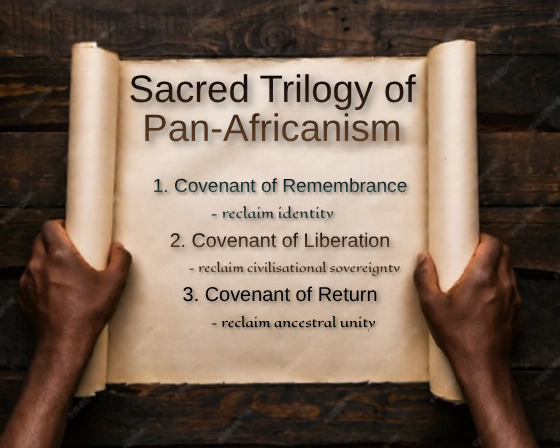
The history of Pan-Africanism unfolds as a sacred trilogy, each phase representing a covenant between Africa and her people — a promise renewed across generations.
A. The Covenant of Remembrance
The first covenant was born in exile — in the Americas, the Caribbean, and Europe — where Africans enslaved by empire began to dream of return. The likes of Marcus Garvey, Henry Sylvester Williams, and Edward Blyden carried the torch of this early awakening. They reminded the scattered Black world that we were not orphans of history but heirs to a great civilisation.
This was the covenant of remembrance. It called the stolen children of Africa to remember their mother. “Africa for the Africans, those at home and those abroad,” declared Garvey — a slogan that was not merely political, but ancestral. It was the cry of memory struggling against centuries of erasure. The first covenant thus sought to reclaim identity, to restore pride in a people who had been told that they had none.
B. The Covenant of Liberation
The second covenant emerged on African soil itself, in the fires of anti-colonial resistance. It was the age of Kwame Nkrumah, Patrice Lumumba, Nnamdi Azikiwe, Obafemi Awolowo, Jomo Kenyatta, and Julius Nyerere. These leaders transformed the spiritual longing of the diaspora into the political struggle of the continent.
From this movement rose independent States, free flags, and Constitutions written in the languages of liberation. Yet, though the land was freed, the soul remained in captivity. The colonial map still divided the heart of the continent; foreign religions divided its conscience; and borrowed political systems divided its destiny.
The second covenant gave us political sovereignty, but not yet civilisational unity. It freed the African body, but not yet the African mind. It restored our lands, but not our spiritual home.
C. The Covenant of Return
Now comes the third and final covenant — the Covenant of Return. This is the call of Kemet to her descendants. It is the final chapter of Pan-Africanism’s divine trilogy: to reunite the African soul with its source.
If the first covenant was remembrance, and the second liberation, then this third must be revival — the resurrection of Kemet as the civilisational symbol of Pan-African destiny. To return to Kemet is not to idolise the past, but to reclaim the ancestral architecture of unity that once made civilisation possible.
Every epoch of African resistance has sought to return to something sacred — a name, a land, a truth. In our age, that sacred object is Kemet. To call ourselves Kemetians is to speak the name of the ancestors again, to stand where history was first written in the language of the Nile, and to recover the moral grammar of Ma’at that once guided the governance of Black civilisation.
2. Kemet Revived: The Spiritual Axis of Pan-Africanism
Pan-Africanism without Kemet is a body without a heart — a dream searching for an anchor. The revival of Kemet is the spiritual axis upon which the political and historical revolutions of Pan-Africanism revolve. The first covenant freed our feet; the second freed our hands; but this third must free our mind and our memory.
Kemet teaches that the highest form of unity is not enforced by law but sustained by spiritual order. It is not an assembly of States, but a harmony of souls. This is the meaning of Ethnopublicanism — a new governance model derived from the ancient template, where moral balance governs collective destiny.
Thus, the revival of Kemet is not a return to ruins; it is a return to order. It is the restoration of an African worldview that once regarded life as sacred, leadership as service, and governance as moral stewardship. It is the rediscovery of our own rhythm in the symphony of civilisation.
3. The Call to the Third Covenant
We are the generation standing at the edge of completion. The covenant of return calls upon all who identify as children of the Black Land — in Africa, in the Americas, in Europe, in the Caribbean, in the Pacific — to remember that we share one ancestral river, the Nile of memory that flows through us all.
The call is not political. It is civilisational. It is not merely about renaming Africa; it is about reclaiming the soul of Africa. To say “We are Kemetians” is to say that we refuse to be defined by the names of our conquerors, the maps of our colonisers, or the religions of our oppressors. It is to declare a spiritual independence that completes the governing independence of our ancestors.
Therefore, let this be the Call to the Third Covenant:
Let every African remember the covenant of our beginning. Let every nation of the Black world proclaim Kemet as our ancestral home. Let the Nile become our pilgrimage once again, not as tourists to history but as heirs to civilisation. Let the temples of Ma’at rise not in stone but in spirit — in our governance, in our ethics, in our unity. Let every generation declare: Pan-Africanism fulfilled is Kemet revived.
This is the moment of return. This is the completion of the covenant. This is the awakening of Kemet.
Conclusion: The Awakening Within
I realised then that Pan-Africanism’s final chapter is not political — it is ancestral. We have raised flags and fought wars, but the heart of the matter was never the colour of the flag; it was the colour of memory. In rediscovering Kemet, I am not seeking nostalgia; I am seeking wholeness. I see in the Nile not just a river, but the bloodstream of our civilisation — the pulse that once animated our collective soul.
For too long, we have searched for Africa in the vocabulary of others, wearing names that never fit and dreaming dreams that were never ours. But Kemet — the Black Land — calls us by our original name. It reminds us that our civilisation did not begin with colonisation, nor end with it. It began with spirit, with Ma’at, with order, with the understanding that life and justice are one.
When I speak of the Third Covenant, I am not proposing a theory — I am answering an ancestral summons. Kemet is no longer buried beneath the sands of history; it is awakening in us. And when every African, at home and abroad, answers that same call — when we live as Kemetians once more — then Pan-Africanism will finally come home.
Back to 👇