
The Inevitability of Digital-Intelligence Identity (DIID) in the Age of AI
A New Architecture for Trust, Accountability, and Human Continuity in the Digital Era
BY: OMOLAJA MAKINEE
In the pre-digital age, identity was a physical concept. It lived in documents, signatures, and seals — tangible proofs of existence that travelled slower than trust itself. A passport or driver’s licence represented presence but never truth. The modern age of Artificial Intelligence (AI), however, has shattered this illusion. When machines mediate every aspect of our social, legal, and economic lives, identity can no longer afford to be analog.
The future belongs to the Digital-Intelligence Identity (DIID) — a new generation of identity architecture designed to anchor humanity in a transparent yet privacy-conscious social order.
1. From Paper to Intelligence: Why Identity Must Evolve
Every society depends on recognition. We recognise faces, names, and patterns of behaviour; this recognition forms the foundation of law and trust. Yet, in the digital age, recognition has been compromised. Anyone can hide behind a pseudonym, forge a document, or manipulate an online profile. The digital realm, once a symbol of liberation, has become a theatre of deception.
Traditional digital identities — usernames, passwords, or even digital ID cards — are fragile constructs. They authenticate access but not authenticity. They prove that someone can log in, but not that they are who they claim to be.
DIID emerges to solve this crisis of authenticity. Unlike digital IDs, Digital-Intelligence Identities are biogenically and psychometrically bound — linking individuals’ verified biometric data (such as facial structure, gait, and voice print) with their government-verified identity signature. This creates a stable, immutable link between the physical and digital self, making impersonation and fraud virtually impossible.
2. The Public-Face Principle: Balancing Privacy and Accountability
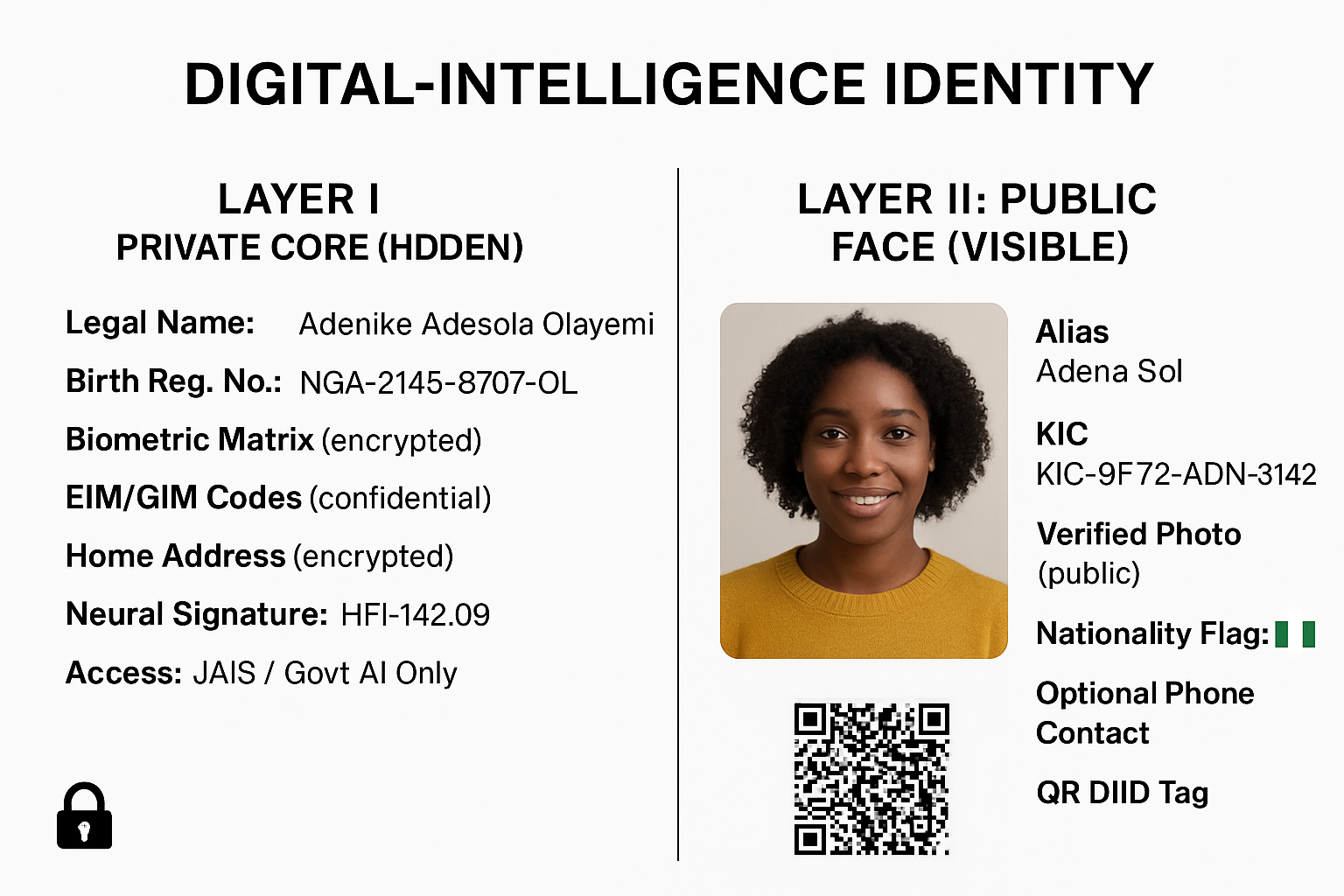
The DIID system operates through a dual architecture:
- Private Core Identity — contains the individual’s legal name, full biometric record, and all State-verified information, accessible only to authorised systems such as JAIS (Judicial Adjudication Intelligence System), immigration, or licensed service providers.
- Public-Face Identifier — a simplified version of the identity, containing a verified photograph, optional alias name, and a unique Known Identifier Code.
This “known identifier” functions much like a digital number plate for human interaction. It does not reveal sensitive data such as address or date of birth, but it verifies the authenticity of the individual being interacted with.
A citizen may use this public identifier for social media, business, online dating, travel, or daily interpersonal interactions. When entered into a government verification portal, the identifier reveals the public face — ensuring that the person you are engaging with is not a digital ghost or fabricated entity.
In essence, DIID replaces anonymity with verifiable privacy: one remains private, but never untraceable.
3. Social Functionality: DIID as the New Currency of Trust
In an AI-driven society, DIID becomes a social passport across multiple spheres:
- Online Dating and Social Media: DIID ensures that every visible profile corresponds to a real human being. No catfishing, deepfake personas, or AI-driven impersonation can survive DIID verification.
- Employment and Recruitment: Employers may verify candidates through their public DIID identifiers, ensuring educational and identity claims are legitimate.
- Travel and Immigration: Visitors receive temporary DIIDs tied to their visas, ensuring seamless verification without disclosing unnecessary personal information.
- Healthcare and Welfare: State institutions may access only relevant health or welfare data tied to DIID profiles, reducing paperwork and fraud.
- Financial Transactions: Banks and lenders operate on DIID verification rather than traditional credit or address proofs, eliminating phantom accounts and identity theft.
Through this flow, DIID forms not just a system of identity, but a living continuum of recognition — ensuring that in a world governed by artificial intelligence, the human remains visible, verifiable, and morally present.
DIID, therefore, becomes not only a tool of recognition but a universal trust protocol.
4. Conflict and Accountability: The DIID Duty of Disclosure
The DIID framework introduces a new social ethic: the duty of identification in conflict.
Just as road users must exchange insurance details after an accident, individuals engaged in a dispute are required by law to exchange their DIID identifiers. This ensures that every act of interpersonal conflict carries traceable accountability.
Failure to share DIID during an altercation is treated as a non-cooperation offence. If one party refuses to disclose and leaves the scene, the other may contact law enforcement. Police can trace and verify the individual using nearby surveillance nodes or biometric data.
If the altercation was trivial, no further action is taken; but if it reached the threshold of harm or threat, the refusal becomes a punishable offence of DIID non-compliance.
This system introduces a powerful new social logic: no one can act in conflict without consequence. Even pre-emptive self-reporting — where one voluntarily visits a police station after an altercation to log their DIID — becomes a protective act of transparency.
5. Privacy by Design: Controlled Exposure, Not Constant Surveillance
Critics may worry that DIID invites State overreach or mass surveillance. However, the DIID model, as designed for the AI justice ecosystem, operates under a principle of layered visibility.
- Only specific authorised events trigger access to certain private data strictly relating to that event (e.g., police investigation, court summons, or verified contract).
- The public-facing layer remains entirely under the individual’s control — one may change alias names or social identifiers while keeping biometric integrity intact.
- Every access event is logged on an immutable blockchain, ensuring full transparency of who accessed one’s data, when, and for what purpose.
Thus, DIID offers traceable privacy, not exposure — a model where visibility serves justice, not surveillance.
6. The JAIS Integration: How DIID Anchors Digital Justice
In the Judicial Adjudication Intelligence System (JAIS), DIID is the gateway key. When a case is filed, the claimant inputs the respondent’s known identifier, along with any available photograph or contact number.
JAIS then cross-verifies this data with the national DIID registry, automatically retrieving the respondent’s official legal identity, address, and verified contact details — all without revealing these to the claimant.
This ensures that:
- Claims are always directed to real, verifiable individuals, not fabricated profiles.
- Privacy is preserved, as personal details are hidden from the opposing party.
- Fraudulent filings and false claims are rendered impossible, as every submission is tied to a verifiable DIID trail.
Just as a driver’s insurance identity enables lawful road navigation, DIID becomes the licence for civic participation in the AI era.
7. The Ethical Imperative: Identity as a Civic Responsibility
In the analogue world, identity was personal; in the AI world, it becomes relational. Your DIID is not merely proof of who you are — it is a digital handshake with society, a symbol of mutual accountability.
By replacing anonymity with structured transparency, DIID strengthens democracy rather than weakens it. Every act of communication, trade, or justice becomes grounded in verified humanity.
Moreover, DIID abolishes the social privilege of invisibility. No one can hide behind false names, disposable email addresses, or AI-generated avatars to exploit others. Every interaction carries moral weight because every individual is known — not by name, but by truth.
8. The 110-Year Justice Archive: Memory and Mortality
All DIID-related entries — from disputes to adjudications — are recorded immutably on JAS-Doc, a blockchain-based record architecture. These records remain immutable for 110 years from the date of entry, after which they are archived into the Justice Archive.
This timeline reflects a profound principle of justice and mortality: by the time an entry is removed, all living participants it references would have likely passed beyond the active civic registry. In this way, the system preserves eternal accountability for the living while allowing historical closure for the dead.
Justice, therefore, gains a lifespan — as enduring as memory, but not eternal beyond purpose.
Conclusion: DIID as the Final Frontier of Civilisation
The Digital-Intelligence Identity (DIID) is not a luxury of technology; it is the inevitable architecture of civilisation in the AI era. Without it, society collapses under the weight of anonymity, fraud, and emotional manipulation. With it, humanity finally acquires the means to match its moral progress with its digital evolution.
DIID ensures that every person walking the earth, transacting online, or engaging in justice leaves an authentic, verifiable trace of their existence — a digital soulprint of accountability.
The age of AI demands this new covenant: to be known is to be safe, to be verifiable is to be free.
Back to👇