
Rethinking First Imprisonment: Why the Justice System Must Drastically Reduce Prison Sentences for First-Time Offenders
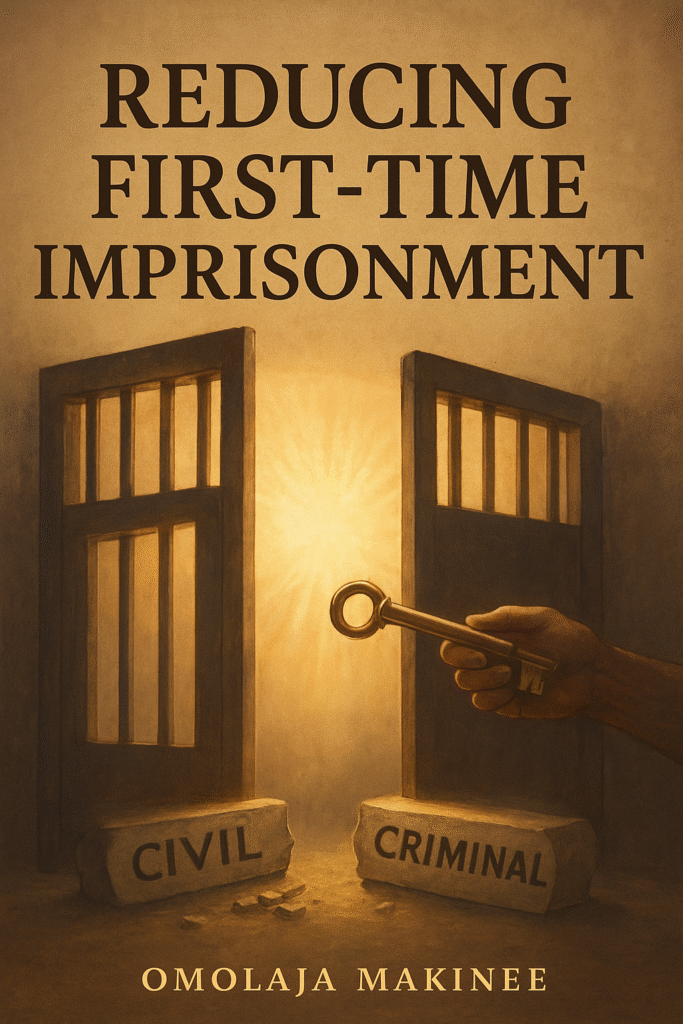
BY: OMOLAJA MAKINEE
1. Introduction: When a Moment Defines a Lifetime
For many people who have never entered the walls of a prison, the concept of incarceration remains abstract — a punishment somewhere “out there” reserved for those who must be corrected. But for those who have lived inside those walls, especially as first-time offenders, the experience is transformative in ways that are seldom understood outside.
Prison is not merely a place of confinement; it is a place of definition. For many, the first entry into prison marks the beginning of an identity they never intended to assume. The walls do not just contain—they transform, often irreversibly.
Joseph Maxwell Spencer’s experience offers a clear lens into this truth: that our justice system too often creates repeat offenders by criminalising first offenders, treating situational human fallibility as permanent moral failure.
During his time in prison, Joseph Maxwell Spencer met dozens of men whose first offence became a lifelong sentence — not because of the crime itself, but because of the system’s inability to distinguish human error from criminal pathology. Many of them were not hardened criminals. They were ordinary people who had made an impulsive decision, found themselves in a situation that escalated beyond their control, or were caught in the grey areas of legal interpretation.
For many, the first imprisonment destroyed any chance of recovery — socially, economically, and psychologically. Instead of rehabilitation, the prison system became a mechanism of social alienation, leading to recidivism, homelessness, and despair.
This essay argues that the number of people going to prison on their first offence should be drastically reduced and reserved strictly for cases of serious violence or loss of life, or those requiring rehabilitation and epigenetic recalibration — meaning, correction at the neurological and behavioural levels, not mere confinement.
The Human Cost of First Imprisonment
Inside prisons, first-time offenders often share a common story: “I didn’t think it would go that far.” A heated argument becomes an assault charge; a misunderstanding becomes a sexual offence; an unpaid fine becomes a custodial sentence. These are not the stories of organised criminals or serial offenders — they are stories of situational collapse, of human beings whose lives were defined by a single, regrettable moment.
What Joseph Maxwell Spencer observed — and lived — is that prison is not neutral. It doesn’t freeze life; it fractures it. The stigma, trauma, and loss of social position that follow a first imprisonment can be devastating. The individual’s self-concept changes. Employment prospects vanish. Family ties weaken. Mental health declines. And as research repeatedly shows, once someone has been imprisoned, their probability of reoffending increases dramatically, not because they have grown more criminal, but because they have been excluded from normality.
The first imprisonment is a rupture of identity. It shatters one’s sense of belonging, security, and self-worth. Upon release, the world no longer recognises the person it once knew; employers turn away, relationships collapse, and community trust evaporates. The stigma is enduring. Many who leave prison on a first offence return—not because they crave criminal life, but because they have been socially amputated.
Spencer’s conversations with first-time prisoners painted a strikingly similar picture: the majority were suffering from anxiety, shame, and fear of reintegration. They spoke of losing homes, jobs, and family stability; of being branded as irredeemable. When institutions label someone as “criminal,” society follows suit. What could have been an opportunity for education, counselling, or reconciliation becomes instead a cycle of exclusion that feeds back into the justice system itself.
This is not rehabilitation; it is systemic recidivism. For many, the first imprisonment becomes the beginning of recidivism — a revolving door of punishment and exclusion. The system punishes, but not design to heal.
The Problem: When Governance Punishes Before Understanding
In modern societies, imprisonment has become the reflex of governance—a symbol of “control” rather than of justice. A person’s first offence, regardless of gravity, is frequently treated as proof of inherent criminality. Yet, as Spencer’s experience in prison revealed, the majority of inmates on their first convictions were not habitual offenders. Many were ordinary individuals caught in extraordinary circumstances—moments of anger, fear, intoxication, desperation, or misunderstanding.
These are not excuses; they are contexts. And context, as Spencer’s case exemplifies, is what the legal system routinely ignores. Convicted under a legislative category that did not fit the reality of his conduct, he was imprisoned not for harm done, but for how the law imagined his actions. Inside prison, he met countless others like himself—men and women who were not inherently criminal but had become entrapped by a system that mistakes reaction for disposition.
The Context Problem: When Law Outpaces Life
A key part of the problem lies in context blindness. Modern legal systems, especially in common law jurisdictions, are structured around categorical offences, not situational realities. The offence is defined by statute, and the statute carries a penalty. But as Joseph Maxwell Spencer’s own case shows, not all cases fit the moral weight of the law that is applied to them.
He was convicted under section 1 of the Protection of Children Act 1978 — a law meant to target indecent images of children. Yet in his case, no such images existed. The context — that it involved a consensual and established family life relationship between age of consents, and an Halloween costume depiction of “Fifty Shades of Grey” — was lost beneath the legal label. The public, reading the law’s title and the verdict, would naturally assume guilt of something heinous. The context, which would have exonerated or at least clarified, was erased from public consciousness.
This is not an isolated phenomenon. In many sexual offence prosecutions, contextual ambiguity reigns: cases where both parties were intoxicated, where disputes arose over payment for consensual sex, or where communication was misinterpreted — yet one side emerges criminalised for life.
Such cases, while legally defined as “serious offences,” often bear no resemblance to predatory criminal conduct. But because the law deals in absolutes, nuance dies at the courtroom door.
Redefining the Threshold: When Prison Should Begin
If the purpose of justice is to restore balance rather than to destroy lives, then the threshold for first-time imprisonment must be redefined. Imprisonment should not be the reflexive response to wrongdoing; it should be the final resort, reserved for cases where:
- The harm is severe and irreversible (e.g., loss of life, grievous bodily harm).
- The individual presents an ongoing danger to others that requires controlled rehabilitation.
- The behaviour indicates deep-rooted dysfunction that warrants epigenetic or neuro-behavioural recalibration.
All other offences — especially those born of circumstance, misunderstanding, or contextually ambiguous situations — should be resolved through:
- Community service and restitution,
- Police monitoring or behavioural contracts, and
- Restorative dialogue or participatory resolution forums.
The objective is not to avoid accountability, but to match the remedy to the reality, ensuring that the system does not inflict greater harm than the original act.
Why the First Offence Should Rarely Lead to Prison
If the goal of justice is repair rather than ruin, imprisonment must be reserved for only the most serious harms—particularly those involving irreversible violence or loss of life. For non-violent offences, the evidence is overwhelming: prison rarely prevents reoffending. Instead, it accelerates it by damaging mental health, dismantling community ties, and normalising criminal identity.
The logic is simple but profound:
A first offence should be treated as a moment to educate, not incarcerate.
This principle should extend even to certain sexual offence categories, where the facts are often complex, the evidence interpretative, and the context disputed. Spencer’s own case, in which a £25 Halloween costume with a keyless plastic handcuff became misrepresented as a “sexual offence”, within the context of an enduring family life relationship, under a statute never intended for such scenarios, demonstrates the danger of context-blind prosecution.
Other examples abound:
– Cases where both parties were intoxicated, and memory gaps blurred consent.
– Situations where commercial disagreements during consensual sex led to criminal charges.
– Instances where digital miscommunication resulted in allegations interpreted as predatory.
Each of these reflects moral ambiguity, not predation. The law may classify them as “serious,” but context reveals something else: human error, misunderstanding, and the limits of moral language.
Prison should never be the default response to ambiguity.
Epigenetic Restoration and the Science of Behaviour
Among those who do commit serious violent offences, the justice system must evolve beyond punishment toward rehabilitation at the neuropsychological level. Emerging research in behavioural neuroscience and epigenetics shows that violent tendencies often result from trauma-induced maladaptation—patterns written into neural and hormonal pathways over time. These are not moral failings; they are biological inscriptions of suffering.
Thus, imprisonment for such individuals should not be about containment, but about epigenetic recalibration and behavioural restoration—therapeutic interventions that target hormonal balance, impulse control, and emotional regulation. If the system aims to prevent recurrence, it must repair the architecture of response, not merely the structure of restraint.
The Continuum of Harm and Proportionate Response
Justice must operate on a continuum of harm, not on a rigid binary of offence categories.
– Minor or situational offences: Community service, education, police monitoring
– Moderate offences: Behavioural supervision, counselling, and restorative agreements
– Serious violent or sexual offences: Structured rehabilitation with custodial oversight
Such a model preserves public safety while protecting human potential. It acknowledges that the vast majority of first-time offenders are not dangers to society, but victims of circumstance, impulse, or misjudgment.
From Retribution to Renewal
Joseph Maxwell Spencer’s story is not an anomaly; it is a mirror. His wrongful categorisation and imprisonment expose the deeper flaw in a system that punishes before understanding. Every prison that houses a first-time offender for a non-violent act becomes a school for despair—a place where society teaches alienation instead of accountability.
Reducing first-time imprisonment is not leniency; it is moral intelligence. It redefines justice as the capacity to distinguish between danger and mistake, between harm and misunderstanding, between those who need containment and those who need guidance.
The future of justice depends on our ability to see context as clearly as we see conduct. For it is context—not condemnation—that tells us who a person truly is, and what they can still become.
In essence:
A society that imprisons its first offenders builds its prisons for the wrong people.
A society that restores them builds its future.
Back to 👇