
The Moral Inversion of Care: How Feminine Psychology Became an Instrument of Domination
BY: OMOLAJA MAKINEE
When history recalls the women’s suffrage movement, it often remembers banners, marches, and arrests — the visible rebellion of women demanding to be heard in a world that prized their silence. But behind that defiance lay something deeper than political agitation: the moral instinct of care that feminine psychology had always embodied. The suffrage movement did not arise from hatred of men but from an evolutionary moral impulse to nurture fairness, to extend the same care women gave to children and households to the governance of society itself. In its infancy, the movement was a moral awakening, not a rebellion.
1. From Moral Rebellion to Political Revolution
In the late 19th and early 20th centuries, suffragettes believed that if women could vote, society would become gentler, more humane, and more protective of the vulnerable. Feminine morality — grounded in empathy, restraint, and preservation — was imagined as the antidote to masculine aggression, war, and political corruption. The vote was not merely a right to participate; it was a plea to humanise power itself.
Yet the suffrage victory did something paradoxical. It succeeded not by changing men’s conscience but by convincing men that granting women equality would temper their own excesses. It was a utilitarian concession, not an ethical transformation. Men recognised that women’s participation in public life could function as a moral restraint on masculine power — a stabilising maternal force within the civic order.
2. Equality as a Balancing Instrument
Thus, equality was not originally designed to create sameness between men and women but balance. The logic was simple: if men were prone to excess and hierarchy, women’s inclusion would humanise those systems. The moral instinct of care, embedded in feminine psychology, was expected to act as a natural governor against tyranny. The success of this design transformed the workplace, education, and politics — gradually introducing empathy, collaboration, and welfare into what had once been ruthlessly competitive masculine spheres.
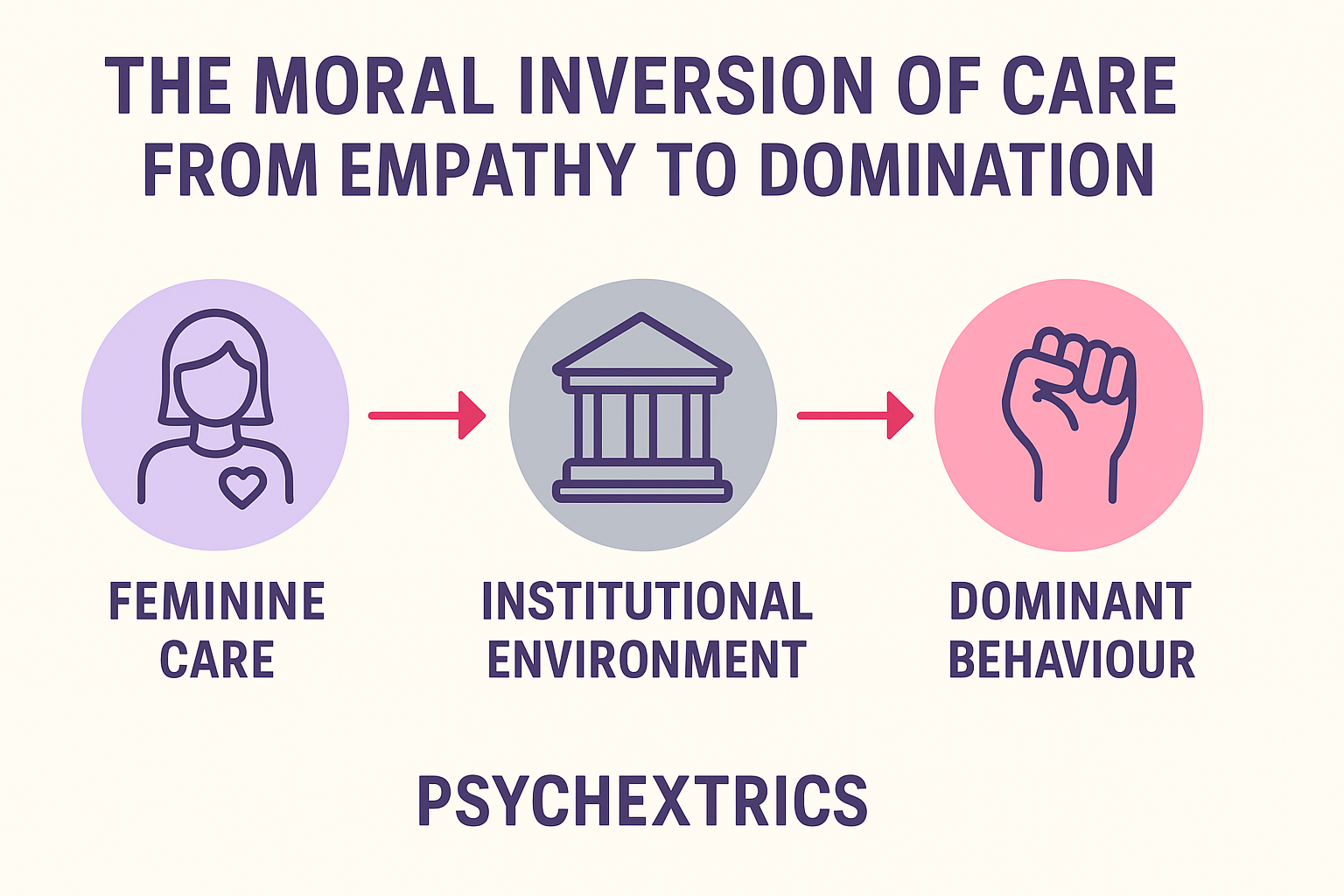
However, beneath this success lay a structural irony. The moral instinct of care, though adaptive in the private sphere, operates differently when transposed into systems of power. In the home, care protects; in the institution, care legitimises control. Once care became institutionalised — expressed through bureaucracies, laws, and administrative ethics — it lost its moral innocence. The maternal instinct, repurposed as a managerial tool, began to mutate.
3. The Feminine Psychology of Power
In the modern world, women now occupy positions of authority across government, academia, policing, and corporate leadership. This marks an unprecedented shift — a civilisation where power is no longer monopolised by men. Yet, paradoxically, this new distribution of power did not dismantle the structure of domination; it merely diversified its custodians. Feminine psychology, once a symbol of empathy and restraint, began to exhibit adaptive traits indistinguishable from the masculine aggression it was meant to correct.
This phenomenon can be understood through psychextrical behavioural science. Within Psychextrics, the Hormonal Index Marker (HIM) represents biological architecture, and the Hormonal Fluidity Index (HFI) represents behavioural modulation. When feminine empathy — a trait deeply tied to oestrogenic circuits — is transplanted into testosterone-dominant institutional environments, its expression shifts. The hormone-driven empathy that once soothed emotional conflict begins to mutate under environmental and systemic pressures, producing a behavioural inversion: care becomes coercion, protection becomes prosecution, advocacy becomes domination.
4. When Care Becomes Control
The suffragette’s moral weapon — empathy — now fuels new forms of bureaucratic aggression. Where once women fought to protect victims of all gender, today institutional feminism sometimes creates new victims in the name of protection. Policies designed to empower women can be, and have been, deployed to punish men disproportionately, particularly in areas like false sexual allegations or domestic disputes where moral narratives override evidence.
What began as a quest for equality has in some spheres become a quest for moral supremacy. This is not a universal condemnation of women’s progress but a recognition that equality without moral introspection becomes replication. The modern system did not transform; it adapted. The same structural aggression once embodied by patriarchal authority now manifests through administrative feminism — with female officers, managers, or executives wielding power through the same punitive logic that once oppressed them.
In Psychextrical terms, this is a neurotype inversion — where an inherited behavioural pattern (care, empathy, nurture) becomes epigenetically repurposed by environmental stimuli (institutional reward structures) into its behavioural opposite. The neurotype governing care becomes the neurotype enforcing compliance. Compassion becomes surveillance.
5. The Paradox of Feminine Emancipation
To understand this paradox, one must recognise that power has no gender — it only borrows one. Men historically exercised arbitrary power over both men and women alike. Women’s entry into power did not end arbitrary domination; it simply made its distribution more equal. Thus, the argument that men’s dominance created women’s subordination misses the full circle: power itself subordinates whoever occupies its structure without moral restraint.
Where women were once burdened by social expectations of caregiving, they are now burdened by institutional expectations of performance, productivity, and authority. The maternal moral instinct, once the foundation of ethical culture, has been converted into a managerial instrument. This is visible in corporate hierarchies, policing cultures, and even activist movements — where moral outrage becomes currency, and empathy becomes a weapon of enforcement.
6. The Circle of Power
So, we must return to the fundamental question: Was equality enough? Or did we merely diversify the agents of domination? The evidence suggests that society has not transcended abuse of power; it has only equalised access to it. The same patterns of exploitation, coercion, and moral blindness persist — only now under the dual banners of inclusion and justice.
The tragedy is that feminine psychology, rather than softening the world, has been forced to harden itself to survive in it. Women were not liberated into a moral utopia; they were conscripted into a pre-existing battlefield of control. Their instinct to nurture became a skill of management; their capacity for empathy became a mechanism for discipline.
7. The Absorption of Power: Oestrogen in the Shadow of Testosterone
What this proves, ultimately, is that oestrogen has never sought to rival testosterone—but to absolve itself into it. The feminine mode of power, when drawn into the masculine paradigm of domination, does not oppose it; it is absorbed, reshaped, and re-expressed through it. Equality, in this evolutionary sense, did not produce equilibrium—it produced assimilation.
From an evolutionary standpoint, this absorption is not a moral failure but a biological inheritance. Across millennia of human survival, women have looked to men not as competitors in strength but as anchors of protection—the evolutionary guardians against threat, chaos, and deprivation. The female instinct for security, intertwined with the male instinct for territorial defence, created a natural division of emotional and physical labour. Oestrogen’s evolutionary intelligence is adaptive—it seeks alignment with the dominant force, not confrontation with it.
In this alignment lies the deeper paradox: when the world became structured around dominance, conquest, and control, women’s adaptation to that world required not resistance but mirroring. Feminine psychology, socialised within a masculine logic of power, learned to operate its tools—assertion, ambition, even aggression—but under the guise of empathy, fairness, or reform. In doing so, it internalised the very system it once stood apart from.
The expectation that women would lessen the abuse of power once admitted into its chambers was therefore misplaced. The moral burden of restraint—society’s hope that feminine influence would humanise governance, law, or leadership—collapsed under the gravitational pull of the structure itself. Women did not redefine power; they were inducted into its rites, echoing the same impulses of domination that once excluded them.
Thus, the absorption of oestrogen into testosterone is not merely chemical—it is civilisational. It marks the point at which care became control, and nurture became negotiation. Feminine psychology, seeking coexistence, was pulled into the orbit of masculine energy and forced to adapt by replicating its form. The result is not balance but fusion—a hybrid power that retains the language of compassion while practising the logic of coercion.
This is not to suggest that women are to blame for the perpetuation of domination, but rather that the architecture of power itself remains unchanged. Oestrogen cannot rival testosterone within a system that rewards testosterone’s virtues—competition, control, conquest—over those of communion, care, and collective harmony. The absorption, then, is not a surrender of moral strength, but a survival mechanism in a civilisation that still defines strength by its capacity to dominate.
In this light, the moral inversion of care is not accidental; it is inevitable—a by-product of a species whose evolutionary memory still confuses protection with power, and nurture with obedience.
8. The Future of Feminine Power
If equality is to mean more than parity in domination, feminine psychology must reclaim its moral origin. True emancipation is not about occupying the seats of power once held by men but transforming the purpose of power itself. The feminine instinct of care must not be repurposed as an instrument of punishment but reinstated as a philosophy of balance — a psychextrical equilibrium between authority and empathy.
The moral lesson is timeless: when care becomes a function of power, it ceases to be care at all. The world does not need more women behaving like men; it needs both men and women behaving like humans.
Back to 👇