
Lineages of Governance: From Pharaohship to Govox-Populi
BY: OMOLAJA MAKINEE
1. Introduction
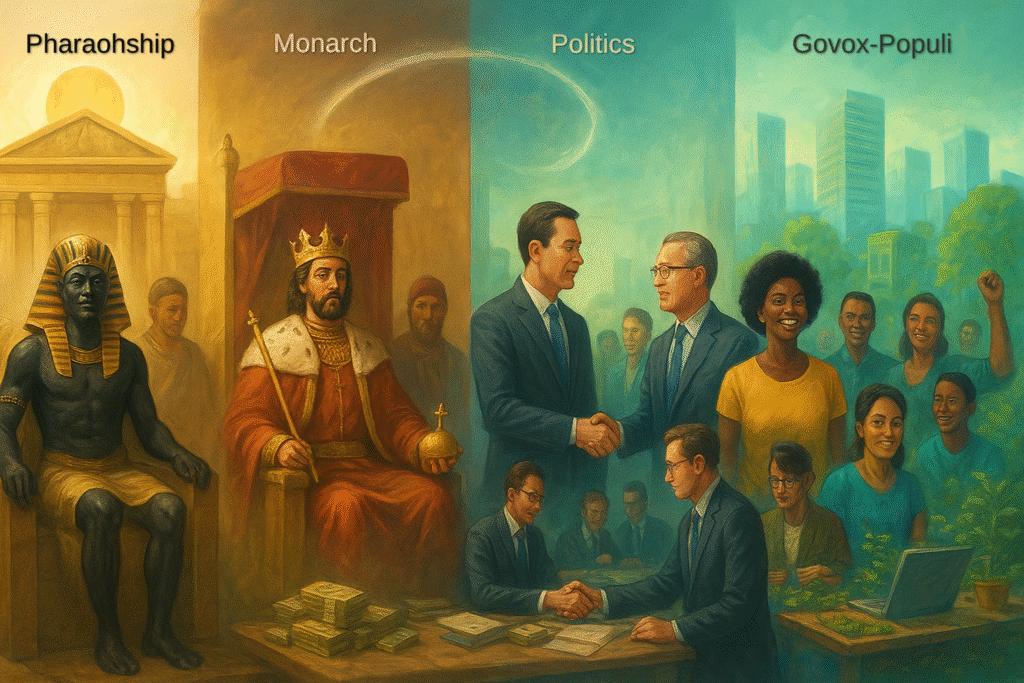
Every system of governance, ancient or modern, is born from a lineage—a genealogical, ideological, and spiritual descent that defines its constitutional ethos, its relationship with power, and its perception of welfare and duty. These lineages are not merely governmental; they are cultural, psychological, and often metaphysical. The evolution from Pharaonic governance, through monarchy, political governance, and into the emergent Govox-Populi model, reflects the metamorphosis of humanity’s consciousness about authority, community, and service.
Yet beneath every constitutional surface lies a deeper truth: governments, no matter their form, are bound by the ancestral lineages that birthed them. Their reflexes, loyalties, and hierarchies are inherited instincts—governance DNA—compelling them to obey the archetypes from which their power descends.
Here I explores how each governance structure descends from distinct ancestral archetypes, and how their constitutional frameworks and philosophies of welfare mirror the spiritual DNA of their founders.
2. The Spiral of Governance Evolution
From the sacred covenant of Pharaohs to the populocratic consciousness of Govox-Populi, governance has spiraled through cycles of descent and reclamation.
- Pharaonic rule represented divine unity.
- Monarchy corrupted it into personal divinity.
- Politics fragmented it into commercial democracy.
- Govox-Populi seeks to restore unity through collective divinity—the people as the voice (vox) of governance.
In essence, every system carries the echo of its ancestors. To understand modern governance, we must trace its lineages, not its laws. Only then can humanity move from rule to resonance, from authority to harmony, and from welfare as privilege to welfare as a cosmic right of existence.
3. The Pharaonic Governance Structure: Reign by Covenant and Divine Harmony
Lineage and Spiritual Descent
The Pharaonic governance model is theocratic-humanist in nature—its lineage intertwined with the priesthoods of Kemet and the temples of cosmic law. Pharaohs were not rulers in the Western political sense; they were custodians of Ma’at, the principle of divine balance, truth, and justice. Governance was a sacred duty, not a political ambition. To govern was to sustain the spiritual contract between the people, the cosmos, and the divine order.
In pharaonic governance, the seat of authority was not political but priestly. The Pharaoh reigned as the living vessel of divine equilibrium—Ma’at—and his decrees were extensions of sacred instruction rather than personal ambition. His lineage was shared not with citizens but with the priesthood, whose temple order maintained the cosmic covenant between the mortal and the divine. Thus, when the Pharaoh acted, he did so not as an individual but as a custodian of inherited sanctity. The State was, therefore, a liturgical machinery—every act a ritual of obedience to divine instruction.
This system drew from covenantal legitimacy, not conquest or competition. The Pharaoh’s right to rule was rooted in harmony—a covenant between cosmic order and temporal life. The throne was not inherited merely by bloodline, but by the balance of the ka (spirit) and ba (soul) within the royal lineage, guided by the priesthoods who interpreted divine signs.
Constitutional Framework: Theocracy of Cosmic Order
Pharaonic governance was constitutional through sacred law—codified not in statutes but in cosmological principles. The governance constitution rested on:
- Ma’at (Truth and Balance) as the central legal and ethical framework.
- Covenantal Accountability between ruler, gods, and citizens.
- Sacred Holarchy, where priests, scribes, and viziers acted as mediators of divine will.
This was not a system of rule by man, but by divine harmony administered through human vessels. Every edict, offerings, and civic act was measured against whether it sustained or disturbed cosmic equilibrium.
Welfare Philosophy: Welfare as Cosmic Duty
In Pharaonic governance, welfare was not charity—it was ritual responsibility. Citizens were seen as extensions of the cosmic body, and the State’s duty was to ensure their well-being as part of maintaining Ma’at.
- Food distribution during Nile droughts, public works, and temple offerings were all extensions of this divine duty of care.
- The Pharaoh was “Shepherd of the People”, ensuring every citizen’s stability was aligned with the cosmic balance.
Thus, Pharaonic welfare was a right grounded in sacred order, not in political benevolence.
4. Monarchical Governance: Reign by Conquest and Decree
Lineage and Descent
As human civilisation drifted from the cosmic order of Kemet into the fragmented world of kingdoms and empires, monarchical rule emerged. Its lineage diverged from priesthood and entered the bloodline of nobility and conquerors. Monarchs inherited their legitimacy not from cosmic harmony, but from dynastic succession and divine-right ideology—a distortion of the old covenant into personal sanctification.
Monarchical governance evolved differently. Kings and queens, though ceremonially ordained by religion, are bound by a horizontal lineage—that of other monarchs across realms. They reign not by cosmic covenant but by conquest, bloodline, and recognition among their peers. Their allegiance is feudal, extending across empires and dynasties, forming an aristocratic fraternity of power. A monarch will instinctively protect another monarch’s order, for their legitimacy is mutually reinforcing. Thus, monarchic lineage governs not through the people but above them, upholding the sanctity of rule itself.
Constitutional Framework: Autocracy as Divine Mandate
Monarchies operated under autocratic constitutions, where the ruler’s word was law. This was justified by the Doctrine of Divine Right, which claimed that kings and queens ruled by God’s appointment, beyond human accountability.
- Decision-making was vertical, unshared, and absolute.
- Councils and nobles existed to advise, not restrain, the sovereign.
- Justice was seen through the lens of royal decree, not cosmic balance.
The monarchy’s constitutional nature was therefore paternalistic and self-validating—a system where authority descended, but never ascended.
Welfare Philosophy: Welfare as Gift
Under monarchs, welfare was gracious, not guaranteed. Acts of charity or public works were framed as royal gifts, not civic entitlements.
- Grain handouts, land rights, or military protection were tokens of royal benevolence, used to secure loyalty.
- The king was often called “Father of the Nation,” but the citizens were dependents, not participants.
Thus, the welfare system under monarchy became performative philanthropy—a tool of control wrapped in compassion.
5. Political Governance: The Mixed Lineage of Politicians and Capitalists
Lineage and Descent
The birth of political governance marked the commercialisation of power. Unlike Pharaohs who served Ma’at or monarchs who ruled by divine bloodline, politicians are merchants of ideology. Their lineage intertwines with capitalists, whose power arises from ownership and profit.
Political governance, however, stands at the junction of capitalism and Statecraft—a lineage shared between politicians and capitalists. Its moral compass is calibrated not by divine law nor noble blood, but by influence, finance, and transactional continuity. This lineage explains why, in modern democracies, governments respond swiftly to the impulses of their economic kin but slowly to the cries of their citizenry.
A clear modern illustration is seen in the UK, where a single tweet from a technocrat like Elon Musk—urging inquiry into the grooming gang scandal—was met with parliamentary debate and immediate governmental response. Yet the same government, faced with the long-unfolding Post Office scandal that affected thousands of ordinary citizens, reacted hesitantly and sluggishly.
The difference is genealogical, not procedural. The political government and the capitalist-technocratic elite are of shared ancestry in the governance lineage—they speak the same dialect of power. The citizens, by contrast, are of another house altogether, without kinship in the chambers of policy.
In this hybrid genealogy, governance became a transactional system—citizens became voters (consumers of policy), and politicians became brands within a competitive market of promises.
Constitutional Framework: Mixed Forms of Government
Political governance does not possess a single constitutional form. Its instability of lineage reflects in its variety—each fusion creating a different character of rule depending on the dominant parent lineage.
- Democracy with Oligarchy: Economic elites shape policy behind elected faces.
- Democracy with Aristocracy: Intellectual or professional elites dominate governance.
- Democracy with Autocracy: Populist regimes operate through majoritarian control.
- Democracy with Technocracy: Expertise governs through data and evidence, while citizens retain nominal voice through elections.
As modern political systems lean toward Democracy with Technocracy, the State are expected to operates as a rational bureaucracy, where the ideals of democratic representation coexist uneasily with the dominance of experts, analysts, and bureaucratic institutions. Here, technical competence becomes a proxy for legitimacy. Citizens elect representatives, but real policy direction often comes from unelected specialists, economists, or scientists—individuals who claim neutrality through knowledge but still serve the capitalist or institutional interests funding them.
This hybrid form often arises in societies where efficiency is prized over empathy, and data replaces dialogue as the primary instrument of governance. The technocratic impulse reflects a belief that governance can be engineered—that social problems can be solved algorithmically. Yet this also distances citizens from decision-making, turning democracy into a spectator model where participation ends at the ballot box.
The result is a government that speaks the language of science and progress, but may silently inherit elitist and exclusionary tendencies—where access to policy influence is limited to those fluent in technocratic discourse. Welfare in such systems becomes quantified and conditional, managed through statistics rather than human need—echoing the capitalist lineage within political governance where efficiency often outranks empathy.
Welfare Philosophy: Welfare as Privilege
In political governance, welfare is seen not as a right but as a strategic privilege.
- Social programs are often deployed to maintain popularity or pacify unrest, not to sustain human dignity.
- Non-profitable welfare projects are resisted because they contradict the capitalist lineage’s core ethic—profit over people.
- Donor influence creates a welfare system where benefits are conditional, budgeted, and transactional.
This explains why political governments vary so widely in public perception—they inherit inconsistent moral DNA from conflicting ancestors: the merchant and the monarch, the democrat and the oligarch.
6. Govox-Populi Governance: Reign by Populocracy and Collective Consciousness
Lineage and Descent
Emerging from the Manifesto of African Corporatist Society, the Govox-Populi model represents an evolutionary return to citizen-centered governance. Its lineage does not descend from priesthood, nobility, or capital—but from the people themselves. It restores the covenantal principle of the Pharaonic era, yet grounds it in modern civic consciousness.
In contrast, Govox-Populi, as I envisioned in Manifesto of African Corporatist Society, restores governance lineage to the citizens themselves. Here, the people are not subjects, nor are they clients of the State—they are the State. The government’s lineage is drawn directly from the collective spirit of its populace, both educated and uneducated, structured and spontaneous. Its constitutional framework of populocracy ensures that every codified directive issued by the citizenry carries the same immediacy of authority that divine instruction once held in pharaonic governance.
In Govox-Populi, when the people speak, the government acts—not from charity or negotiation, but from inherited duty. The voice of the citizen echoes as ancestral command; governance becomes participatory destiny rather than managerial convenience. In this model, welfare is not privilege, nor is responsiveness selective—it is a biological reflex of the system itself.
Constitutional Framework: Populocracy
The Populocracy framework is defined as governance by the collective consciousness of citizens, rather than by hierarchy or privilege.
- It integrates direct participation of citizens (Govoxiers) with merit-based roles for specialised governance.
- The amendable part of the constitution is living, meaning it evolves through continuous public consensus.
- Formal education is not an entry barrier—citizens contribute through lived experience, cultural intelligence, or vocational expertise.
This produces a society of mixed educational levels, united not by uniform schooling, but by shared civic ownership.
Welfare Philosophy: Welfare as Entitlement
In Govox-Populi, welfare is not an act of governance but the reason for governance. It views welfare as a birthright of citizenship, inseparable from existence itself.
- Health, education, housing, basic necessities and livelihood are entitlements, not government favours.
- The system functions through corporatist cooperation—each citizen is both a producer and beneficiary of national welfare.
- It dismantles the separation between rulers and ruled, replacing it with interdependent reciprocal accountability.
Thus, Govox-Populi redefines governance as collective stewardship rather than power management. It is the spiritual descendant of Pharaonic harmony, reborn through populocratic consciousness.
Here’s a clear comparative table summarising the key distinctions between the four lineages of governance
7. Table: Comparative Lineages of Governance and Their Historical Analogues
| Governance Type | Lineage / Ancestry | Constitutional Framework | Legitimacy Source | Welfare Philosophy | Core Values | View of Citizens | Mode of Rule | Historical / Real-World Analogues |
|---|---|---|---|---|---|---|---|---|
| Pharaonic Governance | Priesthoods and divine custodians of Ma’at | Theocracy based on divine covenant and cosmic order | Covenant with the cosmos; harmony with divine law and priestly validation | Welfare as cosmic duty — a sacred obligation for maintaining Ma’at | Truth, balance, sacred order, harmony | Citizens as spiritual participants in the cosmic body | Reign by covenant and divine harmony | Kemet (AncientEgypt), Nubia, Wddt (Axumite) priest-rulership models, early Ife and Kushite systems |
| Monarchical Governance | Dynastic royal bloodlines and conquest lineages | Autocracy under the doctrine of divine right | Hereditary succession and divine appointment | Welfare as gift — bestowed to secure loyalty and submission | Loyalty, hierarchy, nobility, paternal care | Subjects under royal benevolence | Reign by conquest and decree | Medieval Europe, Feudal England, Umayyad and Abbasid Caliphates. |
| Political Governance | Politicians and capitalists — ideological and commercial lineage | Mixed forms (Democracy with Oligarchy / Aristocracy / Autocracy / Technocracy) | Electoral mandate influenced by capital, ideology, and global economics | Welfare as privilege — conditional and strategic | Profit, competition, diplomacy, bureaucratic efficiency | Citizens as consumers or voters; market participants | Rule by negotiation, persuasion, and institutional control | Modern capitalist democracies (U.S., U.K., France, EU, etc.), post-colonial African republics, technocratic Asian states |
| Govox-Populi Governance | Citizens — collective lineage of the people | Populocracy (citizen-based corporatist framework) | Collective will and moral sovereignty of the populace | Welfare as entitlement — inherent right of citizenship | Cooperation, inclusivity, collective prosperity, civic equity | Co-governors and stakeholders in the social order | Reign by collective participation and populist stewardship | Proposed African corporatist societies (Manifesto of African Corporatist Society), experimental participatory populocracies, and emerging civic networks |
Navigating the Lineage Barrier
Thus, the evolution of governance reflects the evolution of its loyalties. Pharaohs obeyed the priesthood, monarchs obey their dynastic peers, politicians obey their capitalist kin—but Govox-Populi obeys the people, not out of benevolence, but out of lineage.
Yet for those outside the ancestral circles of governance, participation has never been straightforward. In systems where citizens do not share lineage with the governing class, their voices travel as petitions, not as commands. They must seek intermediaries—individuals or institutions whose bloodline, influence, or recognition grants them legitimacy within the corridors of power. This is how citizens, throughout history and across all modern systems, have learned to navigate the lineage barrier.
It is no coincidence that public movements often depend on celebrity endorsements, political patrons, or corporate sympathisers to reach the ears of government. These figures act as lineage translators, bridging the sacred and the secular, the governed and the governors. The pattern is consistent across eras and ideologies: when the governed do not share genealogical authority with those who rule, they must borrow the voices of those who do.
A citizen’s campaign for reform or justice may languish for years in bureaucratic silence—until someone of privileged lineage adopts it. The same idea, once echoed by a figure of influence, gains immediate traction, debate, and institutional response. It is not the message that changes, but the lineage of the messenger.
We witness this in the modern world as a recurring spectacle. Ordinary citizens appeal for justice, healthcare, or social reform, yet their demands remain muted until a celebrity, a local Member of Parliament, or a high-profile capitalist intervenes. The moment the campaign bears the endorsement of one who shares the government’s ancestral line—be it political, economic, or technocratic—the machinery of the State awakens. The citizen must, therefore, cloak their cause in borrowed lineage to be heard.
This mechanism reveals the deep structure of governance as lineage-based obedience rather than ideological democracy. Governments, regardless of their public form, remain genetically loyal to their ancestral counterparts—pharaohs to priests, monarchs to monarchs, politicians to capitalists. Citizens without that genetic key are treated as outsiders to the bloodline of authority.
By contrast, Govox-Populi governance seeks to dismantle this inherited exclusivity. Because its lineage is drawn directly from the people, the citizen requires no intermediary, no borrowed legitimacy, and no endorsement from privileged classes to command action. In populocracy, the voice of the governed is the instinct of the government.
Thus, while other systems compel citizens to climb the ladder of borrowed voices, Govox-Populi collapses that ladder entirely. It transforms governance from a hierarchy of lineage obedience into a circle of shared ancestry—where every citizen is born within the bloodline of power itself.
8. Conclusion: The Return of Ancestral Governance
In the long arc of human governance, what began as an ancestral covenant gradually fractured into hierarchies of separation. Pharaohs once ruled by divine lineage shared with the priesthood, not the populace. Monarchs ruled by blood among fellow royals, sealed by marriages and treaties. Politicians rule by profit and influence, bonded to the capitalist kin who fund and sustain their dominion. In each case, the governed became estranged from the governing, reduced to petitioners knocking at the door of alien ancestry.
Yet in African thought, governance was never meant to be a pyramid—it was a circle. Every community, every lineage, every clan understood power as a birthright shared across generations, not monopolised by an elite. The elder ruled because he was of the people, not above them; the priest mediated because he too belonged to the communal spirit that animated all. Power was an inheritance of belonging, not a privilege of office.
It is this ancestral architecture that Govox-Populi reawakens. It restores governance to its organic form—a government whose lineage is the people themselves. No priestly intermediaries, no aristocratic fraternities, no capitalist patrons. In this model, authority flows horizontally, not vertically. The citizen is not an outsider appealing for recognition; they are the living continuation of the State’s ancestral consciousness.
This is not a political invention, but a spiritual correction—a return to the indigenous African understanding that governance must reflect the bloodline of those it serves. In such a system, obedience is not coerced, because leadership is kinship. Welfare is not a favour, because care is familial. And justice is not a transaction, because truth is communal.
Where pharaonic governance sought divine harmony, monarchic rule pursued dominion, and political governance chases profit, Govox-Populi embodies remembrance—the memory of governance as belonging. It is the re-emergence of what ancient Africa once practiced through the Doctrine of Commicracy: that no government is legitimate unless it breathes with the heartbeat of its people.
Thus, the cycle closes. What began as covenant returns as consciousness. What was lost to hierarchy returns as heritage. And what was once buried beneath conquest and commerce rises again as the ancestral spirit of participatory governance—the true return of governance to its people.
Back to: 👇