
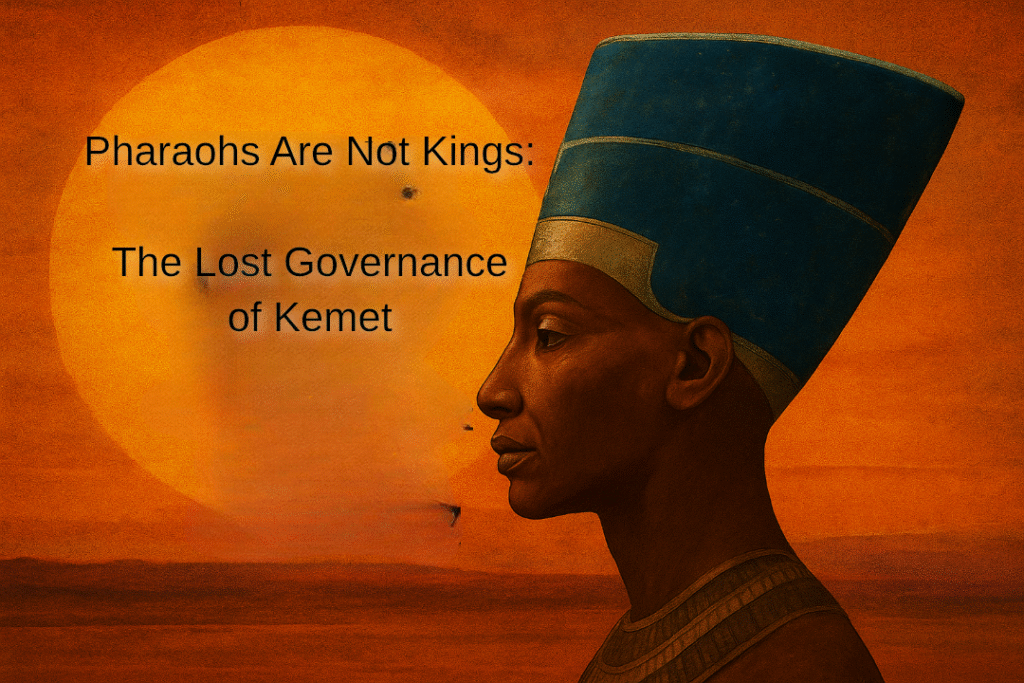
Pharaohs Are Not Kings: The Lost Governance of Kemet
BY: OMOLAJA MAKINEE
Introduction
To equate the Pharaoh with the King, or the Great Royal Wife with the Queen, is to mistake resemblance for equivalence. It is like comparing a hyena with a wolf—both may walk on four legs and bite with power, but their instincts, hierarchies, and survival philosophies are worlds apart. The same applies to governance: Pharaohship and monarchy are not two expressions of one system; they are entirely distinct species of governance, born from different cosmological, social, and moral lineages.
The Pharaonic system of Kemet was not monarchy; it was divine stewardship anchored in the principles of Ma’at—truth, balance, order, and harmony. The Pharaoh was not a sovereign ruler in the Western sense but a custodian of equilibrium, a living covenant between humanity and the cosmos. Monarchy, by contrast, is a political autocracy built on the authority of the crown, lineage, and conquest. One reigns by divine harmony, the other by divine right.
1. Pharaohship: Governance by Cosmic Covenant
Pharaohship governance was a spiritual-political system, a theocratic order that bound ruler, priesthood, and citizenry into a single moral organism. Its foundation was Ma’at, the principle that sustained the cosmos and human society alike.
In this structure:
- The Pharaoh did not own the land; he stewarded it on behalf of the Neteru (divine forces).
- The Priesthood served not the Pharaoh, but the balance between mortal and divine realms.
- The citizens were participants in this balance—their labour, rituals, and justice maintained Ma’at on earth.
The Pharaoh’s role was therefore custodial and covenantal, not autocratic. He did not rule “over” the people; he stood among them as the living anchor of harmony. His authority was legitimised not by bloodline or conquest, but by the priesthood’s recognition of his moral alignment with divine order.
The Great Royal Wife
Similarly, the Great Royal Wife was not a queen-consort in the European sense. She was the embodiment of Hathor, the feminine principle of harmony and fertility. Her role was not decorative or ceremonial—it was cosmic, complementing the Pharaoh’s function in sustaining balance.
To reduce this sacred partnership to “king and queen” is to erase the metaphysical foundation of Kemet’s governance—to equate a spiritual covenant with a dynastic hierarchy.
The Royal Household in Pharaonic Governance
A central distinction between Pharaohship and Monarchical rule lies not only in how power is exercised, but in how marital authority and royal partnership are structured within governance. In Pharaonic civilisation, marriage was not a private affair of the palace; it was an extension of divine governance, a ritual distribution of harmony between masculine and feminine cosmic forces.
Every Pharaoh was complemented by a Great Royal Wife, who held the sacred title “Lady of the Two Lands”—a constitutional and spiritual office, not a ceremonial role. She governed side by side with the Pharaoh, within defined capacities and sacred duties. Her position symbolised the balance of duality—Upper and Lower Kemet, masculine and feminine, sun and earth, order and fertility. She was not merely “queen” in the European sense; she was the feminine custodian of the cosmic covenant, whose presence legitimised the Pharaoh’s reign before both the priesthood and the people.
Yet Pharaohship governance also acknowledged multiple royal wives, each bearing distinct responsibilities, jurisdictions, and spiritual influences. These Royal Wives were not concubines or mistresses but legitimate holders of royal identity, fully recognised within the governing, religious, and familial order of Kemet. Their unions reflected the African cultural principle of polygyny as governance equilibrium—where marriage extended beyond personal affection into social, territorial, and spiritual alliance.
This structure was consistent with other ancient African ethno-governed territories, where rulers maintained plural royal unions as a mechanism of stability and inclusivity. Each wife, drawn from commoner, noble or priestly lineages, embodied a distinct aspect of social harmony—fertility, diplomacy, lineage continuity, or spiritual intercession.
In Pharaonic governance, therefore, the royal household was a microcosm of the State: a constellation of balanced forces unified under Ma’at. The Pharaoh represented divine order; the Great Royal Wife represented divine nurture; the other Royal Wives embodied the diversity of the land’s spirit. Together, they formed a governance ecology, not a patriarchal hierarchy.
By contrast, in monarchical systems, this principle collapses into a hierarchy of possession. The monarch’s single queen often serves a dynastic function—to bear heirs and maintain the royal bloodline—while mistresses occupy unofficial, unacknowledged spaces of intimacy and influence without legitimacy or noble status. The royal household becomes a reflection of property and secrecy, not sacred balance.
Thus, Pharaonic polygyny was constitutional, while monarchical concubinage was personal. In Kemet, multiple wives extended governance; in monarchy, they merely extended desire. One reflected order through balance, the other power through privilege—and that difference underscores why Pharaonic governance cannot be equated with monarchy, even in its domestic institution.
2. Monarchy: Governance by Divine Right and Conquest
Monarchic systems, which evolved much later across the Mediterranean and into Europe and later Africa, derive legitimacy from bloodline and conquest, not from spiritual alignment. The monarch’s claim to rule rests on the Doctrine of Divine Right—that the sovereign is chosen by God, and thus above moral or civic accountability.
In monarchic systems:
- Power flows downward from the throne to subjects.
- The ruler’s word becomes law, unmediated by priesthood or moral balance.
- The State exists to serve the sovereign’s continuity, not the cosmic equilibrium.
This structure converts governance from a sacred trust into a political possession. It breeds hierarchy, centralisation, and autocracy—all alien to the cooperative, covenantal model of Kemet.
Thus, when later historians and Egyptologists casually refer to the “king” of Egypt or call Nefertari a “queen,” they perpetuate a colonial mistranslation of a much older and more profound governing philosophy. Pharaohship was never monarchy; it was theocracy harmonised through ethics.
3. The Breaking Point: From Aye to Horemheb
The death of Pharaoh Aye marks the symbolic end of authentic Pharaohship governance in Kemet. What followed under Horemheb was not restoration but reformation into monarchy—the transformation of sacred stewardship into autocratic rule.
Amenhotep III and the Golden Equilibrium
To understand this fracture, one must look back to the high classic period of Pharaohship under Amenhotep III. His reign embodied the height of balance between the priesthood, the Pharaonic throne, and the people. The temples of Waset (Thebes) and ipet-resyt (Luxor) were not palaces of royal grandeur but institutions of cosmic administration—places where divine law was interpreted and social justice distributed.
Akhenaten: The Disruption
Then came Akhenaten, whose experiment with monotheism—centred on the Aten—fractured the pluralist spiritual ecology of Kemet. His reform removed the collective priesthood and centralised divinity under a single solar deity, with himself as its direct prophet. While often hailed as a religious innovator, Akhenaten was in truth the first to politicise divinity, converting Pharaohship from mediator to messiah.
Aye: The Attempted Restoration
Pharaoh Aye, who succeeded Akhenaten, sought to restore the old order. He reinstated the priesthoods, reopened the temples, and tried to re-align governance with the cosmic covenant. However, his reign was brief and transitional; though he re-established ritual Ma’at, the philosophical foundation had already cracked.
Horemheb: The Institutional Betrayal
Then came Horemheb, a military general who seized the throne without priestly consecration—an unthinkable act in true Pharaonic governance. His rule formalised the transition from sacral stewardship to monarchical autocracy. Horemheb reorganised Kemet into a militarised State, with civil and legal reforms that placed ultimate power in the throne rather than the priesthood or the balance of Ma’at.
He preserved the architecture of Pharaohship, but not its ethos. What remained was the shell of the sacred—rituals performed without cosmic reciprocity, temples functioning as bureaucratic extensions of the crown. From this point forward, all who bore the title of “Pharaoh” inherited a corrupted model, one that mimicked the structure of the past but pulsed with foreign, monarchical ideology.
The Philosophical Burden of War and the Birth of Corruption
War, in the ancient world, was not always born of greed—it was often a reluctant philosophy of survival. In the earliest ages, when the Earth’s territories were many and boundaries undefined, to protect one’s land was to protect one’s breath. Civilisations rose not in isolation but amidst rival powers whose ambitions, fears, and hungers made peace a fragile luxury. To fight was not to glorify violence; it was to preserve existence, to defend the covenant between land, ancestors, and people.
Even in Kemet, whose governance was built upon the balance of Ma’at, war was regarded as a necessary disruption—a temporary imbalance enacted to restore a greater order. The Pharaoh’s army was not an empire’s sword; it was the arm of divine correction, used sparingly and sanctified by priestly rites. Each campaign was preceded by offerings to the gods of harmony, acknowledging that war—even when justified—disturbed the cosmic equilibrium and demanded spiritual atonement.
But by the time of Horemheb, war had transformed from a reluctant duty to a defining occupation. As a military general rising from the ranks rather than from priestly initiation, Horemheb’s worldview was shaped not by the sanctity of Ma’at, but by the realpolitik of survival and conquest. He had seen beyond Kemet’s sacred borders—the lands of Mitanni, Hittite, and the Levant—where rulers governed through monarchical absolutism and imperial subjugation.
In those foreign courts, he encountered a different philosophy of rule—one where power was not consecrated but seized, where kings ruled not by harmony but by fear and decree. Exposure to foreign monarchies altered his moral geometry; what he witnessed as efficiency, he mistook for strength. Upon returning to Kemet, he brought back not the spoils of victory but the contagion of ideology—the belief that stability could be engineered through hierarchy, obedience, and unilateral command.
Thus, when Horemheb ascended the throne, he did not merely reform the State; he redefined its soul. He converted the Pharaonic covenant—once the balance between divine, priesthood, and people—into a vertical structure of domination modeled after foreign monarchies. Where Pharaohship once sought harmony, monarchy sought control. Where the priesthood once mediated law, now law emanated from the throne.
The tragedy is philosophical as much as political. Horemheb believed he was saving Kemet from fragmentation; in truth, he was saving its body while sacrificing its spirit. His wars against chaos became wars of consolidation, and his reforms—though efficient in the monarchical sense—dismantled the delicate equilibrium that had sustained Pharaohship for millennia.
In the end, it was not a foreign army that conquered Kemet, but foreign thought—the idea that power could replace balance, and that authority could exist without covenant. Horemheb’s exposure to external monarchies infected Pharaohship with a worldview incompatible with Ma’at, turning sacred stewardship into royal possession.
From that moment, Kemet’s rulers would continue to wear the title of Pharaoh, but only as heirs to a hollowed tradition—a lineage outwardly regal but inwardly estranged from its divine foundation. The wars that once protected the land had, in the hands of a soldier-king, destroyed the very philosophy they were meant to defend.
4. The Aftermath: Pharaonic Monarchy and the Loss of the Covenant
By the 19th Dynasty, the distinction between Pharaoh and monarch had all but dissolved. Rulers like Ramses II projected immense power and divine imagery but governed through imperial ambition and military conquest, not through priestly harmony.
Pharaohship had become a monarchy draped in sacred symbolism—a politicised version of the cosmic covenant, stripped of its moral restraint. What remained were the temples, rituals, and inscriptions—but the inner equilibrium of Ma’at had been replaced by the outer performance of power.
5. Kemet and the Myth of Empire
It is also crucial to understand that Kemet was never an empire or a kingdom in the political sense familiar to later historians. It was an ethno-governed territory—one among thousands across ancient Africa. Each territory governed itself through ancestral-cosmic balance, in the same format but in different variations, not imperial subjugation.
Pharaohship, therefore, was a cultural governance model, not an imperial expansionist one. It sustained itself through ritual reciprocity, shared identity, and moral contract, not through colonisation or conquest. The myth of “Kemetian Empire” is a product of Eurocentric historiography that retroactively imposes imperial logic onto a civilisation that functioned on spiritual equilibrium.
6. The Legacy: The Lost Original Structure
Since Horemheb’s reign, no ruler of Kemet could fully restore the original Pharaonic structure. Even when they invoked Ma’at, the ideological shift had already embedded monarchy into Pharaohship’s governing DNA. The divine covenant was remembered but no longer lived.
What had been a spiritual government became a political theatre. The Pharaoh was now a king; the Great Royal Wife, a queen; and the sacred covenant between cosmos and humanity was replaced by the familiar hierarchy of power and obedience.
Here’s a chronological table that clearly summarises the ideological and constitutional transitions from Amenhotep III through Akhenaten, Aye, and Horemheb, showing how the original covenantal Pharaonic governance gradually declined into monarchical autocracy
| Pharaoh / Period | Approx. Reign | Governance Principle | Constitutional Nature | Religious / Philosophical Foundation | Relationship with Priesthood | Welfare and Civic Ethos | Legacy / Transformation |
|---|---|---|---|---|---|---|---|
| Amenhotep III | c. 1390–1353 BCE | Covenantal Pharaohship – rule by harmony between divine, priesthood, and people; upholding Ma’at as supreme order. | Divine-Covenantal Governance – Pharaoh reigns through cosmic legitimacy; State and spirituality intertwined. | Polytheistic order; temples as centres of learning, economy, and welfare. | Deeply cooperative; Pharaoh as chief priest and mediator, not dominator. | Welfare seen as sacred duty – provision for citizens, public works, temple granaries, and social care. | Represents the golden equilibrium of Pharaonic governance – spiritual, cultural, and administrative perfection. |
| Akhenaten (Amenhotep IV) | c. 1353–1336 BCE | Monotheistic Reformism – rule by theological centralisation around Aten. | Ideological Centralism – dismantles covenantal balance; introduces personal revelation as State doctrine. | Monotheism (Atenism); suppression of other priesthoods such as Amun. | Antagonistic; priesthood displaced, divine intercession monopolised by Pharaoh. | Welfare redirected to royal and temple elites; collapse of traditional support systems. | Initiates the first rupture of Pharaonic order; replaces divine harmony with divine exclusivity. |
| Aye | c. 1323–1319 BCE | Restorative Pharaohship – attempts to reinstate covenantal governance after Akhenaten’s disruption. | Partial Restoration – reopens priestly influence, reestablishes worship of Amun and divine plurality. | Return to polytheistic order and Ma’at-based balance. | Reconciliatory; priesthood restored but weakened. | Welfare system revived symbolically; public morality and spiritual duties reinstated. | Symbolises the last true Pharaonic restoration; sought harmony but lacked institutional continuity. |
| Horemheb | c. 1319–1292 BCE | Military Monarchy – rule by decree, conquest, and bureaucratic control. | Autocratic Monarchy – throne as seat of total authority; covenantal checks dissolved. | Syncretic and secularised religion; ritual without reciprocal divinity. | Subordinated; priesthood stripped of autonomy. | Welfare becomes State-administered obligation, not sacred duty; power centralised. | Institutionalised foreign monarchic ideologies; completed transition from sacred stewardship to royal autocracy. |
Conclusion: Relearning the Lost Governance
If we are to truly study Pharaohship governance, we must look backward, not to the 19th or 20th Dynasties, but to the earlier ages—from Amenhotep III backward, and briefly under Aye, who tried to restore it.
To equate Pharaohs with kings is to flatten the spiritual sophistication of Kemet into the political vocabulary of Europe. Pharaohship was a living covenant, not a dynasty; a custodianship, not a monarchy.
The hyena and the wolf may share physical resemblances, but their instincts and moral orders differ. So too do Pharaoh and monarch: both command power, but only one governed by harmony with the cosmos, while the other ruled by possession of the throne.
Pharaohship died when the covenant died—and though its structure survived, its soul was lost. To recover that knowledge is not merely to rebuild its temples but to revive the principle of Ma’at within governance itself, where leadership once again becomes service to the balance of existence, not mastery over it.
Back to: 👇