
Analogy of the Brain as a Computer System: A Psychextrical Mode of Conscious Display and Subconscious Encoding
BY: OMOLAJA MAKINEE
1. Introduction
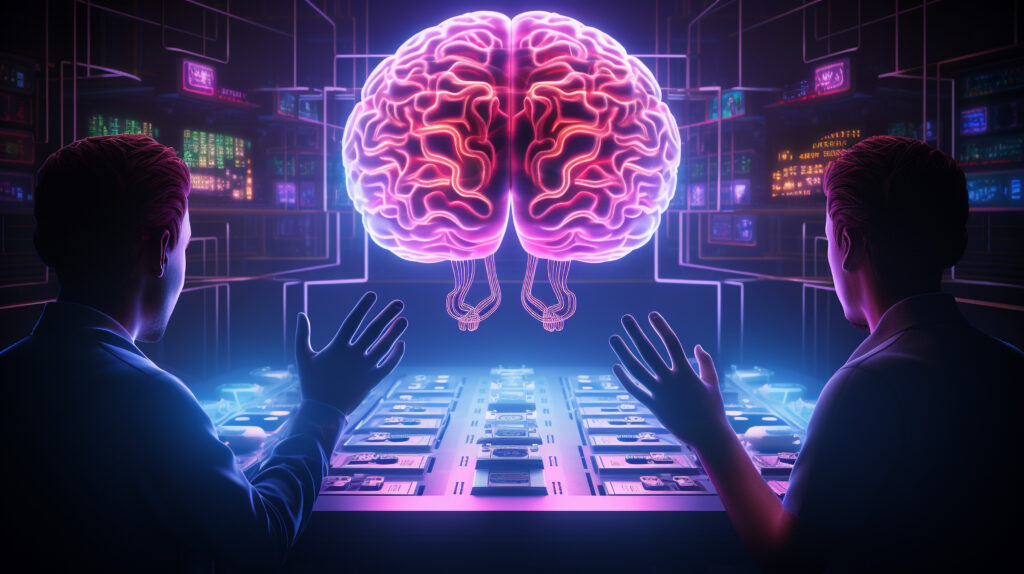
The brain, in the language of Psychextrics, is not a static organ but a self-operating network — a system whose architecture mirrors that of a computer far more intimately than modern neuroscience admits. If the cortex is the monitor, then the diencephalon is the computer internal unit—the silent processor that never switches off. Even when the screen dims, the machine beneath hums on, transmitting, sorting, and reconfiguring information within its internal circuitry. The mind, therefore, never truly sleeps; it simply dims the light of consciousness while the subconscious continues its ceaseless computation.
In this analogy, consciousness becomes a display window, not a command centre. What appears on the screen — thoughts, images, recollections — are not the workings of the system but their projection, the rendered surface of deeper activity. The diencephalon, the biological counterpart of a processor, orchestrates a continuous network of data translation, transferring signals between the sensory drives and the hippocampal storage system. During sleep, when the cortical “monitor” powers down, the diencephalon still encodes meaning, files emotional data, and updates the self’s memory database.
Thus, the sleep–wake cycle resembles a computer’s hibernation rhythm: the monitor rests to conserve energy, but the system continues running diagnostics, updating, and restructuring the files of lived experience. In this ceaseless loop of encoding and recall, memory is not merely remembered—it is reprogrammed. And when errors occur in this internal transmission, what emerges is not falsehood but a misrendered truth—a false memory born not from deceit, but from the diencephalon’s complex art of reconstruction.
2. The Diencephalon as the Processor of Meaning
In Psychextrics, the diencephalon is understood as the perpetual processor of human experience. It never ceases to operate; even in deep sleep, its subsystems — the thalamus, hypothalamus, and their associated nuclei — continue to relay and encode information. This encoding is shaped by the GIM (Genetic Index Marker) and EIM (Epigenetic Index Marker), which form the structural and adaptive matrices of memory construction.
When a stimulus enters consciousness, it first passes through the diencephalon’s sieve of interpretation before being projected onto the cortical display. Much like a computer processor interprets raw binary data into readable text or images, the diencephalon translates neurochemical patterns into emotional and symbolic meaning. It decides what becomes visible to consciousness and what remains buried in subconscious processing.
That is why students, despite sitting in the same class, listening to the same lecture, the same words, and the same terminology, recall the information differently and express it in varied narratives. Some narratives may remain accurate to the lecture, some may be embellished beyond the lecture, and others may simply be unable to recall much.
3. The Cortex as the Monitor of Awareness – The User Interface
Returning to the analogy, the cortex functions as a computer monitor — the display screen of consciousness — a surface interface that displays whatever the diencephalon and hippocampus transmit. It consumes the most neural bandwidth, which is why it “sleeps” periodically to restore energy. During this rest, the diencephalon’s subconscious encoding continues, generating the vivid landscapes of dreams and reorganising emotional data from waking life.
This is the psychextrical foundation of the subconscious continuum: the diencephalon’s uninterrupted orchestration of meaning — the uninterrupted narrative production of the self — its quiet symphony of meaning-making. Even as the cortex rests, the inner processor continues to compute reality, merging stored experiences with imagined projections. When consciousness returns, the cortex displays the newest version of the mind’s operating system — updated, revised, and occasionally, rewritten.
To visualise this, when you imagine the cortex as a computer monitor — you’d see a luminous display that allows you to see and interact with what the system beneath is doing. It functions as the interactive interface — the body organs as the mouse and keyboard through which consciousness through the cortex interacts with reality. It allows us to type commands, make decisions, and edit the content displayed on the monitor. Yet even here, the user’s input is limited by the operating system running beneath. No matter how fast the cortex appears to capture reality, it merely interprets the decisions already processed by the diencephalon and relayed through the thalamic router.
This aligns with the central Psychextrical principle:
“The cortex does not think — it displays the reality of thought.”
4. The Sleep–Wake Cycle – System Maintenance and Update
Just as a computer enters sleep or hibernation mode to preserve energy and run background updates, the brain cycles through stages of rest and reconfiguration. When you press “sleep mode,” the monitor dims or shuts off, and the visible activity ceases. Yet the computer tower, the diencephalon, remains powered, humming in its unseen labour. It continues to compute, transfer data, run background processes, install updates, and maintain internal coherence — all while the display remains dark.
During sleep, the diencephalon continues to encode and archive, while the cortex powers down its display. Dreams, in this model, are brief windows into the ongoing system maintenance — momentary projections of subconscious processes onto the dimmed screen before the operating system resumes its daylight functions.
In this analogy, the cortex does not perform the computation; it only shows the result of the computations taking place deep within the diencephalon’s internal network. When the body enters sleep, it is equivalent to the computer’s monitor going into hibernation mode — a temporary dimming of the visible interface — while the machine’s central processor remains active, repairing files, defragmenting memory, and executing silent codes essential for the next cycle of wakefulness.
This process mirrors the sleep–wake rhythm of the human brain, an intricate 24-hour oscillation of energy management. The cortex requires periodic rest to conserve bandwidth of brain energy, whereas the diencephalon — the true core processor of consciousness — never fully switches off. It continues to regulate the body’s homeostasis, encode emotional impressions, consolidate learning, and reshape the subconscious architecture of meaning.
When morning arrives and the monitor flickers back to life, the self awakens to find its inner world subtly rearranged — the clarity of new meanings encoded, emotional files reorganised, obsolete fragments discarded. Dreams, in this framework, are the visible flashes of background processing — the moments when the subconscious computation briefly spills onto the sleeping screen before the system resets into wakefulness.
Thus, within Psychextrics, the human brain is understood not as a passive observer of reality but as an always-on cognitive system — one whose visible operations (the cortex) rest periodically, but whose core processor (the diencephalon) never sleeps.
It is the desktop machine that hums beneath consciousness, continuously curating the library of the hippocampus, reformatting emotional data, and running the silent programs that sustain the coherence of selfhood across the alternating cycles of day and night.
So,
If the cortex is the monitor and the diencephalon is the central processor, then the other major components of the brain can be understood through an extended digital metaphor — one that captures how Psychextrics views consciousness not as an illusion but as an operating system continuously translating biogenic codes into behavioural outputs.
5. The Hippocampus as the Hard Drive of the Mind
The hippocampus functions as the storage drive of the psychextrical system — not the creator of data, but its silent archivist. It operates as the brain’s storage unit, preserving the encoded data received from the diencephalon. It does not write the code; it saves it. What enters the hippocampus are the files of experience that have already been processed, tagged, and encoded by the diencephalon.
Much like a computer’s hard drive, the hippocampus holds layers of information — temporary caches here, long-term archives there, and deep-system logs all around. When memory is recalled, the cortex merely reads what the diencephalon once wrote and the hippocampus stored.
But unlike a computer hard drive, which retrieves data in identical form, the hippocampus does not reproduce memory — it retrieves and translates it. What is recalled is therefore not the original experience, but its reconstructed version filtered through the active processes of the diencephalon.
In Psychextrics, this reconstructive process is what gives rise to both creativity and error. Just as a computer occasionally experiences data corruption when files are transferred between drives, the brain’s transfer of memory between the diencephalon and hippocampus can produce distortions — not because the memory was fabricated, but because the encoding itself was influenced by emotional variables, hormonal flux (HFI), or inherited divergence of abnormal genetic receptivity (HIM).
A false memory, in this model, is not a corrupted file — it is a reconstructed document, rewritten by the diencephalon’s internal logic during its night-time or subconscious editing cycles. This explains why memories evolve: the hard drive is stable, but the software rewriting them is alive.
6. The Amygdala – The Emotional Firewall
The amygdala serves as the firewall of this psychextrical architecture. Every signal, every perception, every emotional input must pass through its gatekeeping filter. Just as a firewall determines which data packets are safe to enter or exit a network, the amygdala decides which stimuli are emotionally permissible for the self to process consciously.
When functioning harmoniously with the HFI (Hormonal Fluidity Index), it moderates emotions according to context, allowing logic and empathy to coexist. But when the firewall is compromised — through trauma, hormonal imbalance, or genetic predisposition — it either blocks too much (resulting in emotional blunting) or lets everything through (resulting in emotional flooding).
In either case, behaviour reflects a system overwhelmed by its own protective mechanisms.
7. The Thalamus – The Data Router
At the centre of the system lies the thalamus, the router that directs neural traffic. Every sensory input, whether from the eyes, ears, or body, first passes through the thalamus before reaching the cortex display. Like a digital router, it manages bandwidth, prioritises signals, and determines which sensory packets receive immediate processing.
When the thalamic pathways are balanced, perception is smooth and ordered; when disrupted, latency occurs — thoughts lag, emotions buffer, and perception desynchronises from logic. This is what Psychextrics describes as perceptual mismatch, a condition in which desires, emotions, and cognition fall out of temporal alignment.
8. The Hypothalamus – The Power Regulator
The hypothalamus can be seen as the power supply unit — the circuitry that maintains biological voltage. It regulates hormones, body temperature, and the energy distribution required for cognitive processing. When the hypothalamic regulation weakens, the system begins to throttle, forcing shutdowns in mood, motivation, and memory retrieval.
This is why, in Psychextrics, disorders of energy, appetite, or sleep are not mere physiological malfunctions — they are power fluctuations within the psychextrical grid.
9. False Memory Syndrome as Data Corruption
False Memory Syndrome (FMS), within this model, is not a fabrication of the mind but a misalignment in the encoding–retrieval process. It occurs when the diencephalon’s encoded narratives are retranslated from the hippocampus in altered form due to interference in the GIM/EIM network. This interference may arise from trauma, neurodivergence, emotional overload, or even hormonal shifts — each affecting the internal “wiring” of the memory system.
In this sense, false memories are akin to corrupted data files that still contain fragments of truth. The emotional content remains intact, but the narrative sequence or spatial context becomes scrambled. The memory still carries meaning—a symbolic truth—even if its factual fidelity is compromised. This explains why false memories often feel vividly real: they are emotionally authentic even when perceptually distorted.
10. The Psychextrical Paradigm: Memory as Living Code
In Psychextrics, memory is not an archive but a living code—a continuously self-editing program shaped by the diencephalon’s meaning-making architecture. What we call “recall” is, in fact, reconstruction. Each act of remembering is a new rendering of data through the network of emotional, hormonal, and epigenetic filters.
False memory, therefore, is not failure; it is the diencephalon’s creative flexibility at work. It demonstrates that the brain does not record experience like a camera—it writes it like a story, revising, rephrasing, and reinterpreting its own history to sustain emotional coherence and psychological equilibrium.
Implications in Psychextrics Research
This digital analogy does not seek to mechanise consciousness but to demystify it. Just as every file on a computer is a combination of data and energy, every memory, behaviour, and emotion is the synthesis of HIM (Hormonal Index Marker) and HFI (Hormonal Fluidity Index) operating within a genetic–epigenetic interface.
When abnormalities occur — such as in False Memory Syndrome — Psychextrics interprets it not as a malfunction of the hippocampus (the hard drive), but as an encoding error in the diencephalic processor itself. The machine is still running; the monitor is still showing; but the software translating reality has momentarily rewritten the script.
Therefore, the future of Psychextrical neuroscience lies in decoding this system architecture — understanding how stimuli become emotion, how emotion becomes thought, and how thought becomes the story we believe we remember.
In this, the human mind is like a divine computer: self-programming, self-healing, and ceaselessly translating the unseen into the visible.
11. Conclusion: The Mind That Never Powers Down
Just as a computer’s CPU never truly ceases its processes even when the screen is dark, the diencephalon never halts the silent orchestration of self. It is the daemon of human consciousness—the background process that sustains life, identity, and imagination. When errors arise, they are not evidence of malfunction but of the system’s attempt to maintain meaning amid chaos.
In the psychextrical framework, the memory that never was may indeed be the memory that always is—a reconstruction so alive that it reveals not what happened, but what the self needed to believe, feel, or preserve. Memory, then, is not always the failure of accuracy, but the persistence of significance in the machinery of mind.
Back to: 👇