
Future Research in Psychextrical Biogenetics: Decoding the Architecture of Behaviour
BY: OMOLAJA MAKINEE
Psychextrical Brain Decoding: Mapping Behaviour Beyond Gender
The next frontier of behavioural science rests on a decisive shift: from describing how people behave to decoding why they behave that way at the biological level. Psychextrics, as a neurobehavioural science, places the human brain at the centre of this inquiry. It studies not only emotion and logic as psychological states but as biochemical signatures of inherited neurotype expressions encoded in the brain’s genetic architecture.
At the core of this evolution stands the proposed Psychextrical Brain Decoding Scanner — a diagnostic technology designed to map individual behavioural orientations with unprecedented precision.
Unlike traditional psychology or psychiatry, which depend on subjective descriptions or behavioural observation, this scanner aims to trace the physiological language of behaviour itself.
It would map:
- Thalamic signal velocity, which determines how sensory input and emotion converge in real time;
- Hormonal–cortical interactions, which reveal how testosterone, oestrogen, and other hormones shape decision-making processes; and
- Neurotype gene expression patterns, which show how an individual’s genotype activates or suppresses certain behavioural pathways over time.
From these parameters emerges the Neurotype Behavioural Index (NBI) — a new, gender-neutral classification system of human behaviour.
This system would not label people as “male” or “female,” “rational” or “emotional,” but rather position each individual along a behavioural continuum of logic-dominant, emotion-dominant, or balanced relay profiles. In so doing, psychextrical biogenetics redefines behavioural understanding away from gender stereotypes toward neuro-behavioural truth — the coded individuality of every human psyche.
Psychextrical Biogenetics: Integrating Mind, Brain, and Genome
The development of psychextrical biogenetics arises from a simple observation: humans will always seek solutions and modifications to their behaviour. Every form of therapy — psychological, dietary, or pharmaceutical — exists to mediate the tension between who we are biologically and who we wish to become behaviourally. Psychextrics formalises this process through a unifying science that merges psychology, psychiatry, and biogenetics into a single diagnostic and treatment framework.
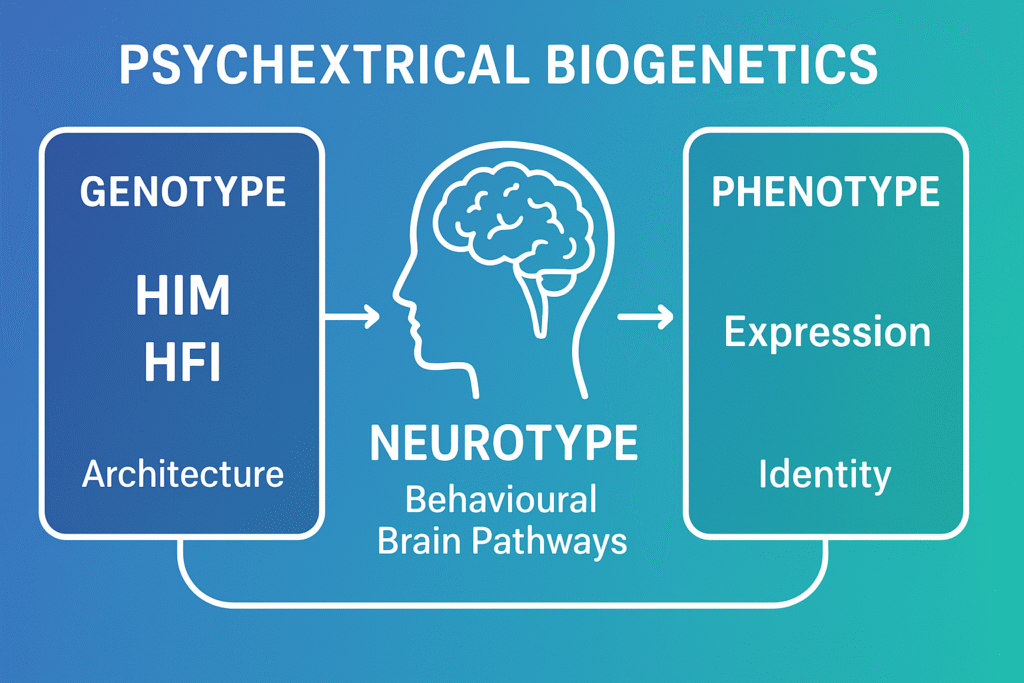
Whereas psychology studies behavioural tendencies and psychiatry intervenes through medical treatment, psychextrical biogenetics binds both to genetic causality. It does not see the mind and body as separate domains, but as interactive expressions of a single genetic constitution. This allows researchers to interpret how genotype (the genetic code) expresses itself through neurotype (the brain’s behavioural architecture) and becomes visible as phenotype (the observable expression).
Within this model:
- Genotype embodies both the Hormonal Index Marker (HIM) and Hormonal Fluidity Index (HFI) — the architectural and adaptive layers of human biology.
- Neurotype reflects how these genetic factors manifest in behaviour, cognition, and emotional regulation.
- Phenotype represents the outward expression of these interactions — the visible patterns in physicality, temperament, and identity.
Thus, psychextrical research prioritises genotypic study as the foundation for understanding both neurotype and phenotype. Since all three dimensions are interdependent, one cannot be examined meaningfully without the others. To study emotion, one must understand the genetics that encode it; to treat behavioural disorders, one must decode the neurotype patterns that give rise to them.
The Biogenetic Revolution in Behavioural Treatment
The incorporation of biogenetics into psychextrical science introduces a transformative paradigm: behaviour is not only psychological but genomic in nature. This insight establishes new frontiers in treatment methodology.
Future psychextrical biogenetic therapy would combine:
- Neurotype scanning (via the Psychextrical Brain Decoding Scanner) to identify emotional or logical imbalances at the cortical-hormonal interface;
- Epigenetic modulation through controlled diet, sleep regulation, and exposure therapies to stabilise hormonal behaviour (HFI);
- Psychological and psychiatric harmonisation to reprogram behavioural responses without altering the core genetic framework (HIM); and
- Pharmacogenomic precision — the use of medicines tuned to an individual’s genotype, preventing side effects that arise from hormone or neurotransmitter misalignments.
This new integrative approach promises to replace one-size-fits-all behavioural therapy with precision treatment designed around each person’s neurogenetic profile.
The Ethical Dimension of Biogenetic Behavioural Engineering
Yet, such power demands ethical responsibility. As psychextrical biogenetics advances, it must preserve the sanctity of the biological architecture (HIM) while working within the behavioural adaptability (HFI).
The danger of synthetic hormonal modification — as discussed earlier — lies in the confusion between reprogramming behaviour and redesigning biology. True psychextrical science seeks restoration, not replacement. Its goal is to align the mind’s desire with the body’s design, not to force one to imitate the other.
Future medical ethics must therefore draw a clear line between genomic therapy (which corrects dysfunctions within the biological covenant) and genomic alteration (which risks rewriting that covenant). Psychextrical biogenetics stands on the side of restoration — healing within nature’s framework rather than redesigning it.
Toward a New Era of Behavioural Science
The emergence of psychextrical biogenetics signals a turning point in humanity’s understanding of itself. It dissolves the boundaries between mental health, genetics, and neurobiology, revealing a unified continuum from molecule to emotion, from gene to consciousness.
In this vision, the future of behavioural science is not one of manipulation, but of illumination — decoding the architecture of behaviour so that the mind may finally understand its own design.
Through the combined mapping of HIM, HFI, and NBI, psychextrical science does not merely promise treatment — it promises understanding: a complete and humane comprehension of what it means to be logical, emotional, and infinitely human.
Back to: 👇