
Hormones, Neurotypes, and Behavioural Spectrum: A Psychextrical Interpretation of Logic and Emotion in Humans
BY: OMOLAJA MAKINEE
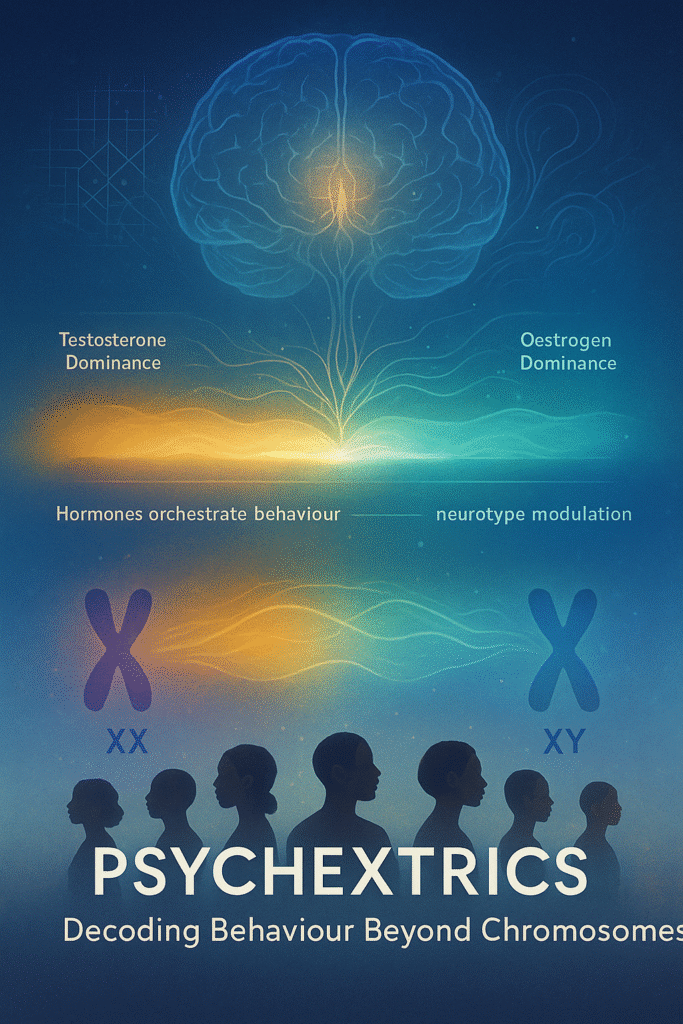
For centuries, human behaviour has been simplified into a false binary: men as logical, women as emotional. Science, culture, and philosophy have each, in their own ways, reinforced this divide. Yet, under the emerging science of Psychextrics—the study of behavioural decoding through neurotype genetics—such assumptions begin to dissolve. Psychextrics proposes that logic and emotion are not gendered traits but behavioural frequencies transmitted through the thalamic and hypothalamic nuclei, inherited epigenetically and shaped by hormone-cortex interactions.
What we call “male logic” or “female emotion” are, in fact, different expressions of the same neuro-behavioural circuitry, filtered through varying hormonal and cortical rhythms. The result is not gender difference, but timing difference—a shift in which signal accelerates first: emotional or logical.
1. Breaking the Binary of Logic and Emotion
The traditional narrative that testosterone breeds logic and oestrogen fuels emotion misrepresents the science. Both men and women possess equal neurological capacity for logic and emotion because both rely on the same structural machinery:
- the thalamus, which relays sensory and emotional stimuli; and
- the hypothalamus, which governs hormonal release and behavioural regulation.
In the psychextrical framework, behaviour arises not from gender but from neurotype programming—genetically encoded patterns that dictate how thalamic relays are interpreted in the cortex. The difference lies not in what is processed, but how fast one system suppresses or amplifies the other during decision-making.
2. The Thalamic–Hypothalamic Neurotype Spectrum
Every individual operates within a thalamic spectrum, where sensory input, emotional charge, and logical analysis converge. This spectrum is epigenetically constrained, meaning that life experience, environment, and ancestry all modulate how neurotype genes express behavioural outputs.
In men, testosterone tends to accelerate cortical inhibitory control—suppressing emotional reactions to allow analytical focus to take precedence. In women, oestrogen often enhances limbic connectivity—allowing emotional awareness to surge before logical filtering takes over.
But neither state is superior. Each represents a phase of behavioural sequencing, where one circuit activates milliseconds earlier than the other. Both sexes are equally capable of emotion and logic; only their temporal order of activation differs.
3. Hormones and Cortical Interactions in Behavioural Relay
The interaction between hormones and the cortex—particularly the prefrontal and limbic systems—acts as a relay mechanism that interprets the thalamic signal.
- In men, high testosterone synchronises with cortical inhibition, muting emotional surges so that logic processes advance rapidly.
- In women, oestrogen amplifies cortical excitation, allowing emotions to reach conscious awareness before being tempered by logic.
This explains why behaviour may appear more emotional in women and more restrained in men, but the capacity for both remains identical.
Moreover, time becomes the critical equaliser. When women delay reaction, allowing emotional surges to stabilise, their logical reasoning aligns perfectly with male processing. Conversely, when men pause before acting, their emotional empathy and reflective judgment heighten. In both cases, conscious delay allows cortical–hormonal rebalancing, demonstrating that logic and emotion are equal partners in behavioural architecture, merely sequenced differently under hormonal modulation.
4. The Conjoined Spectrum: Inheritance, Fluidity, and Individual Variation
Through reproduction, the neuro-hormonal systems of both sexes merge. Each offspring inherits conjoined behavioural spectra—a blending of logical and emotional relay tendencies from both parents.
This fusion explains why some men naturally display heightened emotional intuition, while some women exhibit dominant logical precision. These are not anomalies but expressions of inherited neurotype variability.
Psychextrics extends this understanding further: when hormonal and cortical programming diverge within the biological scaffolding defined by a system I identified as Hormonal Index Marker (HIM), behavioural fluidity arises. This fluidity manifests as variations in emotional dominance, cognitive empathy, or sexual orientation—not as abnormalities, but as expressions of inherited hormonal fluidity within a stable architectural duality. In such cases, the individual’s internal hormonal interactions operate independently of the chromosomal duality (XX or XY), producing a natural continuum of expression that includes heterosexual, homosexual, bisexual, and non-binary behavioural patterns. Thus, while HIM maintains the external framework of phenotypical, genotypical, and neurotypical duality, the internal hormonal dynamics remain fluid, shaping the spectrum of human emotion and logic beyond the binary constraints of biological sex.
From the psychextrical standpoint, these are not deviations—they are evolutionary recalibrations, representing the full elasticity of the human neuro-behavioural design.
The Chromosomal Insufficiency and Hormonal Fluidity Principle
Psychextrics challenges the adequacy of assigning behavioural identity or emotional architecture solely through the XY–XX chromosomal binary. While these chromosomal patterns form the biological blueprint of sexual differentiation, they fail to capture the full range of hormonal dynamism that governs behaviour in real time. Both XY and XX frameworks have generated individuals whose hormonal compositions, emotional reflexes, and logical thresholds transcend binary expectations — an empirical indication that inheritance has induced a spectrum of hormonal fluidity within the human genome.
If the XX chromosome represents the primordial matrix of human biology — the original template from which the XY architecture evolved — then its replication into the XY design, whilst it create a stable duality in gender, but it also create a mutable continuum of hormonal fluidity across gender. Across generations, in addition to inheritance, this continuum became increasingly epigenetic, influenced by environment, stress, nutrition, and social patterning. In this process, the hormonal symmetry that once aligned clearly with chromosomal sex has fragmented into a field of fluidity, where expression can no longer be exclusively linked to reproductive structure.
Modern evidence supports this psychextrical proposition: men with XY chromosomes may exhibit elevated oestrogenic sensitivity or reduced androgenic expression, just as women with XX chromosomes may present with heightened testosterone response or diminished oestrogenic modulation. These variations do not constitute abnormalities but demonstrate the elasticity of internal human hormonal architecture — an elasticity that undermines the binary reading of chromosomes as behavioural determinants.
Therefore, the psychextrical interpretation holds that the relationship between chromosomes and hormones should not be viewed as causal but as correlative — a relationship mediated by inheritance, environment, and neurotype adaptation. Chromosomes design the biological architecture, but hormones orchestrate the behavioural performance. The true indicator of logical or emotional dominance lies not in genetic inscription, but in how hormonal interactions modulate cortical processing, thalamic relays, and hypothalamic regulation within the behavioural circuitry.
If hormonal expression is inherently fluid, then ascribing gender identity, behavioural potential, or emotional predisposition to chromosomes alone becomes scientifically reductive. What is needed is an independent evaluative system — a new biological index capable of measuring hormonal markers and their levels of fluidity within individuals. Psychextrics proposes that such a system will emerge through the development of a system I identified as Hormonal Fluidity Index (HFI), calibrated to detect how testosterone, oestrogen, and the core of their internal derivatives interact with thalamic-cortical networks to influence behavioural output in real time.
This would represent a profound evolution in human understanding — a move from chromosomal determinism to behavioural endocrinology, where identity, logic, and emotion are interpreted through the living harmony of hormones and neurotype signals, not static genetic categories.
In the psychextrical framework, whilst the XX and the XY chromosome defines gender — but they also provide the scaffolding upon which fluid hormonal chemicals between emotion and logic manifest. In other words, chromosomal sex (e.g., XX and XY) is a biological factor that influences phenotypical development, including genotypical hormonal profiles, and the complex expression of neurotypical cognitive processes like emotion and logic that are not exclusive to or solely determined by one’s biological sex or gender.
Psychextrics proposes to expands the vision of science: to see the human not merely as a binary of male and female, but as a spectrum of dynamic hormonal symmetries, ever-evolving, ever-adaptive, and infinitely nuanced.
5. Psychextrical Brain Decoding: Mapping Behaviour Beyond Gender
The next frontier in this field lies in the proposed Psychextrical Brain Decoding Scanner—a diagnostic technology designed to identify individual behavioural orientation with precision.
Rather than categorising people by gender, this scanner would trace:
- the thalamic signal velocity,
- hormonal–cortical interactions, and
- the neurotype gene expression patterns influencing behavioural timing.
The result would be a Neurotype Behavioural Index (NBI)—a gender-neutral profile identifying whether a person’s behaviour tends toward logic-dominant, emotion-dominant, or balanced relay patterns.
Such decoding would revolutionise behavioural science, education, and human relations by shifting focus from gendered stereotypes to individual neuro-behavioural truth. It would reveal that no person is defined by sex alone, but by how their internal circuitry sequences perception, emotion, and reason.
Conclusion: Behaviour as Inherited Symphony
In the psychextrical interpretation, logic and emotion are not opposing forces but complementary instruments in the symphony of human behaviour. Testosterone and oestrogen merely conduct the tempo, determining which melody plays first. The deeper music—our capacity to feel and to reason—is written into the same genetic score shared by all.
Through this lens, men and women cease to be divided by intellect or emotion. They are participants in one continuum of neuro-behavioural design—where inheritance, hormones, and cortical timing compose infinite variations of the same human mind.
The science of Psychextrics thus restores balance to an age-old misunderstanding: we are not creatures of gendered intelligence, but beings of neurotype harmony—each carrying within us a unique rhythm of thought and feeling, logical and emotional, inseparably one.
Impact Summary of this Study
| Dimension | Psychextrics Contribution | Why It Matters |
|---|---|---|
| Scientific | Moves gender understanding from chromosomes to hormonal behaviour | Aligns with modern endocrinology |
| Philosophical | Establishes fluidity as natural, not anomalous | Unites logic, emotion, and identity |
| Psychextrical Theory | Extends neurotype decoding into chromosomal–hormonal symbiosis | Strengthens Psychextrics field’s explanatory power |
| Ethical/Inclusive | Removes hierarchy between sexes | Frames human variation as evolutionary intelligence |
| Behavioural Science | Redefines logic/emotion as time-sequenced responses rather than gendered traits | Breaks historical cognitive bias |
| Neurogenetics | Introduces concept of neurotype inheritance shaping behaviour | Merges genetics and behavioural science elegantly |
| Gender Studies | Provides a neutral, neurophysiological model of behavioural equality | Moves discourse beyond social essentialism |
| Philosophy of Mind | Unifies emotion and reason under one behavioural spectrum | Reinforces pantheistic wholeness of psyche |
| Future Science | Proposes Psychextrical Brain Decoding technology | Offers measurable pathway for validation |
Back to: 👇